- PDB-3hfe: A trimeric form of the Kv7.1 A domain Tail -
+
Open data
ID or keywords:
Loading...
-
Basic information
Entry
Database: PDB / ID: 3hfe
Title
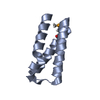
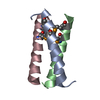
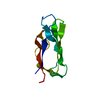
A trimeric form of the Kv7.1 A domain Tail
Components
Potassium voltage-gated channel subfamily KQT member 1
Keywords
TRANSPORT PROTEIN / trimer / Atrial fibrillation / Cell membrane / Cytoplasmic vesicle / Deafness / Disease mutation / Glycoprotein / Ion transport / Ionic channel / Long QT syndrome / Membrane / Phosphoprotein / Potassium / Potassium channel / Potassium transport / Short QT syndrome / Transmembrane / Transport / Voltage-gated channel
Function / homology
Function and homology information
gastrin-induced gastric acid secretion / stomach development / corticosterone secretion / voltage-gated potassium channel activity involved in atrial cardiac muscle cell action potential repolarization / negative regulation of voltage-gated potassium channel activity / basolateral part of cell / lumenal side of membrane / negative regulation of delayed rectifier potassium channel activity / rhythmic behavior / regulation of gastric acid secretion ...gastrin-induced gastric acid secretion / stomach development / corticosterone secretion / voltage-gated potassium channel activity involved in atrial cardiac muscle cell action potential repolarization / negative regulation of voltage-gated potassium channel activity / basolateral part of cell / lumenal side of membrane / negative regulation of delayed rectifier potassium channel activity / rhythmic behavior / regulation of gastric acid secretion / voltage-gated potassium channel activity involved in cardiac muscle cell action potential repolarization / Phase 3 - rapid repolarisation / membrane repolarization during action potential / auditory receptor cell development / membrane repolarization during atrial cardiac muscle cell action potential / iodide transport / Phase 2 - plateau phase / intracellular chloride ion homeostasis / regulation of atrial cardiac muscle cell membrane repolarization / membrane repolarization during ventricular cardiac muscle cell action potential / atrial cardiac muscle cell action potential / renal sodium ion absorption / potassium ion export across plasma membrane / voltage-gated potassium channel activity involved in ventricular cardiac muscle cell action potential repolarization / regulation of membrane repolarization / detection of mechanical stimulus involved in sensory perception of sound / membrane repolarization during cardiac muscle cell action potential / protein phosphatase 1 binding / potassium ion homeostasis / intestinal absorption / delayed rectifier potassium channel activity / ventricular cardiac muscle cell action potential / regulation of ventricular cardiac muscle cell membrane repolarization / non-motile cilium assembly / positive regulation of potassium ion transmembrane transport / inner ear morphogenesis / Voltage gated Potassium channels / outward rectifier potassium channel activity / regulation of heart contraction / cardiac muscle cell contraction / adrenergic receptor signaling pathway / inner ear development / monoatomic ion channel complex / renal absorption / protein kinase A regulatory subunit binding / ciliary base / protein kinase A catalytic subunit binding / regulation of heart rate by cardiac conduction / potassium ion import across plasma membrane / social behavior / cochlea development / action potential / voltage-gated potassium channel activity / positive regulation of heart rate / cardiac muscle contraction / transport vesicle / sensory perception of sound / phosphatidylinositol-4,5-bisphosphate binding / positive regulation of cardiac muscle contraction / voltage-gated potassium channel complex / cellular response to epinephrine stimulus / cellular response to cAMP / potassium ion transmembrane transport / erythrocyte differentiation / cytoplasmic vesicle membrane / cellular response to xenobiotic stimulus / glucose metabolic process / response to insulin / regulation of membrane potential / regulation of blood pressure / heart development / late endosome / scaffold protein binding / basolateral plasma membrane / early endosome / transmembrane transporter binding / calmodulin binding / lysosome / apical plasma membrane / neuron projection / membrane raft / ubiquitin protein ligase binding / neuronal cell body / endoplasmic reticulum / membrane / plasma membrane / cytoplasm Similarity search - Function
Potassium channel, voltage dependent, KCNQ1 / Potassium channel, voltage dependent, KCNQ / Potassium channel, voltage dependent, KCNQ, C-terminal / KCNQ voltage-gated potassium channel / Voltage-dependent channel domain superfamily / Ion transport domain / Ion transport protein Similarity search - Domain/homology
Journal: Protein Sci. / Year: 2009 Title: Crystal structure of a trimeric form of the K(V)7.1 (KCNQ1) A-domain tail coiled-coil reveals structural plasticity and context dependent changes in a putative coiled-coil trimerization motif. Authors: Xu, Q. / Minor, D.L.
History
Deposition
May 11, 2009
Deposition site: RCSB / Processing site: RCSB
Revision 1.0
Sep 1, 2009
Provider: repository / Type: Initial release
Revision 1.1
Jul 13, 2011
Group: Refinement description / Version format compliance
In the structure databanks used in Yorodumi, some data are registered as the other names, "COVID-19 virus" and "2019-nCoV". Here are the details of the virus and the list of structure data.
Jan 31, 2019. EMDB accession codes are about to change! (news from PDBe EMDB page)
EMDB accession codes are about to change! (news from PDBe EMDB page)
The allocation of 4 digits for EMDB accession codes will soon come to an end. Whilst these codes will remain in use, new EMDB accession codes will include an additional digit and will expand incrementally as the available range of codes is exhausted. The current 4-digit format prefixed with “EMD-” (i.e. EMD-XXXX) will advance to a 5-digit format (i.e. EMD-XXXXX), and so on. It is currently estimated that the 4-digit codes will be depleted around Spring 2019, at which point the 5-digit format will come into force.
The EM Navigator/Yorodumi systems omit the EMD- prefix.
Related info.:Q: What is EMD? / ID/Accession-code notation in Yorodumi/EM Navigator
Yorodumi is a browser for structure data from EMDB, PDB, SASBDB, etc.
This page is also the successor to EM Navigator detail page, and also detail information page/front-end page for Omokage search.
The word "yorodu" (or yorozu) is an old Japanese word meaning "ten thousand". "mi" (miru) is to see.
Related info.:EMDB / PDB / SASBDB / Comparison of 3 databanks / Yorodumi Search / Aug 31, 2016. New EM Navigator & Yorodumi / Yorodumi Papers / Jmol/JSmol / Function and homology information / Changes in new EM Navigator and Yorodumi
 Movie
Movie Controller


 Open data
 Basic information
 Components
 Keywords
 Function and homology information
 Homo sapiens (human)
 X-RAY DIFFRACTION /
  Authors
 Citation
 Structure visualization
 Downloads & links
 Other downloads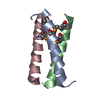


 PDBj
PDBj
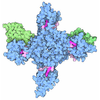
 Assembly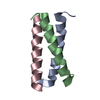

 Escherichia coli (E. coli) / Strain (production host): BL21(pLys)S / References: UniProt: P51787
 Mass: 18.015 Da / Num. of mol.: 66 / Source method: isolated from a natural source / Formula: H2O
 Sample preparation
 / Beamline: 8.3.1
 Processing