 Movie
Movie Controller

[English] 日本語
 Yorodumi
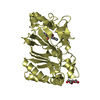
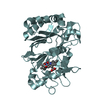
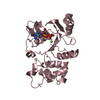
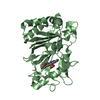
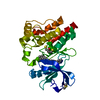
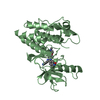
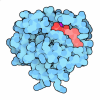
- PDB-3dpk: cFMS tyrosine kinase in complex with a pyridopyrimidinone inhibitor -
+ Open data

- Basic information
| Entry | Database: PDB / ID: 3dpk | ||||||
|---|---|---|---|---|---|---|---|
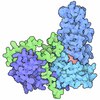
| Title | cFMS tyrosine kinase in complex with a pyridopyrimidinone inhibitor | ||||||
 Components Components | Macrophage colony-stimulating factor 1 receptor, Fibroblast growth factor receptor 1 | ||||||
 Keywords Keywords | TRANSFERASE / RECEPTOR TYROSINE KINASE / KINASE-INHIBITOR COMPLEX / ATP-binding / Glycoprotein / Immunoglobulin domain / Kinase / Membrane / Nucleotide-binding / Phosphoprotein / Proto-oncogene / Receptor / Transmembrane / Tyrosine-protein kinase / Craniosynostosis / Disease mutation / Dwarfism / Heparin-binding / Kallmann syndrome | ||||||
| Function / homology |  Function and homology information Function and homology informationmacrophage colony-stimulating factor receptor activity / CSF1-CSF1R complex / forebrain neuron differentiation / macrophage colony-stimulating factor signaling pathway / regulation of macrophage migration / microglial cell proliferation / Signaling by FGFR1 amplification mutants / cellular response to macrophage colony-stimulating factor stimulus / diphosphate metabolic process / cell-cell junction maintenance ...macrophage colony-stimulating factor receptor activity / CSF1-CSF1R complex / forebrain neuron differentiation / macrophage colony-stimulating factor signaling pathway / regulation of macrophage migration / microglial cell proliferation / Signaling by FGFR1 amplification mutants / cellular response to macrophage colony-stimulating factor stimulus / diphosphate metabolic process / cell-cell junction maintenance / FGFR1c and Klotho ligand binding and activation / Signaling by plasma membrane FGFR1 fusions / mammary gland duct morphogenesis / positive regulation of protein tyrosine kinase activity / cementum mineralization / chordate embryonic development / response to sodium phosphate / Epithelial-Mesenchymal Transition (EMT) during gastrulation / fibroblast growth factor receptor signaling pathway involved in orbitofrontal cortex development / ventricular zone neuroblast division / receptor-receptor interaction / positive regulation of phospholipase activity / olfactory bulb development / positive regulation of cell motility / FGFR1b ligand binding and activation / regulation of postsynaptic density assembly / Signaling by activated point mutants of FGFR1 / FGFR1c ligand binding and activation / Downstream signaling of activated FGFR1 / Phospholipase C-mediated cascade: FGFR1 / fibroblast growth factor receptor activity / host-mediated activation of viral process / ruffle organization / skeletal system morphogenesis / positive regulation of macrophage proliferation / regulation of bone resorption / positive regulation of vascular endothelial cell proliferation / positive regulation of endothelial cell chemotaxis / Other interleukin signaling / fibroblast growth factor receptor signaling pathway / Formation of paraxial mesoderm / growth factor binding / positive regulation of tyrosine phosphorylation of STAT protein / PI-3K cascade:FGFR1 / hemopoiesis / positive regulation of macrophage chemotaxis / positive regulation of MAP kinase activity / cellular response to cytokine stimulus / cytokine binding / macrophage differentiation / regulation of cell differentiation / phosphatidylinositol-mediated signaling / monocyte differentiation / Transcriptional Regulation by VENTX / fibroblast growth factor binding / epithelial to mesenchymal transition / regulation of MAPK cascade / PI3K Cascade / skeletal system development / positive regulation of blood vessel endothelial cell migration / response to ischemia / osteoclast differentiation / positive regulation of neuron differentiation / calcium ion homeostasis / positive regulation of chemokine production / SHC-mediated cascade:FGFR1 / FRS-mediated FGFR1 signaling / cellular response to fibroblast growth factor stimulus / peptidyl-tyrosine phosphorylation / positive regulation of cell cycle / Signaling by FGFR1 in disease / NCAM signaling for neurite out-growth / axon guidance / SH2 domain binding / cell surface receptor protein tyrosine kinase signaling pathway / Signal transduction by L1 / regulation of actin cytoskeleton organization / positive regulation of cell differentiation / neuron migration / Negative regulation of FGFR1 signaling / receptor protein-tyrosine kinase / positive regulation of protein phosphorylation / cell population proliferation / cytokine-mediated signaling pathway / Constitutive Signaling by Aberrant PI3K in Cancer / regulation of cell shape / Signaling by CSF1 (M-CSF) in myeloid cells / MAPK cascade / PIP3 activates AKT signaling / protein autophosphorylation / cell migration / heparin binding / PI5P, PP2A and IER3 Regulate PI3K/AKT Signaling / RAF/MAP kinase cascade / protein tyrosine kinase activity / cytoplasmic vesicle / protein phosphatase binding / positive regulation of phosphatidylinositol 3-kinase/protein kinase B signal transduction / positive regulation of MAPK cascade / positive regulation of ERK1 and ERK2 cascade Similarity search - Function | ||||||
| Biological species |  Homo sapiens (human) Homo sapiens (human) | ||||||
| Method |  X-RAY DIFFRACTION / SYNCHROTRON / MOLECULAR REPLACEMENT / Resolution: 1.95 Å X-RAY DIFFRACTION / SYNCHROTRON / MOLECULAR REPLACEMENT / Resolution: 1.95 Å | ||||||
 Authors Authors | Schubert, C. | ||||||
 Citation Citation | Journal: J.Med.Chem. / Year: 2009 Title: Pyrido[2,3-d]pyrimidin-5-ones: a novel class of antiinflammatory macrophage colony-stimulating factor-1 receptor inhibitors Authors: Huang, H. / Hutta, D.A. / Rinker, J.M. / Hu, H. / Parsons, W.H. / Schubert, C. / DesJarlais, R.L. / Crysler, C.S. / Chaikin, M.A. / Donatelli, R.R. / Chen, Y. / Cheng, D. / Zhou, Z. / ...Authors: Huang, H. / Hutta, D.A. / Rinker, J.M. / Hu, H. / Parsons, W.H. / Schubert, C. / DesJarlais, R.L. / Crysler, C.S. / Chaikin, M.A. / Donatelli, R.R. / Chen, Y. / Cheng, D. / Zhou, Z. / Yurkow, E. / Manthey, C.L. / Player, M.R. | ||||||
| History |
|
- Structure visualization
| Structure viewer | Molecule: MolmilJmol/JSmol |
|---|
- Downloads & links
-Download
| PDBx/mmCIF format | 3dpk.cif.gz | 122.2 KB | Display | PDBx/mmCIF format |
|---|---|---|---|---|
| PDB format | pdb3dpk.ent.gz | 95.2 KB | Display | PDB format |
| PDBx/mmJSON format | 3dpk.json.gz | Tree view | PDBx/mmJSON format | |
| Others |  Other downloads Other downloads |
-Validation report
| Arichive directory | https://data.pdbj.org/pub/pdb/validation_reports/dp/3dpkftp://data.pdbj.org/pub/pdb/validation_reports/dp/3dpk | HTTPS FTP |
|---|
-Related structure data
| Related structure data |  2i1mS S: Starting model for refinement |
|---|---|
| Similar structure data |



-Links
 PDBj
PDBj

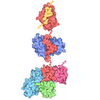
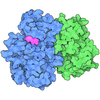
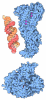
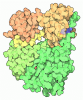

- Assembly
| Deposited unit | 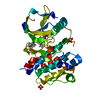
| ||||||||
|---|---|---|---|---|---|---|---|---|---|
| 1 |
| ||||||||
| Unit cell |
|
-Components
| #1: Protein | Mass: 38064.477 Da / Num. of mol.: 1 / Fragment: KINASE DOMAIN Mutation: Native kinase insert domain replaced by FGF receptor kinase insert domain Source method: isolated from a genetically manipulated source Source: (gene. exp.) Homo sapiens (human)Gene: CSF1R, FGFBR, FGFR1, FLG, FLT2, FMS, BFGFR, CEK, HBGFR Production host:   Spodoptera frugiperda (fall armyworm) Spodoptera frugiperda (fall armyworm)References: UniProt: P07333, UniProt: P11362, receptor protein-tyrosine kinase | ||||
|---|---|---|---|---|---|
| #2: Chemical | 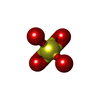 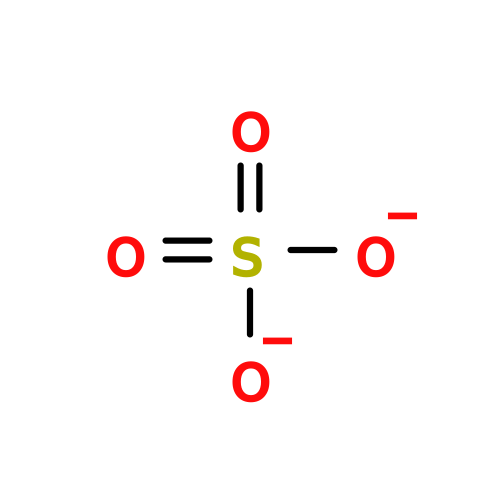 Mass: 96.063 Da / Num. of mol.: 3 / Source method: obtained synthetically / Formula: SO4 Mass: 96.063 Da / Num. of mol.: 3 / Source method: obtained synthetically / Formula: SO4#3: Chemical | ChemComp-8C5 / |  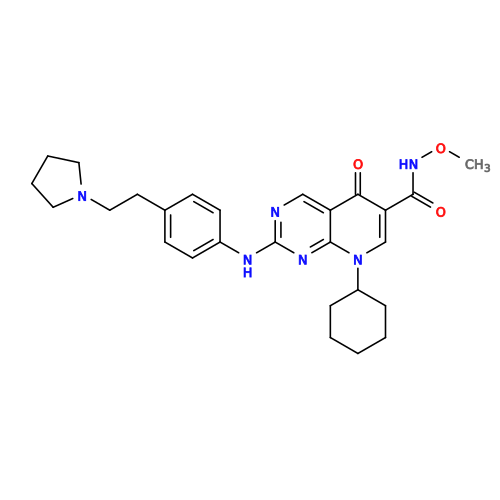 Mass: 490.597 Da / Num. of mol.: 1 / Source method: obtained synthetically / Formula: C27H34N6O3 Mass: 490.597 Da / Num. of mol.: 1 / Source method: obtained synthetically / Formula: C27H34N6O3#4: Water | ChemComp-HOH / |  Mass: 18.015 Da / Num. of mol.: 123 / Source method: isolated from a natural source / Formula: H2O Mass: 18.015 Da / Num. of mol.: 123 / Source method: isolated from a natural source / Formula: H2O |
-Experimental details
-Experiment
| Experiment | Method: X-RAY DIFFRACTION / Number of used crystals: 1 |
|---|
- Sample preparation
| Crystal | Density Matthews: 2.41 Å3/Da / Density % sol: 48.94 % |
|---|---|
| Crystal grow | Temperature: 298 K / Method: vapor diffusion, hanging drop / pH: 5.2 Details: PEG 3350, SODIUM ACETATE, LI2SO4, pH 5.2, VAPOR DIFFUSION, HANGING DROP, temperature 298K |
-Data collection
| Diffraction | Mean temperature: 100 K |
|---|---|
| Diffraction source | Source: SYNCHROTRON / Site: APS  / Beamline: 17-ID / Wavelength: 1 Å / Beamline: 17-ID / Wavelength: 1 Å |
| Detector | Type: ADSC QUANTUM 210 / Detector: CCD / Date: Nov 19, 2005 |
| Radiation | Monochromator: SAGITALLY FOCUSED Si(111) / Protocol: SINGLE WAVELENGTH / Monochromatic (M) / Laue (L): M / Scattering type: x-ray |
| Radiation wavelength | Wavelength: 1 Å / Relative weight: 1 |
| Reflection | Resolution: 1.8→50 Å / Num. all: 27585 / Num. obs: 27585 / % possible obs: 83.8 % / Observed criterion σ(F): 0 / Observed criterion σ(I): -3 / Redundancy: 3.6 % / Rmerge(I) obs: 0.093 / Net I/σ(I): 12.2 |
| Reflection shell | Resolution: 1.8→1.86 Å / Redundancy: 3.6 % / Rmerge(I) obs: 0.276 / Mean I/σ(I) obs: 4.3 / Num. unique all: 3289 / % possible all: 99.6 |
- Processing
| Software |
| |||||||||||||||||||||||||
|---|---|---|---|---|---|---|---|---|---|---|---|---|---|---|---|---|---|---|---|---|---|---|---|---|---|---|
| Refinement | Method to determine structure: MOLECULAR REPLACEMENT Starting model: 2i1m Resolution: 1.95→34.1 Å / Isotropic thermal model: isotropic / Cross valid method: THROUGHOUT / σ(F): 0 / Stereochemistry target values: Engh & Huber Details: Isotropic B-factor refinement for non-hydrogen atoms. Hydrogens were assigned the B-factor of their "parent" atom and one B-factor for all hydrogens was refined, as implemented in phenix
| |||||||||||||||||||||||||
| Displacement parameters | Biso mean: 28.61 Å2 | |||||||||||||||||||||||||
| Refinement step | Cycle: LAST / Resolution: 1.95→34.1 Å
| |||||||||||||||||||||||||
| Refine LS restraints |
|
