regulation by virus of viral protein levels in host cell / Defective translocation of RB1 mutants to the nucleus / Rb-E2F complex / regulation of lipid kinase activity / cell morphogenesis involved in neuron differentiation / positive regulation of collagen fibril organization / negative regulation of myofibroblast differentiation / chromatin lock complex / Positive Regulation of CDH1 Gene Transcription / maintenance of mitotic sister chromatid cohesion ...regulation by virus of viral protein levels in host cell / Defective translocation of RB1 mutants to the nucleus / Rb-E2F complex / regulation of lipid kinase activity / cell morphogenesis involved in neuron differentiation / positive regulation of collagen fibril organization / negative regulation of myofibroblast differentiation / chromatin lock complex / Positive Regulation of CDH1 Gene Transcription / maintenance of mitotic sister chromatid cohesion / sister chromatid biorientation / positive regulation of transcription regulatory region DNA binding / positive regulation of extracellular matrix organization / negative regulation of hepatocyte apoptotic process / Aberrant regulation of mitotic exit in cancer due to RB1 defects / Inhibition of replication initiation of damaged DNA by RB1/E2F1 / myoblast differentiation / positive regulation of protein sumoylation / protein localization to chromosome, centromeric region / importin-alpha family protein binding / positive regulation of mitotic metaphase/anaphase transition / chondrocyte differentiation / Replication of the SARS-CoV-1 genome / aortic valve morphogenesis / SWI/SNF complex / negative regulation of cold-induced thermogenesis / negative regulation of G1/S transition of mitotic cell cycle / chromosome organization / Formation of Senescence-Associated Heterochromatin Foci (SAHF) / negative regulation of cell cycle / Phosphorylation of proteins involved in G1/S transition by active Cyclin E:Cdk2 complexes / RUNX2 regulates osteoblast differentiation / symbiont-mediated perturbation of host cell cycle G1/S transition checkpoint / Defective binding of RB1 mutants to E2F1,(E2F2, E2F3) / negative regulation of apoptotic signaling pathway / molecular sequestering activity / Cyclin E associated events during G1/S transition / Cyclin A:Cdk2-associated events at S phase entry / negative regulation of protein kinase activity / symbiont-mediated suppression of host JAK-STAT cascade via inhibition of STAT1 activity / Nuclear events stimulated by ALK signaling in cancer / regulation of mitotic cell cycle / Condensation of Prophase Chromosomes / RNA polymerase II transcription regulatory region sequence-specific DNA binding / phosphoprotein binding / negative regulation of inflammatory response / negative regulation of cell growth / PML body / Oncogene Induced Senescence / APC/C:Cdh1 mediated degradation of Cdc20 and other APC/C:Cdh1 targeted proteins in late mitosis/early G1 / spindle / neuron projection development / kinase binding / disordered domain specific binding / Cyclin D associated events in G1 / transcription corepressor activity / cellular response to insulin stimulus / regulation of protein localization / MLL4 and MLL3 complexes regulate expression of PPARG target genes in adipogenesis and hepatic steatosis / heterochromatin formation / Replication of the SARS-CoV-2 genome / spermatogenesis / DNA-binding transcription factor binding / RNA polymerase II-specific DNA-binding transcription factor binding / molecular adaptor activity / symbiont-mediated perturbation of host ubiquitin-like protein modification / regulation of cell cycle / Ras protein signal transduction / symbiont-mediated suppression of host innate immune response / chromatin remodeling / apoptotic process / symbiont-mediated suppression of host type I interferon-mediated signaling pathway / symbiont-mediated suppression of host gene expression / negative regulation of gene expression / negative regulation of DNA-templated transcription / ubiquitin protein ligase binding / positive regulation of cell population proliferation / regulation of DNA-templated transcription / host cell nucleus / chromatin / negative regulation of transcription by RNA polymerase II / DNA-templated transcription / zinc ion binding / nucleoplasm / identical protein binding / nucleus / cytosol / cytoplasm Similarity search - Function
Adenovirus early E1A protein / Early E1A protein / Retinoblastoma-associated protein, B-box / Retinoblastoma-associated protein, A-box / Retinoblastoma-associated protein, C-terminal / Retinoblastoma-associated protein, N-terminal / Retinoblastoma protein family / Retinoblastoma-associated protein B domain / Retinoblastoma-associated protein A domain / Rb C-terminal domain ...Adenovirus early E1A protein / Early E1A protein / Retinoblastoma-associated protein, B-box / Retinoblastoma-associated protein, A-box / Retinoblastoma-associated protein, C-terminal / Retinoblastoma-associated protein, N-terminal / Retinoblastoma protein family / Retinoblastoma-associated protein B domain / Retinoblastoma-associated protein A domain / Rb C-terminal domain / Domain of unknown function (DUF3452) / Domain of unknown function (DUF3452) / Retinoblastoma-associated protein A domain / Rb C-terminal domain / Cyclin-like / Cyclin A; domain 1 / Cyclin-like / domain present in cyclins, TFIIB and Retinoblastoma / Cyclin-like superfamily / Orthogonal Bundle / Mainly Alpha Similarity search - Domain/homology
Journal: Genes Dev. / Year: 2007 Title: Structure of the retinoblastoma protein bound to adenovirus E1A reveals the molecular basis for viral oncoprotein inactivation of a tumor suppressor Authors: Liu, X. / Marmorstein, R.
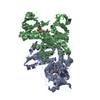
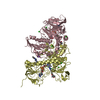
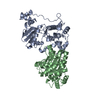
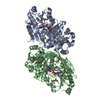
A: Retinoblastoma-associated protein B: Early E1A 32 kDa protein C: Retinoblastoma-associated protein D: Early E1A 32 kDa protein E: Early E1A 32 kDa protein hetero molecules
In the structure databanks used in Yorodumi, some data are registered as the other names, "COVID-19 virus" and "2019-nCoV". Here are the details of the virus and the list of structure data.
Jan 31, 2019. EMDB accession codes are about to change! (news from PDBe EMDB page)
EMDB accession codes are about to change! (news from PDBe EMDB page)
The allocation of 4 digits for EMDB accession codes will soon come to an end. Whilst these codes will remain in use, new EMDB accession codes will include an additional digit and will expand incrementally as the available range of codes is exhausted. The current 4-digit format prefixed with “EMD-” (i.e. EMD-XXXX) will advance to a 5-digit format (i.e. EMD-XXXXX), and so on. It is currently estimated that the 4-digit codes will be depleted around Spring 2019, at which point the 5-digit format will come into force.
The EM Navigator/Yorodumi systems omit the EMD- prefix.
Related info.:Q: What is EMD? / ID/Accession-code notation in Yorodumi/EM Navigator
Yorodumi is a browser for structure data from EMDB, PDB, SASBDB, etc.
This page is also the successor to EM Navigator detail page, and also detail information page/front-end page for Omokage search.
The word "yorodu" (or yorozu) is an old Japanese word meaning "ten thousand". "mi" (miru) is to see.
Related info.:EMDB / PDB / SASBDB / Comparison of 3 databanks / Yorodumi Search / Aug 31, 2016. New EM Navigator & Yorodumi / Yorodumi Papers / Jmol/JSmol / Function and homology information / Changes in new EM Navigator and Yorodumi
 Movie
Movie Controller

 Yorodumi
 Open data
 Basic information
 Components
 Keywords
 Function and homology information
 Homo sapiens (human)
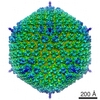 Human adenovirus 5
 X-RAY DIFFRACTION /
  Authors
 Citation
 Structure visualization
 Downloads & links
 Other downloads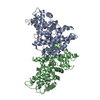

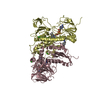
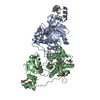
 PDBj
PDBj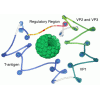
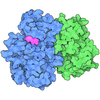

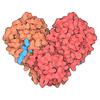
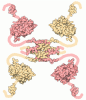
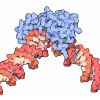
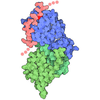
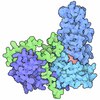
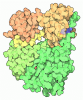
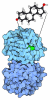
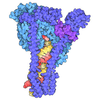

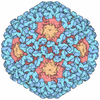
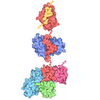
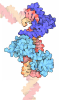
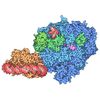
 Assembly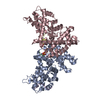

 Escherichia coli BL21(DE3) (bacteria) / Strain (production host): BL21 (DE3) / References: UniProt: P06400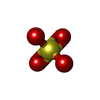
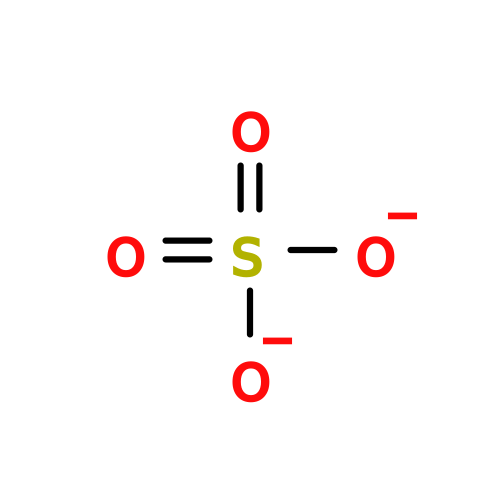 Mass: 96.063 Da / Num. of mol.: 2 / Source method: obtained synthetically / Formula: SO4
 Mass: 18.015 Da / Num. of mol.: 482 / Source method: isolated from a natural source / Formula: H2O
 Sample preparation
 / Beamline: 23-ID-D / Wavelength: 0.98 Å
 Processing