 Movie
Movie Controller


+ Open data

- Basic information
| Entry | Database: PDB / ID: 27tm | ||||||||||||||||||||||||
|---|---|---|---|---|---|---|---|---|---|---|---|---|---|---|---|---|---|---|---|---|---|---|---|---|---|
| Title | GRM1-Acc State Conformation 2 | ||||||||||||||||||||||||
 Components Components | Metabotropic glutamate receptor 1 | ||||||||||||||||||||||||
 Keywords Keywords | MEMBRANE PROTEIN / Receptor | ||||||||||||||||||||||||
| Function / homology |  Function and homology information Function and homology informationG protein-coupled neurotransmitter receptor activity / dendriole / G protein-coupled receptor homodimeric complex / G protein-coupled receptor dimeric complex / G protein-coupled receptor activity involved in regulation of postsynaptic membrane potential / synaptic signaling via neuropeptide / regulation of sensory perception of pain / adenylate cyclase inhibiting G protein-coupled glutamate receptor activity / phospholipase C-activating G protein-coupled glutamate receptor signaling pathway / G protein-coupled glutamate receptor signaling pathway ...G protein-coupled neurotransmitter receptor activity / dendriole / G protein-coupled receptor homodimeric complex / G protein-coupled receptor dimeric complex / G protein-coupled receptor activity involved in regulation of postsynaptic membrane potential / synaptic signaling via neuropeptide / regulation of sensory perception of pain / adenylate cyclase inhibiting G protein-coupled glutamate receptor activity / phospholipase C-activating G protein-coupled glutamate receptor signaling pathway / G protein-coupled glutamate receptor signaling pathway / Class C/3 (Metabotropic glutamate/pheromone receptors) / Neurexins and neuroligins / glutamate receptor activity / regulation of synaptic transmission, glutamatergic / sensory perception of pain / locomotory behavior / postsynaptic density membrane / Schaffer collateral - CA1 synapse / G protein-coupled receptor activity / phospholipase C-activating G protein-coupled receptor signaling pathway / Sensory perception of sweet, bitter, and umami (glutamate) taste / chemical synaptic transmission / G alpha (q) signalling events / positive regulation of MAPK cascade / postsynaptic membrane / G protein-coupled receptor signaling pathway / glutamatergic synapse / nucleus / plasma membrane Similarity search - Function | ||||||||||||||||||||||||
| Biological species |  Homo sapiens (human) Homo sapiens (human) | ||||||||||||||||||||||||
| Method | ELECTRON MICROSCOPY / single particle reconstruction / cryo EM / Resolution: 3.2 Å | ||||||||||||||||||||||||
 Authors Authors | Lu, Y. / Wen, T.L. / Shen, Y.Q. / Yang, X. | ||||||||||||||||||||||||
| Funding support |  China, 1items China, 1items
| ||||||||||||||||||||||||
 Citation Citation | Journal: Sci Adv / Year: 2026 Title: G protein selectivity in group I metabotropic glutamate receptors. Authors: Yue Lu / Tianlei Wen / Xuhang Lu / Guimin Zhang / Tingting Meng / Tianjin Liu / Xinyan Wang / Yuequan Shen / Xue Yang / Abstract: Metabotropic glutamate (mGlu) receptors are class C G protein-coupled receptor involved in synaptic transmission and neurological disorders. Group I mGlu receptors (mGlu1 and mGlu5) predominantly ...Metabotropic glutamate (mGlu) receptors are class C G protein-coupled receptor involved in synaptic transmission and neurological disorders. Group I mGlu receptors (mGlu1 and mGlu5) predominantly couple to G, whereas group II and III receptors primarily engage G. Although G-coupling mechanisms have been defined for several group II/III receptors, how group I receptors preferentially engage G remains unclear. Here we report cryo-electron microscopy structures of active mGlu-G protein complexes (mGlu1-G, mGlu1-G, mGlu5-G, and mGlu5-G) bound to l-glutamate and positive allosteric modulators (PAMs), together with two additional activated-state structures of mGlu1. Comparative structural and biochemical analyses identify a group I-specific ICL2 insertion that promotes preferential G engagement. Each receptor dimer asymmetrically binds one G protein heterotrimer via an intracellular pocket engaging the Gα amino-terminal helix. PAM binding to one 7TM domain induces W rotation and TM6 outward movement, bringing the two 7TMs into closer. These findings provide a structural basis for preferential G engagement and activation of group I mGlu receptors. | ||||||||||||||||||||||||
| History |
|
- Structure visualization
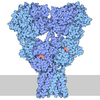
| Structure viewer | Molecule: MolmilJmol/JSmol |
|---|
- Downloads & links
-Download
| PDBx/mmCIF format | 27tm.cif.gz | 292 KB | Display | PDBx/mmCIF format |
|---|---|---|---|---|
| PDB format | pdb27tm.ent.gz | Display | PDB format | |
| PDBx/mmJSON format | 27tm.json.gz | Tree view | PDBx/mmJSON format | |
| Others |  Other downloads Other downloads |
-Validation report
| Arichive directory | https://data.pdbj.org/pub/pdb/validation_reports/7t/27tmftp://data.pdbj.org/pub/pdb/validation_reports/7t/27tm | HTTPS FTP |
|---|
-Related structure data
| Related structure data |  81411MC  9wqkC  9wqlC  9wqmC  9wqnC  9wqoC C: citing same article ( M: map data used to model this data |
|---|---|
| Similar structure data |


-Links
 PDBj
PDBj
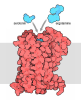
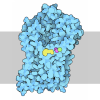
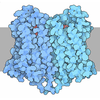
- Assembly
| Deposited unit | 
|
|---|---|
| 1 |
|
-Components
-Protein / Sugars , 2 types, 10 molecules XY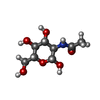
| #1: Protein | Mass: 97322.344 Da / Num. of mol.: 2 Source method: isolated from a genetically manipulated source Source: (gene. exp.) Homo sapiens (human) / Gene: GRM1, GPRC1A, MGLUR1 / Production host:   Spodoptera frugiperda (fall armyworm) / References: UniProt: Q13255 Spodoptera frugiperda (fall armyworm) / References: UniProt: Q13255#3: Sugar | ChemComp-NAG / 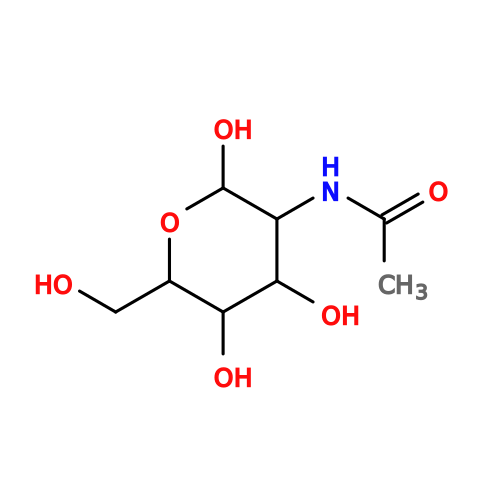 Type: D-saccharide, beta linking / Mass: 221.208 Da / Num. of mol.: 8 / Source method: obtained synthetically / Formula: C8H15NO6 Type: D-saccharide, beta linking / Mass: 221.208 Da / Num. of mol.: 8 / Source method: obtained synthetically / Formula: C8H15NO6 |
|---|
-Non-polymers , 4 types, 7 molecules 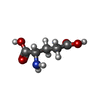

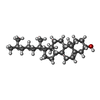
| #2: Chemical |  Type: L-gamma-peptide, C-delta linking / Mass: 147.129 Da / Num. of mol.: 2 / Source method: obtained synthetically / Formula: C5H9NO4 Type: L-gamma-peptide, C-delta linking / Mass: 147.129 Da / Num. of mol.: 2 / Source method: obtained synthetically / Formula: C5H9NO4#4: Chemical |  Mass: 35.453 Da / Num. of mol.: 2 / Source method: obtained synthetically / Formula: Cl Mass: 35.453 Da / Num. of mol.: 2 / Source method: obtained synthetically / Formula: Cl#5: Chemical | 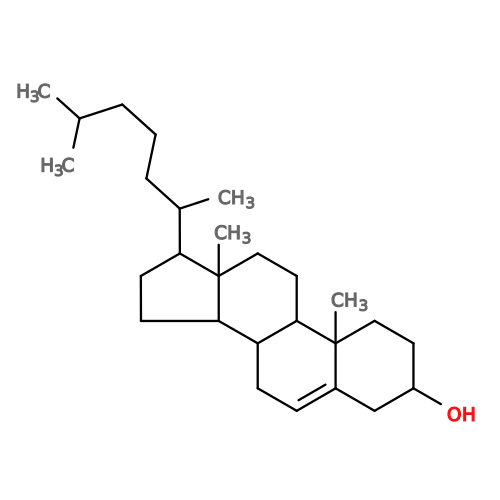 Mass: 386.654 Da / Num. of mol.: 2 / Source method: obtained synthetically / Formula: C27H46O Mass: 386.654 Da / Num. of mol.: 2 / Source method: obtained synthetically / Formula: C27H46O#6: Chemical | ChemComp-A1EX5 / | Mass: 360.287 Da / Num. of mol.: 1 / Source method: obtained synthetically / Formula: C18H11F3N2O3 |
|---|
-Details
| Has ligand of interest | N |
|---|---|
| Has protein modification | Y |
-Experimental details
-Experiment
| Experiment | Method: ELECTRON MICROSCOPY |
|---|---|
| EM experiment | Aggregation state: PARTICLE / 3D reconstruction method: single particle reconstruction |
- Sample preparation
| Component | Name: GRM1 / Type: COMPLEX / Entity ID: #1 / Source: RECOMBINANT |
|---|---|
| Source (natural) | Organism: Homo sapiens (human) |
| Source (recombinant) | Organism: Spodoptera frugiperda (fall armyworm) |
| Buffer solution | pH: 7.2 |
| Specimen | Embedding applied: NO / Shadowing applied: NO / Staining applied: NO / Vitrification applied: YES |
| Vitrification | Cryogen name: ETHANE |
- Electron microscopy imaging
| Experimental equipment |  Model: Titan Krios / Image courtesy: FEI Company |
|---|---|
| Microscopy | Model: TFS KRIOS |
| Electron gun | Electron source:  FIELD EMISSION GUN / Accelerating voltage: 300 kV / Illumination mode: FLOOD BEAM FIELD EMISSION GUN / Accelerating voltage: 300 kV / Illumination mode: FLOOD BEAM |
| Electron lens | Mode: BRIGHT FIELD / Nominal defocus max: 19000 nm / Nominal defocus min: 6000 nm |
| Image recording | Electron dose: 50 e/Å2 / Film or detector model: FEI FALCON IV (4k x 4k) |
- Processing
| EM software |
| ||||||||||||||||||||||||
|---|---|---|---|---|---|---|---|---|---|---|---|---|---|---|---|---|---|---|---|---|---|---|---|---|---|
| CTF correction | Type: NONE | ||||||||||||||||||||||||
| 3D reconstruction | Resolution: 3.2 Å / Resolution method: FSC 0.143 CUT-OFF / Num. of particles: 59726 / Symmetry type: POINT | ||||||||||||||||||||||||
| Refinement | Highest resolution: 3.2 Å Stereochemistry target values: REAL-SPACE (WEIGHTED MAP SUM AT ATOM CENTERS) | ||||||||||||||||||||||||
| Refine LS restraints |
|
