 Movie
Movie Controller


+ Open data

- Basic information
| Entry | Database: EMDB / ID: EMD-9509 | |||||||||
|---|---|---|---|---|---|---|---|---|---|---|
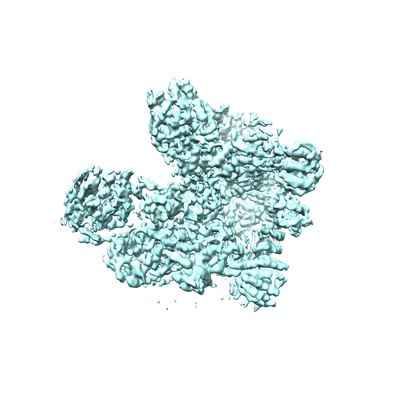
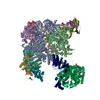
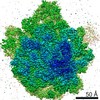
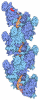
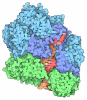
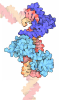
| Title | Cryo-EM map of the RP region (Class1) of human 26S proteasome | |||||||||
 Map data Map data | RP_Class1 | |||||||||
 Sample Sample |
| |||||||||
| Function / homology |  Function and homology information Function and homology informationnegative regulation of ERAD pathway / regulation of chemotaxis / deubiquitinase activity / positive regulation of inclusion body assembly / thyrotropin-releasing hormone receptor binding / nuclear proteasome complex / host-mediated perturbation of viral transcription / Impaired BRCA2 translocation to the nucleus / Impaired BRCA2 binding to SEM1 (DSS1) / protein K48-linked deubiquitination ...negative regulation of ERAD pathway / regulation of chemotaxis / deubiquitinase activity / positive regulation of inclusion body assembly / thyrotropin-releasing hormone receptor binding / nuclear proteasome complex / host-mediated perturbation of viral transcription / Impaired BRCA2 translocation to the nucleus / Impaired BRCA2 binding to SEM1 (DSS1) / protein K48-linked deubiquitination / proteasome accessory complex / purine ribonucleoside triphosphate binding / integrator complex / cytosolic proteasome complex / proteasome regulatory particle / structural constituent of proteasome / positive regulation of proteasomal protein catabolic process / transcription factor binding / CD8-positive, alpha-beta T cell differentiation / CD8-positive, alpha-beta T cell homeostasis / thymic T cell selection / Antigen processing: Ub, ATP-independent proteasomal degradation / transcription export complex 2 / proteasome-activating activity / spermatoproteasome complex / mitochondrion transport along microtubule / proteasome regulatory particle, lid subcomplex / positive regulation of protein monoubiquitination / negative regulation of programmed cell death / negative regulation of regulatory T cell differentiation / T-helper 1 cell differentiation / metal-dependent deubiquitinase activity / Regulation of ornithine decarboxylase (ODC) / proteasome core complex / Proteasome assembly / cellular response to type I interferon / T-helper 17 cell differentiation / Cross-presentation of soluble exogenous antigens (endosomes) / retrograde vesicle-mediated transport, Golgi to endoplasmic reticulum / protein K63-linked deubiquitination / Somitogenesis / K63-linked deubiquitinase activity / endopeptidase inhibitor activity / Homologous DNA Pairing and Strand Exchange / Defective homologous recombination repair (HRR) due to BRCA1 loss of function / Defective HDR through Homologous Recombination Repair (HRR) due to PALB2 loss of BRCA1 binding function / Defective HDR through Homologous Recombination Repair (HRR) due to PALB2 loss of BRCA2/RAD51/RAD51C binding function / Resolution of D-loop Structures through Synthesis-Dependent Strand Annealing (SDSA) / flagellated sperm motility / Resolution of D-loop Structures through Holliday Junction Intermediates / proteasome binding / sperm end piece / Impaired BRCA2 binding to RAD51 / myofibril / immune system process / proteasomal ubiquitin-independent protein catabolic process / positive regulation of RNA polymerase II transcription preinitiation complex assembly / general transcription initiation factor binding / : / ciliary tip / proteasome storage granule / Presynaptic phase of homologous DNA pairing and strand exchange / positive regulation of intrinsic apoptotic signaling pathway by p53 class mediator / protein deubiquitination / proteasome endopeptidase complex / NF-kappaB binding / proteasome core complex, beta-subunit complex / endopeptidase activator activity / threonine-type endopeptidase activity / proteasome core complex, alpha-subunit complex / proteasome assembly / mRNA export from nucleus / presynaptic cytosol / SARS-CoV-1 targets host intracellular signalling and regulatory pathways / proteasome complex / enzyme regulator activity / regulation of G1/S transition of mitotic cell cycle / regulation of macroautophagy / stem cell differentiation / positive regulation of interleukin-2 production / negative regulation of ubiquitin-dependent protein catabolic process / ERAD pathway / response to type II interferon / inclusion body / Maturation of protein E / Maturation of protein E / neuron projection morphogenesis / ER Quality Control Compartment (ERQC) / regulation of neuron apoptotic process / Myoclonic epilepsy of Lafora / FLT3 signaling by CBL mutants / IRAK2 mediated activation of TAK1 complex / Alpha-protein kinase 1 signaling pathway / Glycogen synthesis / regulation of mitochondrial membrane potential / IRAK1 recruits IKK complex / IRAK1 recruits IKK complex upon TLR7/8 or 9 stimulation / Prevention of phagosomal-lysosomal fusion / Endosomal Sorting Complex Required For Transport (ESCRT) / Membrane binding and targetting of GAG proteins Similarity search - Function | |||||||||
| Biological species |  Homo sapiens (human) Homo sapiens (human) | |||||||||
| Method | single particle reconstruction / cryo EM / Resolution: 4.3 Å | |||||||||
 Authors Authors | Huang XL / Luan B / Wu JP / Shi YG | |||||||||
 Citation Citation | Journal: Nat Struct Mol Biol / Year: 2016 Title: An atomic structure of the human 26S proteasome. Authors: Xiuliang Huang / Bai Luan / Jianping Wu / Yigong Shi /  Abstract: We report the cryo-EM structure of the human 26S proteasome at an average resolution of 3.5 Å, allowing atomic modeling of 28 subunits in the core particle (CP) and 18 subunits in the regulatory ...We report the cryo-EM structure of the human 26S proteasome at an average resolution of 3.5 Å, allowing atomic modeling of 28 subunits in the core particle (CP) and 18 subunits in the regulatory particle (RP). The C-terminal residues of Rpt3 and Rpt5 subunits in the RP can be seen inserted into surface pockets formed between adjacent α subunits in the CP. Each of the six Rpt subunits contains a bound nucleotide, and the central gate of the CP α-ring is closed despite RP association. The six pore 1 loops in the Rpt ring are arranged similarly to a spiral staircase along the axial channel of substrate transport, which is constricted by the pore 2 loops. We also determined the cryo-EM structure of the human proteasome bound to the deubiquitinating enzyme USP14 at 4.35-Å resolution. Together, our structures provide a framework for mechanistic understanding of eukaryotic proteasome function. | |||||||||
| History |
|
- Structure visualization
| Movie |
Movie viewer |
|---|---|
| Structure viewer | EM map: SurfViewMolmilJmol/JSmol |
| Supplemental images |
- Downloads & links
-EMDB archive
| Map data | emd_9509.map.gz | 78.4 MB | EMDB map data format | |
|---|---|---|---|---|
| Header (meta data) | emd-9509-v30.xmlemd-9509.xml | 11.5 KB 11.5 KB | Display Display | EMDB header |
| Images |  emd_9509.png emd_9509.png | 97.7 KB | ||
| Archive directory |  https://data.pdbj.org/pub/emdb/structures/EMD-9509ftp://data.pdbj.org/pub/emdb/structures/EMD-9509 https://data.pdbj.org/pub/emdb/structures/EMD-9509ftp://data.pdbj.org/pub/emdb/structures/EMD-9509 | HTTPS FTP |
-Related structure data
| Related structure data |  9507C  9508C  9510C 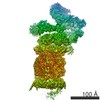 9511C  9512C  5gjqC  5gjrC C: citing same article ( |
|---|---|
| Similar structure data |

-Links
| EMDB pages | EMDB (EBI/PDBe) / EMDataResource |
|---|---|
| Related items in Molecule of the Month |

-Map
| File | Download / File: emd_9509.map.gz / Format: CCP4 / Size: 83.7 MB / Type: IMAGE STORED AS FLOATING POINT NUMBER (4 BYTES) | ||||||||||||||||||||||||||||||||||||||||||||||||||||||||||||
|---|---|---|---|---|---|---|---|---|---|---|---|---|---|---|---|---|---|---|---|---|---|---|---|---|---|---|---|---|---|---|---|---|---|---|---|---|---|---|---|---|---|---|---|---|---|---|---|---|---|---|---|---|---|---|---|---|---|---|---|---|---|
| Annotation | RP_Class1 | ||||||||||||||||||||||||||||||||||||||||||||||||||||||||||||
| Projections & slices | Image control
Images are generated by Spider. | ||||||||||||||||||||||||||||||||||||||||||||||||||||||||||||
| Voxel size | X=Y=Z: 1.07 Å | ||||||||||||||||||||||||||||||||||||||||||||||||||||||||||||
| Density |
| ||||||||||||||||||||||||||||||||||||||||||||||||||||||||||||
| Symmetry | Space group: 1 | ||||||||||||||||||||||||||||||||||||||||||||||||||||||||||||
| Details | EMDB XML:
CCP4 map header:
| ||||||||||||||||||||||||||||||||||||||||||||||||||||||||||||
 Z (Sec.)
 Y (Row.)
 X (Col.)


-Supplemental data
- Sample components
-Entire : human 26S proteasome
| Entire | Name: human 26S proteasome |
|---|---|
| Components |
|
-Supramolecule #1: human 26S proteasome
| Supramolecule | Name: human 26S proteasome / type: complex / ID: 1 / Parent: 0 |
|---|---|
| Source (natural) | Organism: Homo sapiens (human) |
| Molecular weight | Theoretical: 2.5 MDa |
-Experimental details
-Structure determination
| Method | cryo EM |
|---|---|
 Processing Processing | single particle reconstruction |
| Aggregation state | particle |
-Sample preparation
| Concentration | 1 mg/mL | ||||||||||||
|---|---|---|---|---|---|---|---|---|---|---|---|---|---|
| Buffer | pH: 8 Component:
| ||||||||||||
| Grid | Material: COPPER / Support film - Material: CARBON / Support film - topology: CONTINUOUS / Support film - Film thickness: 3.0 nm / Pretreatment - Type: GLOW DISCHARGE / Pretreatment - Atmosphere: AIR | ||||||||||||
| Vitrification | Cryogen name: ETHANE / Chamber humidity: 100 % / Chamber temperature: 281 K / Instrument: FEI VITROBOT MARK IV / Details: blot for 2s before plunging. | ||||||||||||
| Details | This sample was monodisperse |
- Electron microscopy
| Microscope | FEI TITAN KRIOS |
|---|---|
| Temperature | Min: 70.0 K |
| Image recording | Film or detector model: FEI FALCON II (4k x 4k) / Number real images: 4881 / Average exposure time: 1.6 sec. / Average electron dose: 37.0 e/Å2 |
| Electron beam | Acceleration voltage: 300 kV / Electron source:  FIELD EMISSION GUN FIELD EMISSION GUN |
| Electron optics | Illumination mode: FLOOD BEAM / Imaging mode: BRIGHT FIELD / Nominal magnification: 75000 |
| Sample stage | Specimen holder model: FEI TITAN KRIOS AUTOGRID HOLDER / Cooling holder cryogen: NITROGEN |
| Experimental equipment |  Model: Titan Krios / Image courtesy: FEI Company |
