Movie
 Controller


[English] 日本語
 Yorodumi
- EMDB-76752: 2 molecules of Fab NORO-320 bound to A-A' VP1 dimer of GII.4 Syd ... -
+ Open data

- Basic information
| Entry |  | |||||||||
|---|---|---|---|---|---|---|---|---|---|---|
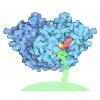
| Title | 2 molecules of Fab NORO-320 bound to A-A' VP1 dimer of GII.4 Syd VLP (T=1) left side | |||||||||
 Map data | ||||||||||
 Sample |
| |||||||||
 Keywords | Norovirus / Sydney / VLP / Capsid / Antibody / VIRUS LIKE PARTICLE | |||||||||
| Function / homology | Calicivirus coat protein C-terminal / Calicivirus coat protein C-terminal / Calicivirus coat protein / Calicivirus coat protein / Picornavirus/Calicivirus coat protein / Viral coat protein subunit / host cell cytoplasm / VP1 Function and homology information | |||||||||
| Biological species |  Norovirus Hu/GII.4/Sydney/NSW0514/2012/AU /  Homo sapiens (human) / Norovirus | |||||||||
| Method | single particle reconstruction / cryo EM / Resolution: 7.5 Å | |||||||||
 Authors | Apostol CV / Anish R / Pham S / Prasad BVV | |||||||||
| Funding support |  United States, 1 items
| |||||||||
 Citation | Journal: Res Sq / Year: 2026 Title: Symmetry-breaking antibody binding reveals extensive capsid malleability in pandemic human norovirus. Authors: Carmen V Apostol / Ramakrishnan Anish / Son Pham / Khalil Ettayebi / Janam Dave / Frederick H Neill / Marina Bok / Banumathi Sankaran / Sue Crawford / Robert L Atmar / James E Crowe / ...Authors: Carmen V Apostol / Ramakrishnan Anish / Son Pham / Khalil Ettayebi / Janam Dave / Frederick H Neill / Marina Bok / Banumathi Sankaran / Sue Crawford / Robert L Atmar / James E Crowe / Viviana Parreño / Mary K Estes / B V Venkataram Prasad /  Abstract: Virus capsids are metastable assemblies with an exquisite balance between stability and flexibility, obligatory for entry, infectivity, and immune escape. Yet, the extent to which human viruses ...Virus capsids are metastable assemblies with an exquisite balance between stability and flexibility, obligatory for entry, infectivity, and immune escape. Yet, the extent to which human viruses exploit capsid plasticity and how that consequently shapes antigenic landscapes remains poorly understood. Human noroviruses (HuNoVs) are the leading cause of acute viral gastroenteritis worldwide. GII.4 HuNoVs have been evolving epochally, driving most global pandemics, and since 2012, GII.4 Sydney has been the dominant variant. The major capsid protein VP1 is central to infectivity and immune recognition, and VP1-based virus-like particles (VLPs) are considered promising vaccine candidates. Yet, how the icosahedral HuNoV capsid responds to antibody pressure at the atomic level is still unclear. Here, we present the first atomic structure of GII.4 Sydney capsid determined by cryo-EM, revealing the structural features that likely contribute to its sustained dominance. Using focused refinement, we uncovered the remarkable capsid plasticity in response to symmetry-breaking binding of neutralizing and non-neutralizing antibodies. VP1 adopts 11 distinct conformational modalities to accommodate asymmetric antibody binding, and antibody-disrupted VLPs reassemble into smaller particles with five additional VP1 states. This previously unrecognized extent of conformational adaptability provides key insights for designing next-generation VLP- or mRNA-based vaccines targeting HuNoV infections. | |||||||||
| History |
|
- Structure visualization
| Supplemental images |
|---|

- Downloads & links
-EMDB archive
| Map data | emd_76752.map.gz | 569.2 MB | EMDB map data format | |
|---|---|---|---|---|
| Header (meta data) | emd-76752-v30.xmlemd-76752.xml | 20.2 KB 20.2 KB | Display Display | EMDB header |
| FSC (resolution estimation) | emd_76752_fsc.xml | 18.7 KB | Display | FSC data file |
| Images |  emd_76752.png | 84 KB | ||
| Filedesc metadata | emd-76752.cif.gz | 6.7 KB | ||
| Others | emd_76752_half_map_1.map.gzemd_76752_half_map_2.map.gz | 621.6 MB 621.7 MB | ||
| Archive directory |  https://data.pdbj.org/pub/emdb/structures/EMD-76752ftp://data.pdbj.org/pub/emdb/structures/EMD-76752 | HTTPS FTP |
-Related structure data
| Related structure data |  12tsMC  12pgC  12qzC  12tfC  12tpC  12tqC  12trC  12ttC  12tuC  12tvC  12twC  12txC  12tyC  12tzC  12uaC  12ubC  12ucC  12udC  12ueC  13kfC  13kgC M: atomic model generated by this map C: citing same article ( |
|---|---|
| Similar structure data |


-Links
| EMDB pages | EMDB (EBI/PDBe) / EMDataResource |
|---|---|
| Related items in Molecule of the Month |
-Map
| File | Download / File: emd_76752.map.gz / Format: CCP4 / Size: 669.9 MB / Type: IMAGE STORED AS FLOATING POINT NUMBER (4 BYTES) | ||||||||||||||||||||||||||||||||||||
|---|---|---|---|---|---|---|---|---|---|---|---|---|---|---|---|---|---|---|---|---|---|---|---|---|---|---|---|---|---|---|---|---|---|---|---|---|---|
| Projections & slices | Image control
Images are generated by Spider. | ||||||||||||||||||||||||||||||||||||
| Voxel size | X=Y=Z: 1.08 Å | ||||||||||||||||||||||||||||||||||||
| Density |
| ||||||||||||||||||||||||||||||||||||
| Symmetry | Space group: 1 | ||||||||||||||||||||||||||||||||||||
| Details | EMDB XML:
|
 Z (Sec.)
 Y (Row.)
 X (Col.)


-Supplemental data
-Half map: #1
| File | emd_76752_half_map_1.map | ||||||||||||
|---|---|---|---|---|---|---|---|---|---|---|---|---|---|
| Projections & Slices |
| ||||||||||||
| Density Histograms |


-Half map: #2
| File | emd_76752_half_map_2.map | ||||||||||||
|---|---|---|---|---|---|---|---|---|---|---|---|---|---|
| Projections & Slices |
| ||||||||||||
| Density Histograms |


- Sample components
-Entire : Norovirus
| Entire | Name: Norovirus |
|---|---|
| Components |
|
-Supramolecule #1: Norovirus
| Supramolecule | Name: Norovirus / type: virus / ID: 1 / Parent: 0 / Macromolecule list: #1-#2 / NCBI-ID: 142786 / Sci species name: Norovirus / Virus type: VIRUS-LIKE PARTICLE / Virus isolate: STRAIN / Virus enveloped: Yes / Virus empty: Yes |
|---|---|
| Host (natural) | Organism: Norovirus Hu/GII.4/Sydney/NSW0514/2012/AU |
| Virus shell | Shell ID: 1 / Name: VP1 / Diameter: 420.0 Å / T number (triangulation number): 3 |
-Macromolecule #1: VP1
| Macromolecule | Name: VP1 / type: protein_or_peptide / ID: 1 / Number of copies: 2 / Enantiomer: LEVO |
|---|---|
| Source (natural) | Organism: Norovirus Hu/GII.4/Sydney/NSW0514/2012/AU |
| Molecular weight | Theoretical: 59.157246 KDa |
| Recombinant expression | Organism:   Spodoptera frugiperda (fall armyworm) |
| Sequence | String: MKMASSDANP SDGSAANLVP EVNNEVMALE PVVGAAIAAP VAGQQNVIDP WIRNNFVQAP GGEFTVSPRN APGEILWSAP LGPDLNPYL SHLARMYNGY AGGFEVQVIL AGNAFTAGKV IFAAVPPNFP TEGLSPSQVT MFPHIVVDVR QLEPVLIPLP D VRNNFYHY ...String: MKMASSDANP SDGSAANLVP EVNNEVMALE PVVGAAIAAP VAGQQNVIDP WIRNNFVQAP GGEFTVSPRN APGEILWSAP LGPDLNPYL SHLARMYNGY AGGFEVQVIL AGNAFTAGKV IFAAVPPNFP TEGLSPSQVT MFPHIVVDVR QLEPVLIPLP D VRNNFYHY NQSNDPTIKL IAMLYTPLRA NNAGDDVFTV SCRVLTRPSP DFDFIFLVPP TVESRTKPFS VPVLTVEEMT NS RFPIPLE KLFTGPSSAF VVQPQNGRCT TDGVLLGTTQ LSPVNICTFR GDVTHITGSR NYTMNLASQN WNDYDPTEEI PAP LGTPDF VGKIQGVLTQ TTRTDGSTRG HKATVYTGSA DFAPKLGRVQ FETDTDRDFE ANQNTKFTPV GVIQDGGTTH RNEP QQWVL PSYSGRNTHN VHLAPAVAPT FPGEQLLFFR STMPGCSGYP NMDLDCLLPQ EWVQYFYQEA APAQSDVALL RFVNP DTGR VLFECKLHKS GYVTVAHTGQ HDLVIPPNGY FRFDSWVNQF YTLAPMGNGT GRRRAV UniProtKB: VP1 |
-Macromolecule #2: Fab NORO-320 Heavy Chain
| Macromolecule | Name: Fab NORO-320 Heavy Chain / type: protein_or_peptide / ID: 2 / Number of copies: 2 / Enantiomer: LEVO |
|---|---|
| Source (natural) | Organism: Homo sapiens (human) |
| Molecular weight | Theoretical: 25.202338 KDa |
| Recombinant expression | Organism:   Cricetulus griseus (Chinese hamster) |
| Sequence | String: QVQLVQSGPE VKKPGSSVKV SCKASGGTVS SYAISWVRQA PGQGLEWMGG IIPIFDTTNY AQKFQGRVTI TADESTGTSD MELSSLRSE DTAVYYCARD RVPSYSPSRR FSTKGAMWGK YGMDVWGQGT LVTVSSASFK GPSVFPLAPS SKSTSGGTAA L GCLVKDYF ...String: QVQLVQSGPE VKKPGSSVKV SCKASGGTVS SYAISWVRQA PGQGLEWMGG IIPIFDTTNY AQKFQGRVTI TADESTGTSD MELSSLRSE DTAVYYCARD RVPSYSPSRR FSTKGAMWGK YGMDVWGQGT LVTVSSASFK GPSVFPLAPS SKSTSGGTAA L GCLVKDYF PEPVTVSWNS GALTSGVHTF PAVLQSSGLY SLSSVVTVPS SSLGTQTYIC NVNHKPSNTK VDKKVEPKSC |
-Macromolecule #3: Fab NORO-320 Light Chain
| Macromolecule | Name: Fab NORO-320 Light Chain / type: protein_or_peptide / ID: 3 / Number of copies: 2 / Enantiomer: LEVO |
|---|---|
| Source (natural) | Organism: Homo sapiens (human) |
| Molecular weight | Theoretical: 23.905609 KDa |
| Recombinant expression | Organism: Cricetulus griseus (Chinese hamster) |
| Sequence | String: DIVMTQSPLS LPVTPGEPAS ISCRSSQSLL HSNGYNYLDW YLQKPGQSPQ LLIYLGSNRA SGVPDRFSGS GSGTDFTLKI SKVEAEDVG VYYCMQALQT PRTFGQGTKV EIKRTAAAPS VFIFPPSDEQ LKSGTASVVC LLNNFYPREA KVQWKVDNAL Q SGNSQESV ...String: DIVMTQSPLS LPVTPGEPAS ISCRSSQSLL HSNGYNYLDW YLQKPGQSPQ LLIYLGSNRA SGVPDRFSGS GSGTDFTLKI SKVEAEDVG VYYCMQALQT PRTFGQGTKV EIKRTAAAPS VFIFPPSDEQ LKSGTASVVC LLNNFYPREA KVQWKVDNAL Q SGNSQESV TEQDSKDSTY SLSSTLTLSK ADYEKHKVYA CEVTHEGLSS PVTKSFNRGE C |
-Experimental details
-Structure determination
| Method | cryo EM |
|---|---|
 Processing | single particle reconstruction |
| Aggregation state | particle |
-Sample preparation
| Buffer | pH: 6 / Details: 1X PBS |
|---|---|
| Grid | Model: Quantifoil R1.2/1.3 / Material: COPPER / Mesh: 200 / Support film - Material: GRAPHENE OXIDE / Support film - topology: HOLEY |
| Vitrification | Cryogen name: ETHANE / Chamber humidity: 100 % / Chamber temperature: 291 K / Instrument: FEI VITROBOT MARK IV |
- Electron microscopy
| Microscope | TFS KRIOS |
|---|---|
| Specialist optics | Energy filter - Name: GIF Bioquantum |
| Image recording | Film or detector model: GATAN K2 SUMMIT (4k x 4k) / Number grids imaged: 1 / Number real images: 3290 / Average electron dose: 50.0 e/Å2 Details: Images were collected in movie mode at 35 frames per second |
| Electron beam | Acceleration voltage: 300 kV / Electron source:  FIELD EMISSION GUN |
| Electron optics | C2 aperture diameter: 70.0 µm / Illumination mode: FLOOD BEAM / Imaging mode: BRIGHT FIELD / Cs: 2.7 mm / Nominal defocus max: 2.5 µm / Nominal defocus min: 0.5 µm / Nominal magnification: 130000 |
| Sample stage | Cooling holder cryogen: NITROGEN |
| Experimental equipment | 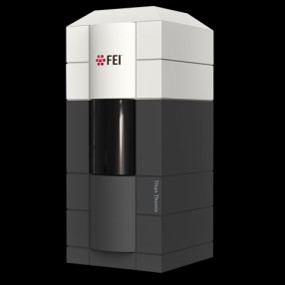 Model: Titan Krios / Image courtesy: FEI Company |