Journal: Nat Commun / Year: 2026 Title: Molecular insights into GPR55 modulation reveal an atypical activation mechanism and glycosylation-dependent efficacy regulation. Authors: Tobias Claff / Chamalee Demalgiriya-Gamage / Andhika B Mahardhika / Nikolaos Angelos Stamos / Frederik Bangnowski / Xue Sun / Katharina L Dürr / Carol V Robinson / Rainer Haney / Lee Frego ...Authors: Tobias Claff / Chamalee Demalgiriya-Gamage / Andhika B Mahardhika / Nikolaos Angelos Stamos / Frederik Bangnowski / Xue Sun / Katharina L Dürr / Carol V Robinson / Rainer Haney / Lee Frego / Herbert Nar / Christa E Müller / Rebecca Ebenhoch / Jörg T Kley / Dietmar Weichert / Abstract: GPR55 is a lipid-activated G protein-coupled receptor (GPCR) implicated in metabolism, inflammation, and neurodegeneration. Lysophosphatidylinositol (LPI) species are proposed as endogenous agonists, ...GPR55 is a lipid-activated G protein-coupled receptor (GPCR) implicated in metabolism, inflammation, and neurodegeneration. Lysophosphatidylinositol (LPI) species are proposed as endogenous agonists, but progress in understanding GPR55 function has still been limited by suboptimal chemical probes. Here, we present cryo-electron microscopy (cryo-EM) structures of GPR55 in both inactive and active states. The inactive-state structure bound to the inverse agonist CID16020046 facilitated the rational design of an improved in vitro tool compound, BI-8310. Surprisingly, mutation of a glycosylation site in extracellular loop 2 converted CID16020046 into a potent agonist, enabling co-structure determination of the active, G-bound receptor. Comparative analysis of both states bound to the same ligand provides insights into an atypical activation mechanism that diverges from the typical helix VI outward movement observed in other GPCRs. Functional mutagenesis, N-glycoproteomics, and hydrogen-deuterium exchange mass spectrometry (HDX-MS) substantiate the findings. These results establish a basis for targeted modulation of GPR55 in pathophysiological conditions.
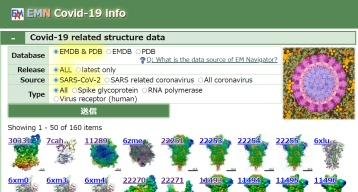
In the structure databanks used in Yorodumi, some data are registered as the other names, "COVID-19 virus" and "2019-nCoV". Here are the details of the virus and the list of structure data.
Jan 31, 2019. EMDB accession codes are about to change! (news from PDBe EMDB page)
EMDB accession codes are about to change! (news from PDBe EMDB page)
The allocation of 4 digits for EMDB accession codes will soon come to an end. Whilst these codes will remain in use, new EMDB accession codes will include an additional digit and will expand incrementally as the available range of codes is exhausted. The current 4-digit format prefixed with “EMD-” (i.e. EMD-XXXX) will advance to a 5-digit format (i.e. EMD-XXXXX), and so on. It is currently estimated that the 4-digit codes will be depleted around Spring 2019, at which point the 5-digit format will come into force.
The EM Navigator/Yorodumi systems omit the EMD- prefix.
Related info.:Q: What is EMD? / ID/Accession-code notation in Yorodumi/EM Navigator
Yorodumi is a browser for structure data from EMDB, PDB, SASBDB, etc.
This page is also the successor to EM Navigator detail page, and also detail information page/front-end page for Omokage search.
The word "yorodu" (or yorozu) is an old Japanese word meaning "ten thousand". "mi" (miru) is to see.
Related info.:EMDB / PDB / SASBDB / Comparison of 3 databanks / Yorodumi Search / Aug 31, 2016. New EM Navigator & Yorodumi / Yorodumi Papers / Jmol/JSmol / Function and homology information / Changes in new EM Navigator and Yorodumi
 Movie
 Controller


 Yorodumi
 Open data

 Basic information

 Map data
 Sample
 Keywords
 Homo sapiens (human)
 Authors
 Citation


 Structure visualization

 Downloads & links
 EMDB map data format
 emd_55781.png
 https://data.pdbj.org/pub/emdb/structures/EMD-55781


 Z (Sec.)
 Y (Row.)
 X (Col.)


 Sample components
 Processing
 Electron microscopy
 FIELD EMISSION GUN