Movie
 Controller


+ Open data

- Basic information
| Entry |  | |||||||||
|---|---|---|---|---|---|---|---|---|---|---|
| Title | Inactive-state structure of GPR55 in complex with BI-6229 | |||||||||
 Map data | ||||||||||
 Sample |
| |||||||||
 Keywords | GPCR / G protein-coupled receptor GPR55 / MEMBRANE PROTEIN | |||||||||
| Function / homology |  Function and homology information cannabinoid receptor activity / negative regulation of osteoclast differentiation / Class A/1 (Rhodopsin-like receptors) / bone resorption / positive regulation of Rho protein signal transduction / bioluminescence / generation of precursor metabolites and energy / electron transport chain / G protein-coupled receptor activity / phospholipase C-activating G protein-coupled receptor signaling pathway ...cannabinoid receptor activity / negative regulation of osteoclast differentiation / Class A/1 (Rhodopsin-like receptors) / bone resorption / positive regulation of Rho protein signal transduction / bioluminescence / generation of precursor metabolites and energy / electron transport chain / G protein-coupled receptor activity / phospholipase C-activating G protein-coupled receptor signaling pathway / G alpha (i) signalling events / positive regulation of ERK1 and ERK2 cascade / electron transfer activity / periplasmic space / iron ion binding / G protein-coupled receptor signaling pathway / heme binding / plasma membrane Similarity search - Function | |||||||||
| Biological species |  Homo sapiens (human) / Synthetic construct (others) | |||||||||
| Method | single particle reconstruction / cryo EM / Resolution: 2.57 Å | |||||||||
 Authors | Claff T / Ebenhoch R / Kley JT / Weichert D | |||||||||
| Funding support | 1 items
| |||||||||
 Citation | Journal: Nat Commun / Year: 2026 Title: Molecular insights into GPR55 modulation reveal an atypical activation mechanism and glycosylation-dependent efficacy regulation. Authors: Tobias Claff / Chamalee Demalgiriya-Gamage / Andhika B Mahardhika / Nikolaos Angelos Stamos / Frederik Bangnowski / Xue Sun / Katharina L Dürr / Carol V Robinson / Rainer Haney / Lee Frego ...Authors: Tobias Claff / Chamalee Demalgiriya-Gamage / Andhika B Mahardhika / Nikolaos Angelos Stamos / Frederik Bangnowski / Xue Sun / Katharina L Dürr / Carol V Robinson / Rainer Haney / Lee Frego / Herbert Nar / Christa E Müller / Rebecca Ebenhoch / Jörg T Kley / Dietmar Weichert /    Abstract: GPR55 is a lipid-activated G protein-coupled receptor (GPCR) implicated in metabolism, inflammation, and neurodegeneration. Lysophosphatidylinositol (LPI) species are proposed as endogenous agonists, ...GPR55 is a lipid-activated G protein-coupled receptor (GPCR) implicated in metabolism, inflammation, and neurodegeneration. Lysophosphatidylinositol (LPI) species are proposed as endogenous agonists, but progress in understanding GPR55 function has still been limited by suboptimal chemical probes. Here, we present cryo-electron microscopy (cryo-EM) structures of GPR55 in both inactive and active states. The inactive-state structure bound to the inverse agonist CID16020046 facilitated the rational design of an improved in vitro tool compound, BI-8310. Surprisingly, mutation of a glycosylation site in extracellular loop 2 converted CID16020046 into a potent agonist, enabling co-structure determination of the active, G-bound receptor. Comparative analysis of both states bound to the same ligand provides insights into an atypical activation mechanism that diverges from the typical helix VI outward movement observed in other GPCRs. Functional mutagenesis, N-glycoproteomics, and hydrogen-deuterium exchange mass spectrometry (HDX-MS) substantiate the findings. These results establish a basis for targeted modulation of GPR55 in pathophysiological conditions. | |||||||||
| History |
|
- Structure visualization
| Supplemental images |
|---|

- Downloads & links
-EMDB archive
| Map data | emd_55776.map.gz | 7.4 MB | EMDB map data format | |
|---|---|---|---|---|
| Header (meta data) | emd-55776-v30.xmlemd-55776.xml | 17.3 KB 17.3 KB | Display Display | EMDB header |
| Images |  emd_55776.png | 90.2 KB | ||
| Filedesc metadata | emd-55776.cif.gz | 6.8 KB | ||
| Archive directory |  https://data.pdbj.org/pub/emdb/structures/EMD-55776ftp://data.pdbj.org/pub/emdb/structures/EMD-55776 | HTTPS FTP |
-Related structure data
| Related structure data |  9tc7MC  9tc8C  9tc9C C: citing same article ( M: atomic model generated by this map |
|---|---|
| Similar structure data |


-Links
| EMDB pages | EMDB (EBI/PDBe) / EMDataResource |
|---|---|
| Related items in Molecule of the Month |
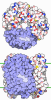
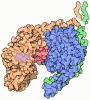
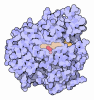
-Map
| File | Download / File: emd_55776.map.gz / Format: CCP4 / Size: 216 MB / Type: IMAGE STORED AS FLOATING POINT NUMBER (4 BYTES) | ||||||||||||||||||||||||||||||||||||
|---|---|---|---|---|---|---|---|---|---|---|---|---|---|---|---|---|---|---|---|---|---|---|---|---|---|---|---|---|---|---|---|---|---|---|---|---|---|
| Projections & slices | Image control
Images are generated by Spider. | ||||||||||||||||||||||||||||||||||||
| Voxel size | X=Y=Z: 0.951 Å | ||||||||||||||||||||||||||||||||||||
| Density |
| ||||||||||||||||||||||||||||||||||||
| Symmetry | Space group: 1 | ||||||||||||||||||||||||||||||||||||
| Details | EMDB XML:
|
 X (Sec.)
 Y (Row.)
 Z (Col.)


-Supplemental data
- Sample components
-Entire : GPR55-bRIL-Fab-Nb-BI-6229
| Entire | Name: GPR55-bRIL-Fab-Nb-BI-6229 |
|---|---|
| Components |
|
-Supramolecule #1: GPR55-bRIL-Fab-Nb-BI-6229
| Supramolecule | Name: GPR55-bRIL-Fab-Nb-BI-6229 / type: complex / ID: 1 / Parent: 0 / Macromolecule list: #1-#4 |
|---|---|
| Source (natural) | Organism: Homo sapiens (human) |
-Macromolecule #1: anti-bRIL fab heavy-chain
| Macromolecule | Name: anti-bRIL fab heavy-chain / type: protein_or_peptide / ID: 1 / Number of copies: 1 / Enantiomer: LEVO |
|---|---|
| Source (natural) | Organism: Synthetic construct (others) |
| Molecular weight | Theoretical: 26.064318 KDa |
| Recombinant expression | Organism:   Cricetulus griseus (Chinese hamster) |
| Sequence | String: MGWSLILLFL VAVATRVLSE VQLVESGGGL VQPGGSLRLS CAASGFNVVD FSLHWVRQAP GKGLEWVAYI SSSSGSTSYA DSVKGRFTI SADTSKNTAY LQMNSLRAED TAVYYCARWG YWPGEPWWKA FDYWGQGTLV TVSSASTKGP SVFPLAPSSK S TSGGTAAL ...String: MGWSLILLFL VAVATRVLSE VQLVESGGGL VQPGGSLRLS CAASGFNVVD FSLHWVRQAP GKGLEWVAYI SSSSGSTSYA DSVKGRFTI SADTSKNTAY LQMNSLRAED TAVYYCARWG YWPGEPWWKA FDYWGQGTLV TVSSASTKGP SVFPLAPSSK S TSGGTAAL GCLVKDYFPE PVTVSWNSGA LTSGVHTFPA VLQSSGLYSL SSVVTVPSSS LGTQTYICNV NHKPSNTKVD KK VEPKS |
-Macromolecule #2: anti-bRIL fab light-chain
| Macromolecule | Name: anti-bRIL fab light-chain / type: protein_or_peptide / ID: 2 / Number of copies: 1 / Enantiomer: LEVO |
|---|---|
| Source (natural) | Organism: Synthetic construct (others) |
| Molecular weight | Theoretical: 25.339463 KDa |
| Recombinant expression | Organism: Cricetulus griseus (Chinese hamster) |
| Sequence | String: MGWSLILLFL VAVATRVLSD IQMTQSPSSL SASVGDRVTI TCRASQSVSS AVAWYQQKPG KAPKLLIYSA SSLYSGVPSR FSGSRSGTD FTLTISSLQP EDFATYYCQQ YLYYSLVTFG QGTKVEIKRT VAAPSVFIFP PSDSQLKSGT ASVVCLLNNF Y PREAKVQW ...String: MGWSLILLFL VAVATRVLSD IQMTQSPSSL SASVGDRVTI TCRASQSVSS AVAWYQQKPG KAPKLLIYSA SSLYSGVPSR FSGSRSGTD FTLTISSLQP EDFATYYCQQ YLYYSLVTFG QGTKVEIKRT VAAPSVFIFP PSDSQLKSGT ASVVCLLNNF Y PREAKVQW KVDNALQSGN SQESVTEQDS KDSTYSLSST LTLSKADYEK HKVYACEVTH QGLSSPVTKS FNRG |
-Macromolecule #3: Fab-Nb
| Macromolecule | Name: Fab-Nb / type: protein_or_peptide / ID: 3 / Number of copies: 1 / Enantiomer: LEVO |
|---|---|
| Source (natural) | Organism: Synthetic construct (others) |
| Molecular weight | Theoretical: 17.585475 KDa |
| Recombinant expression | Organism:   Escherichia coli (E. coli) |
| Sequence | String: MKYLLPTAAA GLLLLAAQPA MAAHHHHHHG SSGENLYFQG SQVQLQESGG GLVQPGGSLR LSCAASGRTI SRYAMSWFRQ APGKEREFV AVARRSGDGA FYADSVQGRF TVSRDDAKNT VYLQMNSLKP EDTAVYYCAI DSDTFYSGSY DYWGQGTQVT V SS |
-Macromolecule #4: Green fluorescent protein,G-protein coupled receptor 55,Soluble c...
| Macromolecule | Name: Green fluorescent protein,G-protein coupled receptor 55,Soluble cytochrome b562 type: protein_or_peptide / ID: 4 / Number of copies: 1 / Enantiomer: LEVO |
|---|---|
| Source (natural) | Organism: Homo sapiens (human) |
| Molecular weight | Theoretical: 83.22425 KDa |
| Recombinant expression | Organism:  Trichoplusia ni (cabbage looper) |
| Sequence | String: MKTIIALSYI FCLVFADYKD DDDKKGEELF TGVVPILVEL DGDVNGHKFS VSGEGEGDAT YGKLTLKFIC TTGKLPVPWP TLVTTLTYG VQCFSRYPDH MKRHDFFKSA MPEGYVQERT ISFKDDGNYK TRAEVKFEGD TLVNRIELKG IDFKEDGNIL G HKLEYNYN ...String: MKTIIALSYI FCLVFADYKD DDDKKGEELF TGVVPILVEL DGDVNGHKFS VSGEGEGDAT YGKLTLKFIC TTGKLPVPWP TLVTTLTYG VQCFSRYPDH MKRHDFFKSA MPEGYVQERT ISFKDDGNYK TRAEVKFEGD TLVNRIELKG IDFKEDGNIL G HKLEYNYN SHNVYITADK QKNGIKANFK IRHNIEDGSV QLADHYQQNT PIGDGPVLLP DNHYLSTQSA LSKDPNEKRD HM VLLEFVT AAGITHGMDE LYKAAGSGEF LEVLFQGPGA GSDSMSQQNT SGDCLFDGVN ELMKTLQFAV HIPTFVLGLL LNL LAIHGF STFLKNRWPD YAATSIYMIN LAVFDLLLVL SLPFKMVLSQ VQSPFPSLCT LVECLYFVSM YGKVFTICFI SMDR FLAIR YPLLVSHLRS PRKIFGICCT IWVLVWTGSI PIYSFHGKVE KYMCFHNMSD DTWSAKVFFP LEVFGFLLPM GIMGF CCSR SIHILLGRRA DLEDNWETLN DNLKVIEKAD NAAQVKDALT KMRAAALDAQ KATPPKLEDK SPDSPEMKDF RHGFDI LVG QIDDALKLAN EGKVKEAQAA AEQLKTTRNA YIQKYLQDWV QQKACIYSIA ASLAVFVVSF LPVHLGFFLQ FLVRNSF IV ECRAKQSISF FLQLSMCFSN VNCCLDVFCY YFVIKEFRMN IRAHRPSRGA GSGAGSAWSH PQFEKGGGSG GGSGGSAW S HPQFEKGAGS HHHHHHHHHH UniProtKB: Green fluorescent protein, G protein-coupled receptor 55, Soluble cytochrome b562, G protein-coupled receptor 55 |
-Macromolecule #5: CHOLESTEROL
| Macromolecule | Name: CHOLESTEROL / type: ligand / ID: 5 / Number of copies: 1 / Formula: CLR |
|---|---|
| Molecular weight | Theoretical: 386.654 Da |
| Chemical component information | 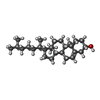 ChemComp-CLR: |
-Macromolecule #6: 4-[(4~{S})-4-(3-hydroxyphenyl)-3-(4-methylphenyl)-6-oxidanylidene...
| Macromolecule | Name: 4-[(4~{S})-4-(3-hydroxyphenyl)-3-(4-methylphenyl)-6-oxidanylidene-1,4-dihydropyrrolo[3,4-c]pyrazol-5-yl]benzoic acid type: ligand / ID: 6 / Number of copies: 1 / Formula: A1JU1 |
|---|---|
| Molecular weight | Theoretical: 425.436 Da |
-Experimental details
-Structure determination
| Method | cryo EM |
|---|---|
 Processing | single particle reconstruction |
| Aggregation state | particle |
-Sample preparation
| Buffer | pH: 7.4 |
|---|---|
| Vitrification | Cryogen name: ETHANE / Instrument: FEI VITROBOT MARK IV |
- Electron microscopy
| Microscope | TFS KRIOS |
|---|---|
| Image recording | Film or detector model: TFS FALCON 4i (4k x 4k) / Average electron dose: 40.0 e/Å2 |
| Electron beam | Acceleration voltage: 300 kV / Electron source:  FIELD EMISSION GUN |
| Electron optics | Illumination mode: OTHER / Imaging mode: BRIGHT FIELD / Nominal defocus max: 28.0 µm / Nominal defocus min: 2.8000000000000003 µm |
| Sample stage | Cooling holder cryogen: NITROGEN |
| Experimental equipment |  Model: Titan Krios / Image courtesy: FEI Company |