chloroplast thylakoid lumen / photosystem I reaction center / photosystem I / photosynthetic electron transport in photosystem I / photosystem I / chloroplast thylakoid membrane / photosynthesis / 4 iron, 4 sulfur cluster binding / electron transfer activity / iron ion binding ...chloroplast thylakoid lumen / photosystem I reaction center / photosystem I / photosynthetic electron transport in photosystem I / photosystem I / chloroplast thylakoid membrane / photosynthesis / 4 iron, 4 sulfur cluster binding / electron transfer activity / iron ion binding / heme binding / magnesium ion binding Similarity search - Function
Cytochrome c6 / Cytochrome c, class IC / Cytochrome C oxidase, cbb3-type, subunit III / Photosystem I PsaL, reaction centre subunit XI / Photosystem I, reaction centre subunit XI / Photosystem I PsaL, reaction centre subunit XI superfamily / Photosystem I reaction centre subunit XI / Photosystem I reaction centre subunit VIII / Photosystem I reaction centre subunit VIII / Photosystem I reaction centre subunit VIII superfamily ...Cytochrome c6 / Cytochrome c, class IC / Cytochrome C oxidase, cbb3-type, subunit III / Photosystem I PsaL, reaction centre subunit XI / Photosystem I, reaction centre subunit XI / Photosystem I PsaL, reaction centre subunit XI superfamily / Photosystem I reaction centre subunit XI / Photosystem I reaction centre subunit VIII / Photosystem I reaction centre subunit VIII / Photosystem I reaction centre subunit VIII superfamily / Photosystem I PsaF, reaction centre subunit III / Photosystem I PsaF, reaction centre subunit III superfamily / Photosystem I reaction centre subunit III / Photosystem I PsaD / Photosystem I, reaction centre subunit PsaD superfamily / PsaD / Photosystem I PsaE, reaction centre subunit IV / Photosystem I reaction centre subunit IV / PsaE / Photosystem I PsaJ, reaction centre subunit IX superfamily / Photosystem I PsaJ, reaction centre subunit IX / Photosystem I reaction centre subunit IX / PsaJ / Photosystem I protein PsaC / Photosystem I PsaA / Photosystem I PsaB / Photosystem I PsaA/PsaB, conserved site / Photosystem I psaA and psaB proteins signature. / : / Photosystem I PsaA/PsaB / Photosystem I PsaA/PsaB superfamily / Photosystem I psaA/psaB protein / Electron transport accessory-like domain superfamily / 4Fe-4S dicluster domain / Cytochrome c family profile. / Cytochrome c-like domain / Cytochrome c-like domain superfamily / 4Fe-4S ferredoxin, iron-sulphur binding, conserved site / 4Fe-4S ferredoxin-type iron-sulfur binding region signature. / 4Fe-4S ferredoxin-type iron-sulfur binding domain profile. / 4Fe-4S ferredoxin-type, iron-sulphur binding domain Similarity search - Domain/homology
Photosystem I reaction center subunit VIII / Photosystem I reaction center subunit XI, chloroplastic / Cytochrome c6, chloroplastic / Photosystem I P700 chlorophyll a apoprotein A2 / Photosystem I P700 chlorophyll a apoprotein A1 / Photosystem I reaction center subunit IV, chloroplastic / Photosystem I reaction center subunit III, chloroplastic / Photosystem I reaction center subunit IX / Photosystem I iron-sulfur center / Photosystem I reaction center subunit II, chloroplastic Similarity search - Component
Biological species
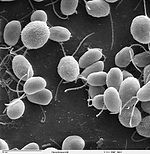
Chlamydomonas reinhardtii (plant)
Method
single particle reconstruction / cryo EM / Resolution: 2.06 Å
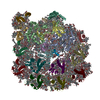
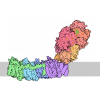
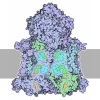
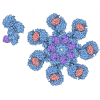
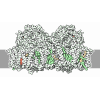
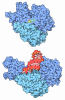
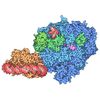
Journal: Nat Commun / Year: 2026 Title: Cryo-EM structure of Chlamydomonas reinhardtii Photosystem I complexed with cytochrome c. Authors: Yu Ogawa / Gyana Prakash Mahapatra / Yuval Milrad / Michelle Schimpf / Genji Kurisu / Michael Hippler / Jan Michael Schuller / Abstract: Photosynthetic electron transfer relies on small soluble carriers that shuttle electrons between the cytochrome b₆f complex and Photosystem I (PSI). While copper-containing plastocyanin (Pc) serves ...Photosynthetic electron transfer relies on small soluble carriers that shuttle electrons between the cytochrome b₆f complex and Photosystem I (PSI). While copper-containing plastocyanin (Pc) serves this role in plants, the heme protein cytochrome c₆ (Cyt c₆) is also employed in algae and cyanobacteria. Here, we present a cryo-electron microscopy structure of a Cyt c₆:PSI complex from Chlamydomonas reinhardtii. We observe that the heme group of Cyt c₆ is positioned ~11 Å away from P700, stabilized by extensive contacts involving a N-terminal helix-loop-helix motif of PSAF, characteristic of eukaryotic PSI. Notably, the algal Cyt c₆ also retains an arginine residue (R66) which is crucial for cyanobacterial donor:PSI reactions. Our structure reveals the previously uncharacterized interactions involving this residue; it can form a putative electrostatic contact with PsaB-D623 while also contributing to a tri-planar π(cation)-π interactions with adjacent residues. Our findings provide a structural framework for understanding the mechanism and evolution of donor:PSI interactions.
In the structure databanks used in Yorodumi, some data are registered as the other names, "COVID-19 virus" and "2019-nCoV". Here are the details of the virus and the list of structure data.
Jan 31, 2019. EMDB accession codes are about to change! (news from PDBe EMDB page)
EMDB accession codes are about to change! (news from PDBe EMDB page)
The allocation of 4 digits for EMDB accession codes will soon come to an end. Whilst these codes will remain in use, new EMDB accession codes will include an additional digit and will expand incrementally as the available range of codes is exhausted. The current 4-digit format prefixed with “EMD-” (i.e. EMD-XXXX) will advance to a 5-digit format (i.e. EMD-XXXXX), and so on. It is currently estimated that the 4-digit codes will be depleted around Spring 2019, at which point the 5-digit format will come into force.
The EM Navigator/Yorodumi systems omit the EMD- prefix.
Related info.:Q: What is EMD? / ID/Accession-code notation in Yorodumi/EM Navigator
Yorodumi is a browser for structure data from EMDB, PDB, SASBDB, etc.
This page is also the successor to EM Navigator detail page, and also detail information page/front-end page for Omokage search.
The word "yorodu" (or yorozu) is an old Japanese word meaning "ten thousand". "mi" (miru) is to see.
Related info.:EMDB / PDB / SASBDB / Comparison of 3 databanks / Yorodumi Search / Aug 31, 2016. New EM Navigator & Yorodumi / Yorodumi Papers / Jmol/JSmol / Function and homology information / Changes in new EM Navigator and Yorodumi
 Movie
Movie Controller

 Yorodumi
 Open data
 Basic information
 Map data
 Sample
 Keywords
 Function and homology information
 Chlamydomonas reinhardtii (plant)
 Authors
 Germany, 1 items
  Citation
 Structure visualization
 Downloads & links
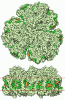
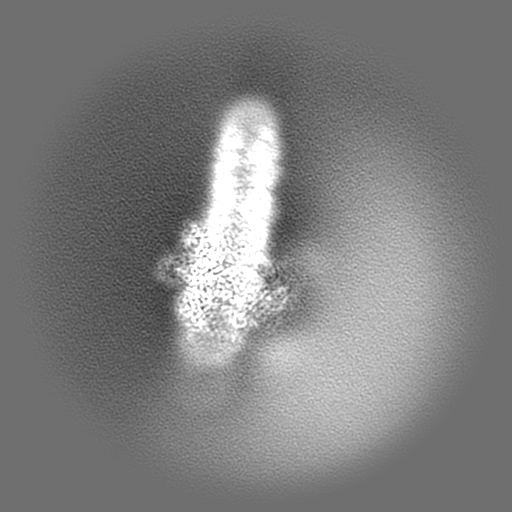
 emd_54804.png
 https://data.pdbj.org/pub/emdb/structures/EMD-54804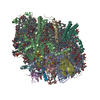


 Z (Sec.)
 Y (Row.)
 X (Col.)




 Sample components
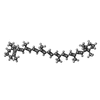
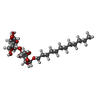
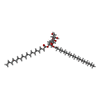
 Processing
 Electron microscopy
 FIELD EMISSION GUN