Journal: Nat Commun / Year: 2025 Title: Structural basis of Nuclear Factor 1-X DNA recognition provides prototypic insight into the NFI family. Authors: Michele Tiberi / Michela Lapi / Louise Jane Gourlay / Antonio Chaves-Sanjuan / Maurizio Polentarutti / Nicola Demitri / Miriam Cavinato / Diane Marie Valérie Bonnet / Valentina Taglietti / ...Authors: Michele Tiberi / Michela Lapi / Louise Jane Gourlay / Antonio Chaves-Sanjuan / Maurizio Polentarutti / Nicola Demitri / Miriam Cavinato / Diane Marie Valérie Bonnet / Valentina Taglietti / Anna Righetti / Rachele Sala / Silvia Cauteruccio / Amit Kumawat / Rosaria Russo / Alberto Giuseppe Barbiroli / Nerina Gnesutta / Carlo Camilloni / Martino Bolognesi / Graziella Messina / Marco Nardini / Abstract: Nuclear Factor I (NFI) proteins are involved in adenovirus DNA replication and regulate gene transcription, stem cell proliferation, and differentiation. They play key roles in development, cancer, ...Nuclear Factor I (NFI) proteins are involved in adenovirus DNA replication and regulate gene transcription, stem cell proliferation, and differentiation. They play key roles in development, cancer, and congenital disorders. Within the NFI family, NFI-X is critical for neural stem cell biology, hematopoiesis, muscle development, muscular dystrophies, and oncogenesis. Here, we present the structural characterization of the NFI transcription factor NFI-X, both alone and bound to its consensus palindromic DNA site. Our analyses reveal a MH1-like fold within NFI-X DNA-binding domain (DBD) and identify crucial structural determinants for activity, such as a Zn²⁺ binding site, dimeric assembly, and DNA-binding specificity. Given the ~85% sequence identity within the NFI DBDs, our structural data are prototypic for the entire family, a NFI Rosetta Stone that allows decoding a wealth of biochemical and functional data and provides a precise target for drug design in a wider disease context.
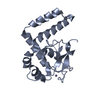
Name: Nuclear factor 1 X-type / type: protein_or_peptide / ID: 1 / Details: The first histidine belongs to the tag / Number of copies: 8 / Enantiomer: LEVO
Name: ZINC ION / type: ligand / ID: 4 / Number of copies: 8 / Formula: ZN
Molecular weight
Theoretical: 65.409 Da
-
Experimental details
-
Structure determination
Method
cryo EM
Processing
helical reconstruction
Aggregation state
filament
-
Sample preparation
Concentration
4 mg/mL
Buffer
pH: 7.4 Component:
Concentration
Formula
Name
150.0 mM
NaCl
sodium chloride
50.0 mM
Tris-HCl
tris(hydroxymethyl)aminomethane
1.0 mM
DTT
Dithiothreitol
Grid
Model: Quantifoil R0.6/1 / Material: COPPER / Support film - Material: CARBON / Support film - topology: HOLEY / Pretreatment - Type: GLOW DISCHARGE / Pretreatment - Time: 30 sec. / Pretreatment - Atmosphere: AIR
Vitrification
Cryogen name: ETHANE / Chamber humidity: 100 % / Chamber temperature: 277 K / Instrument: FEI VITROBOT MARK IV
-
Electron microscopy
Microscope
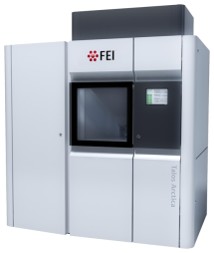
FEI TALOS ARCTICA
Image recording
Film or detector model: FEI FALCON III (4k x 4k) / Detector mode: COUNTING / Number grids imaged: 1 / Number real images: 1225 / Average electron dose: 40.0 e/Å2
Electron beam
Acceleration voltage: 200 kV / Electron source: FIELD EMISSION GUN
In the structure databanks used in Yorodumi, some data are registered as the other names, "COVID-19 virus" and "2019-nCoV". Here are the details of the virus and the list of structure data.
Jan 31, 2019. EMDB accession codes are about to change! (news from PDBe EMDB page)
EMDB accession codes are about to change! (news from PDBe EMDB page)
The allocation of 4 digits for EMDB accession codes will soon come to an end. Whilst these codes will remain in use, new EMDB accession codes will include an additional digit and will expand incrementally as the available range of codes is exhausted. The current 4-digit format prefixed with “EMD-” (i.e. EMD-XXXX) will advance to a 5-digit format (i.e. EMD-XXXXX), and so on. It is currently estimated that the 4-digit codes will be depleted around Spring 2019, at which point the 5-digit format will come into force.
The EM Navigator/Yorodumi systems omit the EMD- prefix.
Related info.:Q: What is EMD? / ID/Accession-code notation in Yorodumi/EM Navigator
Yorodumi is a browser for structure data from EMDB, PDB, SASBDB, etc.
This page is also the successor to EM Navigator detail page, and also detail information page/front-end page for Omokage search.
The word "yorodu" (or yorozu) is an old Japanese word meaning "ten thousand". "mi" (miru) is to see.
Related info.:EMDB / PDB / SASBDB / Comparison of 3 databanks / Yorodumi Search / Aug 31, 2016. New EM Navigator & Yorodumi / Yorodumi Papers / Jmol/JSmol / Function and homology information / Changes in new EM Navigator and Yorodumi
 Movie
Movie Controller

 Yorodumi
 Open data
 Basic information
 Map data
 Sample
 Keywords
 Function and homology information
 Mus musculus (house mouse)
 Authors
 Citation


 Structure visualization
 Downloads & links
 emd_53223.png
 https://data.pdbj.org/pub/emdb/structures/EMD-53223
 Z (Sec.)
 Y (Row.)
 X (Col.)


 Sample components
 Escherichia coli (E. coli)
 Processing
 Electron microscopy
 FIELD EMISSION GUN