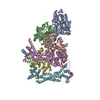
Journal: Nat Commun / Year: 2024 Title: Phalloidin and DNase I-bound F-actin pointed end structures reveal principles of filament stabilization and disassembly. Authors: Micaela Boiero Sanders / Wout Oosterheert / Oliver Hofnagel / Peter Bieling / Stefan Raunser / Abstract: Actin filament turnover involves subunits binding to and dissociating from the filament ends, with the pointed end being the primary site of filament disassembly. Several molecules modulate filament ...Actin filament turnover involves subunits binding to and dissociating from the filament ends, with the pointed end being the primary site of filament disassembly. Several molecules modulate filament turnover, but the underlying mechanisms remain incompletely understood. Here, we present three cryo-EM structures of the F-actin pointed end in the presence and absence of phalloidin or DNase I. The two terminal subunits at the undecorated pointed end adopt a twisted conformation. Phalloidin can still bind and bridge these subunits, inducing a conformational shift to a flattened, F-actin-like state. This explains how phalloidin prevents depolymerization at the pointed end. Interestingly, two DNase I molecules simultaneously bind to the phalloidin-stabilized pointed end. In the absence of phalloidin, DNase I binding would disrupt the terminal actin subunit packing, resulting in filament disassembly. Our findings uncover molecular principles of pointed end regulation and provide structural insights into the kinetic asymmetry between the actin filament ends.
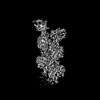
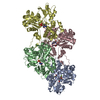
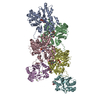
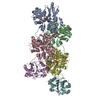
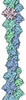
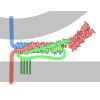
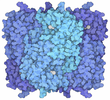
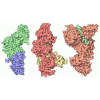
Entire : Actin filament pointed end bound by phalloidin
Entire
Name: Actin filament pointed end bound by phalloidin
Components
Complex: Actin filament pointed end bound by phalloidin
Complex: Actin filament pointed end
Protein or peptide: Actin, cytoplasmic 1, N-terminally processed
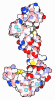
Complex: Phalloidin
Protein or peptide: Phalloidin
Ligand: ADENOSINE-5'-DIPHOSPHATE
Ligand: MAGNESIUM ION
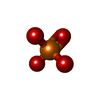
Ligand: PHOSPHATE ION
-
Supramolecule #1: Actin filament pointed end bound by phalloidin
Supramolecule
Name: Actin filament pointed end bound by phalloidin / type: complex / ID: 1 / Parent: 0 / Macromolecule list: #1-#2 Details: Human beta-actin was purified recombinantly, phalloidin (from Amanita phalloides) was bought from sigma. The components were mixed to assemble the complex prior to cryo-EM grid preparation.
-
Supramolecule #2: Actin filament pointed end
Supramolecule
Name: Actin filament pointed end / type: complex / ID: 2 / Parent: 1 / Macromolecule list: #1 Details: The four terminal subunits of the pointed end of the actin filament.
Source (natural)
Organism: Homo sapiens (human)
-
Supramolecule #3: Phalloidin
Supramolecule
Name: Phalloidin / type: complex / ID: 3 / Parent: 1 / Macromolecule list: #2 Details: Toxin from Amanita phalloides that stabilizes the actin filament
In the structure databanks used in Yorodumi, some data are registered as the other names, "COVID-19 virus" and "2019-nCoV". Here are the details of the virus and the list of structure data.
Jan 31, 2019. EMDB accession codes are about to change! (news from PDBe EMDB page)
EMDB accession codes are about to change! (news from PDBe EMDB page)
The allocation of 4 digits for EMDB accession codes will soon come to an end. Whilst these codes will remain in use, new EMDB accession codes will include an additional digit and will expand incrementally as the available range of codes is exhausted. The current 4-digit format prefixed with “EMD-” (i.e. EMD-XXXX) will advance to a 5-digit format (i.e. EMD-XXXXX), and so on. It is currently estimated that the 4-digit codes will be depleted around Spring 2019, at which point the 5-digit format will come into force.
The EM Navigator/Yorodumi systems omit the EMD- prefix.
Related info.:Q: What is EMD? / ID/Accession-code notation in Yorodumi/EM Navigator
Yorodumi is a browser for structure data from EMDB, PDB, SASBDB, etc.
This page is also the successor to EM Navigator detail page, and also detail information page/front-end page for Omokage search.
The word "yorodu" (or yorozu) is an old Japanese word meaning "ten thousand". "mi" (miru) is to see.
Related info.:EMDB / PDB / SASBDB / Comparison of 3 databanks / Yorodumi Search / Aug 31, 2016. New EM Navigator & Yorodumi / Yorodumi Papers / Jmol/JSmol / Function and homology information / Changes in new EM Navigator and Yorodumi
 Movie
Movie Controller

 Yorodumi
 Open data
 Basic information
 Map data
 Sample
 Keywords
 Function and homology information
 Homo sapiens (human) /
  Amanita phalloides (death cap)
 Authors
 Germany, European Union, 3 items
  Citation
 Structure visualization
 Downloads & links
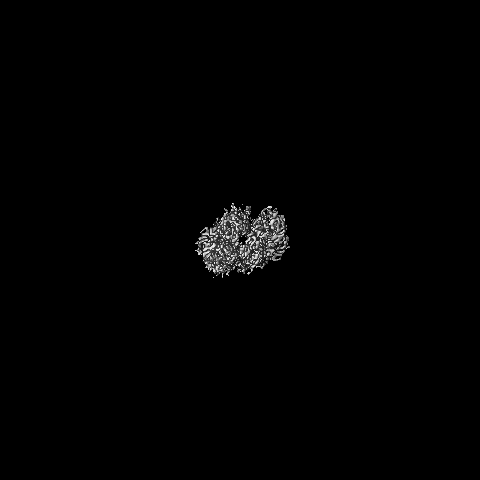
 emd_50506.png
 http://ftp.pdbj.org/pub/emdb/structures/EMD-50506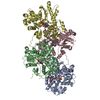

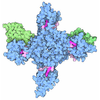

 Z (Sec.)
 Y (Row.)
 X (Col.)







 Sample components
 Trichoplusia ni (cabbage looper)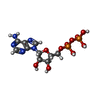
 Processing
 Electron microscopy
 FIELD EMISSION GUN