pollen tube development / plastid translation / 3-hydroxyisobutyryl-CoA hydrolase / 3-hydroxyisobutyryl-CoA hydrolase activity / monocarboxylic acid metabolic process / embryo development ending in seed dormancy / L-valine catabolic process / cell communication / molybdenum ion binding / mitochondrial small ribosomal subunit ...pollen tube development / plastid translation / 3-hydroxyisobutyryl-CoA hydrolase / 3-hydroxyisobutyryl-CoA hydrolase activity / monocarboxylic acid metabolic process / embryo development ending in seed dormancy / L-valine catabolic process / cell communication / molybdenum ion binding / mitochondrial small ribosomal subunit / mitochondrial translation / plastid / catalytic activity / chloroplast / pyridoxal phosphate binding / small ribosomal subunit rRNA binding / small ribosomal subunit / rRNA binding / ribonucleoprotein complex / structural constituent of ribosome / ribosome / translation / mRNA binding / GTPase activity / GTP binding / mitochondrion / RNA binding / cytoplasm Similarity search - Function
CID8-like protein, RNA recognition motif 1 / CID8-like protein, RNA recognition motif 2 / : / Domain of unknown function (DUF8750) / IMS import disulfide relay-system, CHCH-CHCH-like Cx9C / CHCH-CHCH-like Cx9C, IMS import disulfide relay-system, / MOSC, N-terminal beta barrel / MOSC N-terminal beta barrel domain / Ribosomal protein S3, mitochondrial, plant / : ...CID8-like protein, RNA recognition motif 1 / CID8-like protein, RNA recognition motif 2 / : / Domain of unknown function (DUF8750) / IMS import disulfide relay-system, CHCH-CHCH-like Cx9C / CHCH-CHCH-like Cx9C, IMS import disulfide relay-system, / MOSC, N-terminal beta barrel / MOSC N-terminal beta barrel domain / Ribosomal protein S3, mitochondrial, plant / : / Molybdenum cofactor sulfurase, C-terminal / : / MOSC domain / MOSC domain profile. / Ataxin-2, C-terminal / Ataxin-2 C-terminal region / 30S ribosomal protein S31, plant / Ribosomal protein S31e / : / Ribosome biogenesis GTPase RsgA / RsgA GTPase domain / RsgA GTPase / EngC GTPase domain profile. / Pentacotripeptide-repeat region of PRORP / Pentacotripeptide-repeat region of PRORP / Enoyl-CoA hydratase/isomerase, HIBYL-CoA-H type / Ribosomal protein MRP10, mitochondrial / Eukaryotic mitochondrial regulator protein / Enoyl-CoA hydratase/isomerase domain / Enoyl-CoA hydratase/isomerase / Small ribosomal subunit protein mS41 SAM domain / IGR protein motif / IGR / Cysteine alpha-hairpin motif superfamily / Mitochondrial 28S ribosomal protein S34 / Mitochondrial 28S ribosomal protein S34 / Pentatricopeptide repeat domain / Pyruvate kinase-like, insert domain superfamily / Ribosomal protein S27/S33, mitochondrial / : / Mitochondrial ribosomal subunit S27 / Ribosomal protein S24/S35, mitochondrial / Ribosomal protein S24/S35, mitochondrial, conserved domain / Mitochondrial ribosomal subunit protein / Pentatricopeptide (PPR) repeat profile. / Circularly permuted (CP)-type guanine nucleotide-binding (G) domain / Circularly permuted (CP)-type guanine nucleotide-binding (G) domain profile. / Pentatricopeptide repeat / Ribosomal protein S23/S29, mitochondrial / Mitochondrial ribosomal death-associated protein 3 / Mitochondrial mRNA-processing protein COX24, C-terminal / Mitochondrial mRNA-processing protein COX24, C-terminal / Mitochondrial domain of unknown function (DUF1713) / 30S ribosomal protein / Coiled coil-helix-coiled coil-helix (CHCH) domain profile. / ClpP/crotonase-like domain superfamily / Ribosomal protein S21 / Ribosomal protein S21 / RNA recognition motif / RNA recognition motif / Eukaryotic RNA Recognition Motif (RRM) profile. / RNA recognition motif domain / RNA-binding domain superfamily / Ribosomal protein S19, bacterial-type / 30S ribosomal protein S17 / Ribosomal protein S2, bacteria/mitochondria/plastid / Ribosomal protein S16 / Ribosomal protein S16 domain superfamily / Ribosomal protein S16 / Ribosomal protein S15, bacterial-type / Ribosomal protein S6 / Ribosomal protein S6 / Ribosomal protein S6 superfamily / Ribosomal protein S12, bacterial-type / Translation elongation factor EF1B/ribosomal protein S6 / Ribosomal protein S18 / Ribosomal protein S18 / Ribosomal protein S18 superfamily / Ribosomal protein S14, conserved site / Ribosomal protein S14 signature. / Ribosomal protein S2 signature 1. / Ribosomal protein S3, C-terminal / Ribosomal protein S3, C-terminal domain / Ribosomal protein S3, C-terminal domain superfamily / Ribosomal protein S10 / Ribosomal protein S15/S19, conserved site / Ribosomal protein S19 signature. / Ribosomal protein S19/S15 / Ribosomal protein S19/S15, superfamily / Ribosomal protein S19 / K homology domain superfamily, prokaryotic type / Ribosomal protein S2, conserved site / : / Ribosomal protein S2 / Ribosomal protein S2, flavodoxin-like domain superfamily / Ribosomal protein S2 / Ribosomal protein S5 / Ribosomal protein S13, conserved site / Ribosomal protein S13 signature. / S5 double stranded RNA-binding domain profile. Similarity search - Domain/homology
Small ribosomal subunit protein uS3m / Small ribosomal subunit protein bS18c / BnaC06g06470D protein / 30S ribosomal protein S16 / S5 DRBM domain-containing protein / Ribosomal protein S21 / Uncharacterized protein / 30S ribosomal protein S31, mitochondrial / Small ribosomal subunit protein mS29 / Small ribosomal subunit protein uS10 domain-containing protein ...Small ribosomal subunit protein uS3m / Small ribosomal subunit protein bS18c / BnaC06g06470D protein / 30S ribosomal protein S16 / S5 DRBM domain-containing protein / Ribosomal protein S21 / Uncharacterized protein / 30S ribosomal protein S31, mitochondrial / Small ribosomal subunit protein mS29 / Small ribosomal subunit protein uS10 domain-containing protein / Uncharacterized protein / Ribosomal protein S2 / EngC GTPase domain-containing protein / Uncharacterized protein / Small ribosomal subunit protein uS15c / Small ribosomal subunit protein mS41 SAM domain-containing protein / 40S ribosomal protein S15a / Small ribosomal subunit protein uS14m / Small ribosomal subunit protein mS23 / Ribosomal protein S11 / Small ribosomal subunit protein uS17c / MOSC domain-containing protein / Small ribosomal subunit protein mS35 mitochondrial conserved domain-containing protein / RRM domain-containing protein / Small ribosomal subunit protein mS38 / PROP1-like PPR domain-containing protein / Mitochondrial 28S ribosomal protein S34 / 3-hydroxyisobutyryl-CoA hydrolase / Uncharacterized protein / (rape) hypothetical protein / IMS import disulfide relay-system CHCH-CHCH-like Cx9C domain-containing protein / Small ribosomal subunit protein uS19m / Small ribosomal subunit protein uS12m / Ribosomal protein S4 Similarity search - Component
Biological species
Brassica oleracea var. botrytis (cauliflower)
Method
single particle reconstruction / cryo EM / Resolution: 2.27 Å
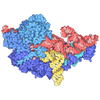
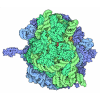
Journal: Nat Commun / Year: 2025 Title: Structural insights into cauliflower mitoribosome in translation state and in association with a late assembly factor. Authors: Vasileios Skaltsogiannis / Philippe Wolff / Tan-Trung Nguyen / Nicolas Corre / David Pflieger / Todd Blevins / Yaser Hashem / Philippe Giegé / Florent Waltz / Abstract: Ribosomes are key molecular machines that translate mRNA into proteins. Mitoribosomes are specific ribosomes found in mitochondria, which have been shown to be remarkably diverse across eukaryotic ...Ribosomes are key molecular machines that translate mRNA into proteins. Mitoribosomes are specific ribosomes found in mitochondria, which have been shown to be remarkably diverse across eukaryotic lineages. In plants, they possess unique features, including additional rRNA domains stabilized by plant-specific proteins. However, the structural specificities of plant mitoribosomes in translation state remained unknown. We used cryo-electron microscopy to provide a high-resolution structural characterization of the cauliflower mitoribosome, in translating and maturation states. The structure reveals the mitoribosome bound with a tRNA in the peptidyl site, along with a segment of mRNA and a nascent polypeptide. Moreover, using structural data, nanopore sequencing and mass spectrometry, we identify a set of 19 ribosomal RNA modifications. Additionally, we observe a late assembly intermediate of the small ribosomal subunit, in complex with the RsgA assembly factor. This reveals how a plant-specific extension of RsgA blocks the mRNA channel to prevent premature mRNA association before complete small subunit maturation. Our findings elucidate key aspects of translation in angiosperm plant mitochondria, revealing its distinct features compared to other eukaryotic lineages.
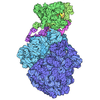
Macromolecule #9: Small ribosomal subunit protein uS10 domain-containing protein
Macromolecule
Name: Small ribosomal subunit protein uS10 domain-containing protein type: protein_or_peptide / ID: 9 / Details: GWHPBJSH050210 / Number of copies: 1 / Enantiomer: LEVO
Source (natural)
Organism: Brassica oleracea var. botrytis (cauliflower)
In the structure databanks used in Yorodumi, some data are registered as the other names, "COVID-19 virus" and "2019-nCoV". Here are the details of the virus and the list of structure data.
Jan 31, 2019. EMDB accession codes are about to change! (news from PDBe EMDB page)
EMDB accession codes are about to change! (news from PDBe EMDB page)
The allocation of 4 digits for EMDB accession codes will soon come to an end. Whilst these codes will remain in use, new EMDB accession codes will include an additional digit and will expand incrementally as the available range of codes is exhausted. The current 4-digit format prefixed with “EMD-” (i.e. EMD-XXXX) will advance to a 5-digit format (i.e. EMD-XXXXX), and so on. It is currently estimated that the 4-digit codes will be depleted around Spring 2019, at which point the 5-digit format will come into force.
The EM Navigator/Yorodumi systems omit the EMD- prefix.
Related info.:Q: What is EMD? / ID/Accession-code notation in Yorodumi/EM Navigator
Yorodumi is a browser for structure data from EMDB, PDB, SASBDB, etc.
This page is also the successor to EM Navigator detail page, and also detail information page/front-end page for Omokage search.
The word "yorodu" (or yorozu) is an old Japanese word meaning "ten thousand". "mi" (miru) is to see.
Related info.:EMDB / PDB / SASBDB / Comparison of 3 databanks / Yorodumi Search / Aug 31, 2016. New EM Navigator & Yorodumi / Yorodumi Papers / Jmol/JSmol / Function and homology information / Changes in new EM Navigator and Yorodumi
 Movie
Movie Controller

 Yorodumi
 Open data
 Basic information
 Map data
 Sample
 Keywords
 Function and homology information
 Brassica oleracea var. botrytis (cauliflower)
 Authors
 Germany,
  Switzerland, 2 items
  Citation
 Structure visualization
 Downloads & links
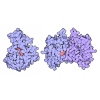
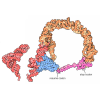
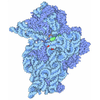
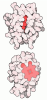
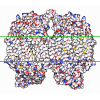
 emd_50014.png
 https://data.pdbj.org/pub/emdb/structures/EMD-50014


 Z (Sec.)
 Y (Row.)
 X (Col.)


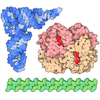
 Sample components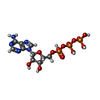
 Processing
 Electron microscopy
 FIELD EMISSION GUN

