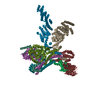
Movie
Movie Controller


+ Open data

- Basic information
| Entry |  | |||||||||
|---|---|---|---|---|---|---|---|---|---|---|
| Title | COP9 signalosome deneddylation complex with cullin-5 | |||||||||
 Map data Map data | ||||||||||
 Sample Sample |
| |||||||||
 Keywords Keywords | COP9 / COP9 signalosome / signalosome / NEDD8 / N8CUL5 / deneddylation / CSN5 / CUL5 / metalloprotease / SIGNALING PROTEIN | |||||||||
| Function / homology |  Function and homology information Function and homology informationnegative regulation of focal adhesion disassembly / COP9 signalosome assembly / macrophage migration inhibitory factor binding / regulation of IRE1-mediated unfolded protein response / exosomal secretion / GTPase inhibitor activity / deNEDDylase activity / ERBB2 signaling pathway / activation of NF-kappaB-inducing kinase activity / regulation of neuron migration ...negative regulation of focal adhesion disassembly / COP9 signalosome assembly / macrophage migration inhibitory factor binding / regulation of IRE1-mediated unfolded protein response / exosomal secretion / GTPase inhibitor activity / deNEDDylase activity / ERBB2 signaling pathway / activation of NF-kappaB-inducing kinase activity / regulation of neuron migration / protein deneddylation / regulation of protein neddylation / negative regulation of focal adhesion assembly / eukaryotic translation initiation factor 3 complex / reelin-mediated signaling pathway / cellular response to camptothecin / COP9 signalosome / cullin-RING-type E3 NEDD8 transferase / NEDD8 transferase activity / deubiquitinase activity / protein K11-linked ubiquitination / protein neddylation / Hydrolases; Acting on peptide bonds (peptidases) / NEDD8 ligase activity / regulation of JNK cascade / response to redox state / regulation of DNA damage response, signal transduction by p53 class mediator / RHOBTB1 GTPase cycle / Cul5-RING ubiquitin ligase complex / metal-dependent deubiquitinase activity / SCF ubiquitin ligase complex / SCF-dependent proteasomal ubiquitin-dependent protein catabolic process / intercellular bridge / TGF-beta receptor signaling activates SMADs / ubiquitin ligase complex scaffold activity / regulation of proteolysis / regulation of postsynapse assembly / response to light stimulus / JNK cascade / cullin family protein binding / anatomical structure morphogenesis / GSK3B-mediated proteasomal degradation of PD-L1(CD274) / endoplasmic reticulum unfolded protein response / site of DNA damage / translation initiation factor activity / intrinsic apoptotic signaling pathway / post-translational protein modification / protein modification process / G1/S transition of mitotic cell cycle / Iron uptake and transport / RING-type E3 ubiquitin transferase / Inactivation of CSF3 (G-CSF) signaling / Vif-mediated degradation of APOBEC3G / Evasion by RSV of host interferon responses / modification-dependent protein catabolic process / DNA Damage Recognition in GG-NER / Downregulation of ERBB2 signaling / calcium channel activity / neuron differentiation / Formation of TC-NER Pre-Incision Complex / metallopeptidase activity / protein tag activity / ubiquitin-protein transferase activity / transcription corepressor activity / ubiquitin protein ligase activity / UCH proteinases / transcription by RNA polymerase II / cell migration / Cargo recognition for clathrin-mediated endocytosis / synaptic vesicle / Antigen processing: Ubiquitination & Proteasome degradation / Neddylation / signaling receptor activity / ubiquitin-dependent protein catabolic process / proteasome-mediated ubiquitin-dependent protein catabolic process / protein phosphorylation / transcription coactivator activity / regulation of cell cycle / postsynapse / nuclear speck / positive regulation of cell migration / protein ubiquitination / translation / negative regulation of cell population proliferation / copper ion binding / ubiquitin protein ligase binding / negative regulation of apoptotic process / chromatin / perinuclear region of cytoplasm / glutamatergic synapse / negative regulation of transcription by RNA polymerase II / enzyme binding / signal transduction / positive regulation of transcription by RNA polymerase II / proteolysis / extracellular exosome / nucleoplasm / zinc ion binding / metal ion binding / nucleus Similarity search - Function | |||||||||
| Biological species |  Homo sapiens (human) Homo sapiens (human) | |||||||||
| Method | single particle reconstruction / cryo EM / Resolution: 3.52 Å | |||||||||
 Authors Authors | Shi H / Zheng N | |||||||||
| Funding support |  United States, 1 items United States, 1 items
| |||||||||
 Citation Citation | Journal: Nature / Year: 2026 Title: CSN5i-3 is an orthosteric molecular glue inhibitor of COP9 signalosome. Authors: Huigang Shi / Xiaorong Wang / Clinton Yu / Haibin Mao / Fenglong Jiao / Merav Braitbard / Ben Shor / Zhongsheng Zhang / Thomas R Hinds / Shiyun Cao / Erkang Fan / Dina Schneidman-Duhovny / ...Authors: Huigang Shi / Xiaorong Wang / Clinton Yu / Haibin Mao / Fenglong Jiao / Merav Braitbard / Ben Shor / Zhongsheng Zhang / Thomas R Hinds / Shiyun Cao / Erkang Fan / Dina Schneidman-Duhovny / Lan Huang / Ning Zheng /  Abstract: Orthosteric inhibitors block enzyme active sites and prevent substrates from binding. Enhancing their specificity through substrate dependence seems inherently unlikely, as their mechanism hinges on ...Orthosteric inhibitors block enzyme active sites and prevent substrates from binding. Enhancing their specificity through substrate dependence seems inherently unlikely, as their mechanism hinges on direct competition rather than selective recognition. Here we show that a molecular glue mechanism unexpectedly imparts substrate-dependent potency to CSN5i-3, an orthosteric inhibitor of the COP9 signalosome (CSN). We first confirm that CSN5i-3 inhibits CSN, which catalyses NEDD8 (N8) deconjugation from the cullin-RING ubiquitin ligases, by occupying the active site of its catalytic subunit, CSN5, and directly competing with the iso-peptide bond substrate. Notably, the orthosteric inhibitor binds free CSN with only micromolar affinity, yet achieves nanomolar potency in blocking its deneddylase activity. Cryogenic electron microscopy structures of the enzyme-substrate-inhibitor complex reveal that active site-engaged CSN5i-3 occludes the substrate iso-peptide linkage while simultaneously extending an N8-binding exosite of CSN5, acting as a molecular glue to cement the N8-CSN5 interaction. The cooperativity of this trimolecular CSN5i-3-N8-CSN5 assembly, in turn, sequesters CSN5i-3 at its binding site, conferring high potency to the orthosteric inhibitor despite its low affinity for the free enzyme. Together, our findings highlight the modest affinity requirements of molecule glues for individual target proteins and establish orthosteric molecular glue inhibitors as a new class of substrate-dependent enzyme antagonists. | |||||||||
| History |
|
- Structure visualization
| Supplemental images |
|---|

- Downloads & links
-EMDB archive
| Map data | emd_47983.map.gz | 228.2 MB | EMDB map data format | |
|---|---|---|---|---|
| Header (meta data) | emd-47983-v30.xmlemd-47983.xml | 32.8 KB 32.8 KB | Display Display | EMDB header |
| Images |  emd_47983.png emd_47983.png | 63.1 KB | ||
| Filedesc metadata | emd-47983.cif.gz | 9.5 KB | ||
| Archive directory |  http://ftp.pdbj.org/pub/emdb/structures/EMD-47983ftp://ftp.pdbj.org/pub/emdb/structures/EMD-47983 http://ftp.pdbj.org/pub/emdb/structures/EMD-47983ftp://ftp.pdbj.org/pub/emdb/structures/EMD-47983 | HTTPS FTP |
-Related structure data
| Related structure data |  9eg1MC  9e5zC  9e77C  9e81C  9efmC  9efqC  9efvC  9eg8C  9eglC  9ph4C C: citing same article ( M: atomic model generated by this map |
|---|---|
| Similar structure data |


-Links
| EMDB pages | EMDB (EBI/PDBe) / EMDataResource |
|---|---|
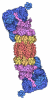
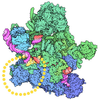
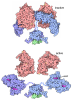
| Related items in Molecule of the Month |

-Map
| File | Download / File: emd_47983.map.gz / Format: CCP4 / Size: 244.1 MB / Type: IMAGE STORED AS FLOATING POINT NUMBER (4 BYTES) | ||||||||||||||||||||||||||||||||||||
|---|---|---|---|---|---|---|---|---|---|---|---|---|---|---|---|---|---|---|---|---|---|---|---|---|---|---|---|---|---|---|---|---|---|---|---|---|---|
| Projections & slices | Image control
Images are generated by Spider. | ||||||||||||||||||||||||||||||||||||
| Voxel size | X=Y=Z: 0.835 Å | ||||||||||||||||||||||||||||||||||||
| Density |
| ||||||||||||||||||||||||||||||||||||
| Symmetry | Space group: 1 | ||||||||||||||||||||||||||||||||||||
| Details | EMDB XML:
|
 Z (Sec.)
 Y (Row.)
 X (Col.)


-Supplemental data
- Sample components
+Entire : The complex of human COP9 signalosome with NEDD8 and CSN5i-3
+Supramolecule #1: The complex of human COP9 signalosome with NEDD8 and CSN5i-3
+Macromolecule #1: COP9 signalosome complex subunit 2

 Escherichia coli (E. coli)
+Macromolecule #2: COP9 signalosome complex subunit 4
+Macromolecule #3: COP9 signalosome complex subunit 5

 Spodoptera frugiperda (fall armyworm)
+Macromolecule #4: COP9 signalosome complex subunit 6
+Macromolecule #5: COP9 signalosome complex subunit 7b
+Macromolecule #6: COP9 signalosome complex subunit 8
+Macromolecule #7: Cullin-5
+Macromolecule #8: RING-box protein 2
+Macromolecule #9: COP9 signalosome complex subunit 1
+Macromolecule #10: COP9 signalosome complex subunit 3
+Macromolecule #11: NEDD8
+Macromolecule #12: ZINC ION
-Experimental details
-Structure determination
| Method | cryo EM |
|---|---|
 Processing Processing | single particle reconstruction |
| Aggregation state | particle |
-Sample preparation
| Buffer | pH: 7.5 |
|---|---|
| Grid | Model: UltrAuFoil R1.2/1.3 / Material: GOLD / Mesh: 300 / Pretreatment - Type: GLOW DISCHARGE |
| Vitrification | Cryogen name: ETHANE / Chamber humidity: 100 % / Instrument: FEI VITROBOT MARK IV |
- Electron microscopy
| Microscope | TFS KRIOS |
|---|---|
| Image recording | Film or detector model: GATAN K3 BIOQUANTUM (6k x 4k) / Average electron dose: 60.0 e/Å2 |
| Electron beam | Acceleration voltage: 300 kV / Electron source:  FIELD EMISSION GUN FIELD EMISSION GUN |
| Electron optics | Illumination mode: FLOOD BEAM / Imaging mode: BRIGHT FIELD / Nominal defocus max: 3.0 µm / Nominal defocus min: 0.8 µm |
| Sample stage | Specimen holder model: FEI TITAN KRIOS AUTOGRID HOLDER / Cooling holder cryogen: NITROGEN |
| Experimental equipment |  Model: Titan Krios / Image courtesy: FEI Company |