Membrane Protein / Ion Channel / Ligand-gate Ion Channel / P2X Receptor / Allosteric Antagonist / High-Affinity Agonist
Function / homology
Function and homology information
Platelet homeostasis / The NLRP3 inflammasome / NAD transport / positive regulation of lymphocyte apoptotic process / phospholipid transfer to membrane / regulation of presynaptic dense core granule exocytosis / positive regulation of bleb assembly / phagolysosome assembly / Elevation of cytosolic Ca2+ levels / positive regulation of cytoskeleton organization ...Platelet homeostasis / The NLRP3 inflammasome / NAD transport / positive regulation of lymphocyte apoptotic process / phospholipid transfer to membrane / regulation of presynaptic dense core granule exocytosis / positive regulation of bleb assembly / phagolysosome assembly / Elevation of cytosolic Ca2+ levels / positive regulation of cytoskeleton organization / positive regulation of interleukin-1 alpha production / positive regulation of monoatomic ion transmembrane transport / plasma membrane phospholipid scrambling / plasma membrane organization / purinergic nucleotide receptor signaling pathway / collagen metabolic process / positive regulation of prostaglandin secretion / bleb assembly / extracellularly ATP-gated monoatomic cation channel activity / ATP export / purinergic nucleotide receptor activity / positive regulation of catalytic activity / pore complex assembly / negative regulation of cell volume / positive regulation of gamma-aminobutyric acid secretion / vesicle budding from membrane / programmed cell death / response to fluid shear stress / bleb / ceramide biosynthetic process / skeletal system morphogenesis / T cell proliferation / negative regulation of bone resorption / positive regulation of mitochondrial depolarization / cell volume homeostasis / homeostasis of number of cells within a tissue / T cell homeostasis / positive regulation of ossification / cellular response to dsRNA / phospholipid translocation / response to zinc ion / response to ATP / positive regulation of bone mineralization / positive regulation of glutamate secretion / sodium channel activity / protein homotrimerization / positive regulation of MAP kinase activity / regulation of sodium ion transport / membrane protein ectodomain proteolysis / synaptic vesicle exocytosis / positive regulation of calcium ion transport into cytosol / neuronal action potential / response to electrical stimulus / reactive oxygen species metabolic process / positive regulation of NLRP3 inflammasome complex assembly / membrane depolarization / potassium channel activity / response to mechanical stimulus / response to bacterium / extrinsic apoptotic signaling pathway / monoatomic cation transport / cell morphogenesis / negative regulation of MAPK cascade / release of sequestered calcium ion into cytosol / sensory perception of pain / apoptotic signaling pathway / positive regulation of glycolytic process / protein serine/threonine kinase activator activity / gene expression / positive regulation of T cell mediated cytotoxicity / positive regulation of protein secretion / positive regulation of interleukin-1 beta production / positive regulation of cytokine production / mitochondrion organization / neuromuscular junction / lipopolysaccharide binding / protein processing / protein catabolic process / response to calcium ion / positive regulation of interleukin-6 production / positive regulation of protein phosphorylation / calcium ion transmembrane transport / calcium ion transport / terminal bouton / cell-cell junction / nuclear envelope / signaling receptor activity / response to lipopolysaccharide / channel activity / scaffold protein binding / protein phosphorylation / positive regulation of MAPK cascade / inflammatory response / cell surface receptor signaling pathway / postsynapse / defense response to Gram-positive bacterium / response to xenobiotic stimulus / positive regulation of apoptotic process / copper ion binding / external side of plasma membrane Similarity search - Function
National Institutes of Health/National Heart, Lung, and Blood Institute (NIH/NHLBI)
R00HL138129
United States
National Institutes of Health/National Institute of General Medical Sciences (NIH/NIGMS)
DP2GM149551
United States
Citation
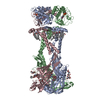
Journal: Sci Adv / Year: 2024 Title: P2X receptors exhibit at least three modes of allosteric antagonism. Authors: Adam C Oken / Ismayn A Ditter / Nicolas E Lisi / Ipsita Krishnamurthy / Michael H Godsey / Steven E Mansoor / Abstract: P2X receptors are trimeric ion channels activated by adenosine triphosphate (ATP) that contribute to pathophysiological processes ranging from asthma to neuropathic pain and neurodegeneration. A ...P2X receptors are trimeric ion channels activated by adenosine triphosphate (ATP) that contribute to pathophysiological processes ranging from asthma to neuropathic pain and neurodegeneration. A number of small-molecule antagonists have been identified for these important pharmaceutical targets. However, the molecular pharmacology of P2X receptors is poorly understood because of the chemically disparate nature of antagonists and their differential actions on the seven constituent subtypes. Here, we report high-resolution cryo-electron microscopy structures of the homomeric rat P2X receptor bound to five previously known small-molecule allosteric antagonists and a sixth antagonist that we identify. Our structural, biophysical, and electrophysiological data define the molecular determinants of allosteric antagonism in this pharmacologically relevant receptor, revealing three distinct classes of antagonists that we call shallow, deep, and starfish. Starfish binders, exemplified by the previously unidentified antagonist methyl blue, represent a unique class of inhibitors with distinct functional properties that could be exploited to develop potent P2X ligands with substantial clinical impact.
In the structure databanks used in Yorodumi, some data are registered as the other names, "COVID-19 virus" and "2019-nCoV". Here are the details of the virus and the list of structure data.
Jan 31, 2019. EMDB accession codes are about to change! (news from PDBe EMDB page)
EMDB accession codes are about to change! (news from PDBe EMDB page)
The allocation of 4 digits for EMDB accession codes will soon come to an end. Whilst these codes will remain in use, new EMDB accession codes will include an additional digit and will expand incrementally as the available range of codes is exhausted. The current 4-digit format prefixed with “EMD-” (i.e. EMD-XXXX) will advance to a 5-digit format (i.e. EMD-XXXXX), and so on. It is currently estimated that the 4-digit codes will be depleted around Spring 2019, at which point the 5-digit format will come into force.
The EM Navigator/Yorodumi systems omit the EMD- prefix.
Related info.:Q: What is EMD? / ID/Accession-code notation in Yorodumi/EM Navigator
Yorodumi is a browser for structure data from EMDB, PDB, SASBDB, etc.
This page is also the successor to EM Navigator detail page, and also detail information page/front-end page for Omokage search.
The word "yorodu" (or yorozu) is an old Japanese word meaning "ten thousand". "mi" (miru) is to see.
Related info.:EMDB / PDB / SASBDB / Comparison of 3 databanks / Yorodumi Search / Aug 31, 2016. New EM Navigator & Yorodumi / Yorodumi Papers / Jmol/JSmol / Function and homology information / Changes in new EM Navigator and Yorodumi
 Movie
Movie Controller

 Yorodumi
 Open data
 Basic information
 Map data
 Sample
 Keywords
 Function and homology information
 Rattus (rats)
 Authors
 United States, 2 items
  Citation
 Structure visualization
 Downloads & links
 emd_41576.png
 https://data.pdbj.org/pub/emdb/structures/EMD-41576




 Z (Sec.)
 Y (Row.)
 X (Col.)


 Sample components
 Homo sapiens (human)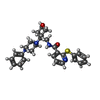
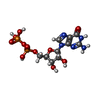

 Processing
 Electron microscopy
 FIELD EMISSION GUN


