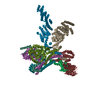
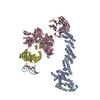
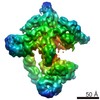
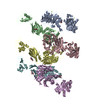
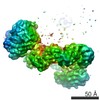
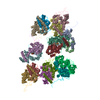
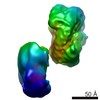
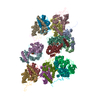
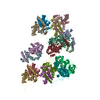
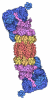
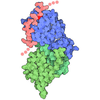
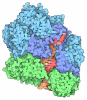
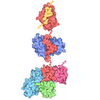
- EMDB-3314: Rigid part of the CSN-N8-CRL4A cryo-EM structure at 6.4 A resolution -
+
データを開く
IDまたはキーワード:
読み込み中...
-
基本情報
登録情報
データベース: EMDB / ID: EMD-3314
タイトル
Rigid part of the CSN-N8-CRL4A cryo-EM structure at 6.4 A resolution
マップデータ
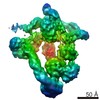
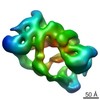
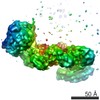
Cryo-EM structure of CSN-N8-CRL4A at 6.4 A resolution
試料
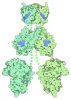
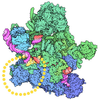
試料: Recombinant human CSN-N8-CRL4A complex
タンパク質・ペプチド: x 12種
キーワード
COP9 Signalosome / Cullin-RING ligases / Cryo-EM
機能・相同性
機能・相同性情報
Prolactin receptor signaling / Recognition of DNA damage by PCNA-containing replication complex / Formation of TC-NER Pre-Incision Complex / DNA Damage Recognition in GG-NER / Dual Incision in GG-NER / Dual incision in TC-NER / Regulation of BACH1 activity / Gap-filling DNA repair synthesis and ligation in TC-NER / Formation of Incision Complex in GG-NER / Regulation of RAS by GAPs ...Prolactin receptor signaling / Recognition of DNA damage by PCNA-containing replication complex / Formation of TC-NER Pre-Incision Complex / DNA Damage Recognition in GG-NER / Dual Incision in GG-NER / Dual incision in TC-NER / Regulation of BACH1 activity / Gap-filling DNA repair synthesis and ligation in TC-NER / Formation of Incision Complex in GG-NER / Regulation of RAS by GAPs / COP9 signalosome assembly / Degradation of DVL / Ubiquitin-Mediated Degradation of Phosphorylated Cdc25A / Regulation of RUNX2 expression and activity / Degradation of GLI1 by the proteasome / FBXL7 down-regulates AURKA during mitotic entry and in early mitosis / trophectodermal cell proliferation / Hedgehog 'on' state / Orc1 removal from chromatin / GSK3B and BTRC:CUL1-mediated-degradation of NFE2L2 / macrophage migration inhibitory factor binding / Oxygen-dependent proline hydroxylation of Hypoxia-inducible Factor Alpha / miRNA-mediated gene silencing by mRNA destabilization / Degradation of beta-catenin by the destruction complex / eukaryotic initiation factor 4E binding / regulation of IRE1-mediated unfolded protein response / negative regulation of granulocyte differentiation / base-excision repair, AP site formation via deaminated base removal / exosomal secretion / Interleukin-1 signaling / GTPase inhibitor activity / deNEDDylase activity / anaphase-promoting complex / GLI3 is processed to GLI3R by the proteasome / protein deneddylation / regulation of protein neddylation / activation of NF-kappaB-inducing kinase activity / eukaryotic translation initiation factor 3 complex / Neddylation / cullin-RING-type E3 NEDD8 transferase / COP9 signalosome / cellular response to camptothecin / KEAP1-NFE2L2 pathway / cullin-RING ubiquitin ligase complex / Cul7-RING ubiquitin ligase complex / regulation of DNA damage checkpoint / positive regulation of protein autoubiquitination / regulation of nucleotide-excision repair / Antigen processing: Ubiquitination & Proteasome degradation / positive regulation by virus of viral protein levels in host cell / RNA polymerase II transcription initiation surveillance / protein neddylation / spindle assembly involved in female meiosis / positive regulation of epithelial cell apoptotic process / NEDD8 ligase activity / epigenetic programming in the zygotic pronuclei / 加水分解酵素; プロテアーゼ; ペプチド結合加水分解酵素 / metal-dependent deubiquitinase activity / negative regulation of response to oxidative stress / RHOBTB1 GTPase cycle / regulation of JNK cascade / regulation of DNA damage response, signal transduction by p53 class mediator / VCB complex / UV-damage excision repair / Cul5-RING ubiquitin ligase complex / inner cell mass cell proliferation / ubiquitin-ubiquitin ligase activity / ubiquitin-dependent protein catabolic process via the C-end degron rule pathway / SCF ubiquitin ligase complex / biological process involved in interaction with symbiont / Cul2-RING ubiquitin ligase complex / lysosome organization / regulation of mitotic cell cycle phase transition / type I interferon-mediated signaling pathway / Cul3-RING ubiquitin ligase complex / negative regulation of type I interferon production / WD40-repeat domain binding / SCF-dependent proteasomal ubiquitin-dependent protein catabolic process / Cul4A-RING E3 ubiquitin ligase complex / Cul4-RING E3 ubiquitin ligase complex / p38MAPK cascade / Cul4B-RING E3 ubiquitin ligase complex / ubiquitin ligase complex scaffold activity / negative regulation of reproductive process / negative regulation of developmental process / TGF-beta receptor signaling activates SMADs / negative regulation of signal transduction by p53 class mediator / hemopoiesis / TORC1 signaling / regulation of proteolysis / viral release from host cell / somatic stem cell population maintenance / : / skeletal muscle cell differentiation / epithelial to mesenchymal transition / regulation of postsynapse assembly / response to light stimulus / cullin family protein binding / anatomical structure morphogenesis / protein monoubiquitination 類似検索 - 分子機能
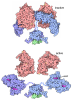
ジャーナル: Nature / 年: 2016 タイトル: Cullin-RING ubiquitin E3 ligase regulation by the COP9 signalosome. 著者: Simone Cavadini / Eric S Fischer / Richard D Bunker / Alessandro Potenza / Gondichatnahalli M Lingaraju / Kenneth N Goldie / Weaam I Mohamed / Mahamadou Faty / Georg Petzold / Rohan E J ...著者: Simone Cavadini / Eric S Fischer / Richard D Bunker / Alessandro Potenza / Gondichatnahalli M Lingaraju / Kenneth N Goldie / Weaam I Mohamed / Mahamadou Faty / Georg Petzold / Rohan E J Beckwith / Ritesh B Tichkule / Ulrich Hassiepen / Wassim Abdulrahman / Radosav S Pantelic / Syota Matsumoto / Kaoru Sugasawa / Henning Stahlberg / Nicolas H Thomä / 要旨: The cullin-RING ubiquitin E3 ligase (CRL) family comprises over 200 members in humans. The COP9 signalosome complex (CSN) regulates CRLs by removing their ubiquitin-like activator NEDD8. The CUL4A- ...The cullin-RING ubiquitin E3 ligase (CRL) family comprises over 200 members in humans. The COP9 signalosome complex (CSN) regulates CRLs by removing their ubiquitin-like activator NEDD8. The CUL4A-RBX1-DDB1-DDB2 complex (CRL4A(DDB2)) monitors the genome for ultraviolet-light-induced DNA damage. CRL4A(DBB2) is inactive in the absence of damaged DNA and requires CSN to regulate the repair process. The structural basis of CSN binding to CRL4A(DDB2) and the principles of CSN activation are poorly understood. Here we present cryo-electron microscopy structures for CSN in complex with neddylated CRL4A ligases to 6.4 Å resolution. The CSN conformers defined by cryo-electron microscopy and a novel apo-CSN crystal structure indicate an induced-fit mechanism that drives CSN activation by neddylated CRLs. We find that CSN and a substrate cannot bind simultaneously to CRL4A, favouring a deneddylated, inactive state for substrate-free CRL4 complexes. These architectural and regulatory principles appear conserved across CRL families, allowing global regulation by CSN.
 ムービー
ムービー コントローラー


 データを開く
 基本情報
基本情報 マップデータ
 試料
試料 キーワード
キーワード 機能・相同性情報
 Homo sapiens (ヒト)
 データ登録者
 引用
引用


 構造の表示
構造の表示
 ダウンロードとリンク
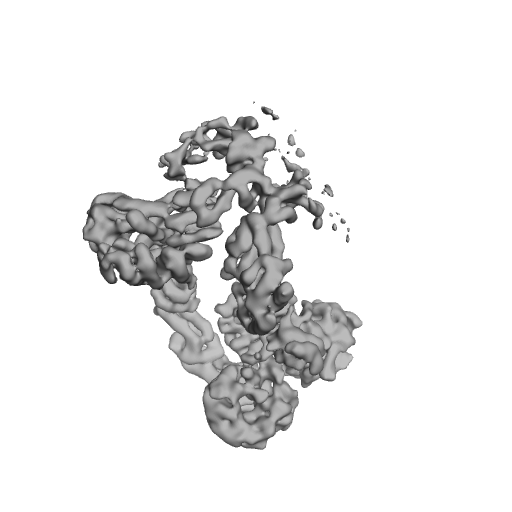 emd_3314.png
 http://ftp.pdbj.org/pub/emdb/structures/EMD-3314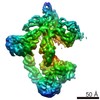



 Z (Sec.)
 Y (Row.)
 X (Col.)


 試料の構成要素
 Trichoplusia ni (イラクサキンウワバ)
 Escherichia coli (大腸菌)
 解析
解析 電子顕微鏡法
 FIELD EMISSION GUN