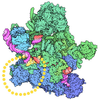
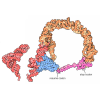
Eukaryotic translation initiation factor 3 subunit F / Eukaryotic translation initiation factor 3 subunit D / Eukaryotic translation initiation factor 3 subunit H / Eukaryotic translation initiation factor 5B / Eukaryotic translation initiation factor 3 subunit G / Eukaryotic translation initiation factor 2 subunit 1 / Small ribosomal subunit protein eS17 / Small ribosomal subunit protein uS2 / Small ribosomal subunit protein uS5 / Small ribosomal subunit protein uS3 ...Eukaryotic translation initiation factor 3 subunit F / Eukaryotic translation initiation factor 3 subunit D / Eukaryotic translation initiation factor 3 subunit H / Eukaryotic translation initiation factor 5B / Eukaryotic translation initiation factor 3 subunit G / Eukaryotic translation initiation factor 2 subunit 1 / Small ribosomal subunit protein eS17 / Small ribosomal subunit protein uS2 / Small ribosomal subunit protein uS5 / Small ribosomal subunit protein uS3 / Small ribosomal subunit protein eS12 / Small ribosomal subunit protein eS19 / Eukaryotic translation initiation factor 2 subunit 3 / Small ribosomal subunit protein eS27 / Small ribosomal subunit protein uS4 / Small ribosomal subunit protein uS7 / Small ribosomal subunit protein eS10 / Eukaryotic translation initiation factor 1A, X-chromosomal / Eukaryotic translation initiation factor 5 / Eukaryotic translation initiation factor 3 subunit B / Eukaryotic translation initiation factor 3 subunit E / Small ribosomal subunit protein uS10 / Small ribosomal subunit protein eS1 / Small ribosomal subunit protein eS7 / Small ribosomal subunit protein eS8 / Small ribosomal subunit protein uS8 / Small ribosomal subunit protein uS9 / Small ribosomal subunit protein uS11 / Small ribosomal subunit protein uS12 / Small ribosomal subunit protein uS13 / Small ribosomal subunit protein uS14 / Small ribosomal subunit protein uS15 / Small ribosomal subunit protein uS17 / Small ribosomal subunit protein eS4, X isoform / Small ribosomal subunit protein eS6 / Small ribosomal subunit protein uS19 / Small ribosomal subunit protein eS24 / Small ribosomal subunit protein eS25 / Small ribosomal subunit protein eS26 / Small ribosomal subunit protein eS28 / Ubiquitin-like FUBI-ribosomal protein eS30 fusion protein / Small ribosomal subunit protein eS32 / Ubiquitin-ribosomal protein eS31 fusion protein / Small ribosomal subunit protein eS21 / Small ribosomal subunit protein RACK1 / Eukaryotic translation initiation factor 3 subunit I / Eukaryotic translation initiation factor 3 subunit A / Eukaryotic translation initiation factor 3 subunit M / Eukaryotic translation initiation factor 3 subunit C / Eukaryotic translation initiation factor 3 subunit K / Eukaryotic translation initiation factor 3 subunit L Similarity search - Component
Biological species
Homo sapiens (human)
Method
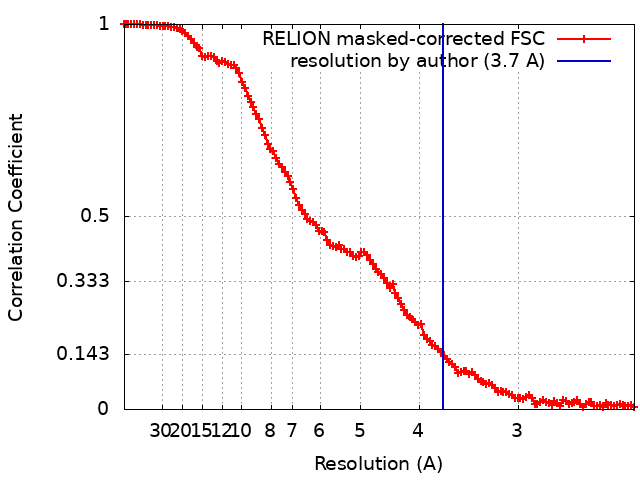
single particle reconstruction / cryo EM / Resolution: 3.7 Å
Journal: Protein Sci / Year: 2018 Title: UCSF ChimeraX: Meeting modern challenges in visualization and analysis. Authors: Thomas D Goddard / Conrad C Huang / Elaine C Meng / Eric F Pettersen / Gregory S Couch / John H Morris / Thomas E Ferrin / Abstract: UCSF ChimeraX is next-generation software for the visualization and analysis of molecular structures, density maps, 3D microscopy, and associated data. It addresses challenges in the size, scope, and ...UCSF ChimeraX is next-generation software for the visualization and analysis of molecular structures, density maps, 3D microscopy, and associated data. It addresses challenges in the size, scope, and disparate types of data attendant with cutting-edge experimental methods, while providing advanced options for high-quality rendering (interactive ambient occlusion, reliable molecular surface calculations, etc.) and professional approaches to software design and distribution. This article highlights some specific advances in the areas of visualization and usability, performance, and extensibility. ChimeraX is free for noncommercial use and is available from http://www.rbvi.ucsf.edu/chimerax/ for Windows, Mac, and Linux.
Spherical aberration corrector: Electron-optical aberrations were corrected using a CETCOR Cs-corrector (CEOS, Heidelberg) aligned with the CETCORPLUS 4.6.9 software package (CEOS, Heidelberg).
Image recording
Film or detector model: FEI FALCON III (4k x 4k) / Average exposure time: 1.5 sec. / Average electron dose: 45.0 e/Å2
Electron beam
Acceleration voltage: 300 kV / Electron source: FIELD EMISSION GUN
In the structure databanks used in Yorodumi, some data are registered as the other names, "COVID-19 virus" and "2019-nCoV". Here are the details of the virus and the list of structure data.
Jan 31, 2019. EMDB accession codes are about to change! (news from PDBe EMDB page)
EMDB accession codes are about to change! (news from PDBe EMDB page)
The allocation of 4 digits for EMDB accession codes will soon come to an end. Whilst these codes will remain in use, new EMDB accession codes will include an additional digit and will expand incrementally as the available range of codes is exhausted. The current 4-digit format prefixed with “EMD-” (i.e. EMD-XXXX) will advance to a 5-digit format (i.e. EMD-XXXXX), and so on. It is currently estimated that the 4-digit codes will be depleted around Spring 2019, at which point the 5-digit format will come into force.
The EM Navigator/Yorodumi systems omit the EMD- prefix.
Related info.:Q: What is EMD? / ID/Accession-code notation in Yorodumi/EM Navigator
Yorodumi is a browser for structure data from EMDB, PDB, SASBDB, etc.
This page is also the successor to EM Navigator detail page, and also detail information page/front-end page for Omokage search.
The word "yorodu" (or yorozu) is an old Japanese word meaning "ten thousand". "mi" (miru) is to see.
Related info.:EMDB / PDB / SASBDB / Comparison of 3 databanks / Yorodumi Search / Aug 31, 2016. New EM Navigator & Yorodumi / Yorodumi Papers / Jmol/JSmol / Function and homology information / Changes in new EM Navigator and Yorodumi
 Movie
Movie Controller

 Yorodumi
 Open data
 Basic information
 Map data
 Sample
 Keywords
 Function and homology information
 Homo sapiens (human)
 Authors
 Germany, 2 items
  Citation
 Structure visualization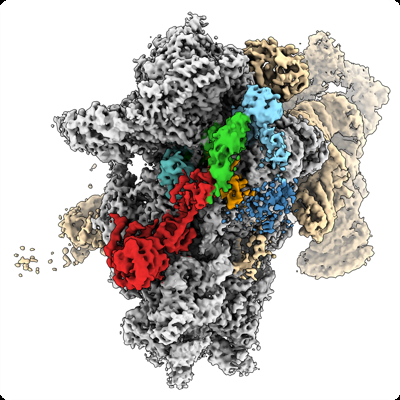
 Downloads & links
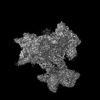
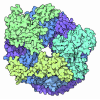
 emd_17698.png
 https://data.pdbj.org/pub/emdb/structures/EMD-17698





 X (Sec.)
 Y (Row.)
 Z (Col.)


 Sample components
 Escherichia coli (E. coli)
 Processing
 Electron microscopy
 FIELD EMISSION GUN