ADA complex / DUBm complex / RITS complex assembly / SAGA-type complex / pseudohyphal growth / invasive growth in response to glucose limitation / TFIIA-class transcription factor complex binding / RNA polymerase III transcription regulatory region sequence-specific DNA binding / RNA polymerase III preinitiation complex assembly / transcription factor TFIIIB complex ...ADA complex / DUBm complex / RITS complex assembly / SAGA-type complex / pseudohyphal growth / invasive growth in response to glucose limitation / TFIIA-class transcription factor complex binding / RNA polymerase III transcription regulatory region sequence-specific DNA binding / RNA polymerase III preinitiation complex assembly / transcription factor TFIIIB complex / transcription export complex 2 / regulatory ncRNA-mediated heterochromatin formation / nuclear mRNA surveillance / regulation of transcription by RNA polymerase III / post-transcriptional tethering of RNA polymerase II gene DNA at nuclear periphery / SLIK (SAGA-like) complex / RNA polymerase I general transcription initiation factor binding / transcription factor TFIIA complex / RNA polymerase I preinitiation complex assembly / hypothalamus gonadotrophin-releasing hormone neuron development / female meiosis I / SAGA complex / positive regulation of protein monoubiquitination / positive regulation of DNA-templated transcription initiation / DNA binding, bending / fat pad development / mitochondrion transport along microtubule / RNA Polymerase III Transcription Initiation From Type 2 Promoter / RNA polymerase II transcribes snRNA genes / RNA Polymerase II Promoter Escape / RNA Polymerase II Transcription Pre-Initiation And Promoter Opening / RNA Polymerase II Transcription Initiation / RNA Polymerase II Transcription Initiation And Promoter Clearance / poly(A)+ mRNA export from nucleus / RNA Polymerase II Pre-transcription Events / transcription factor TFIID complex / RNA polymerase II general transcription initiation factor activity / seminiferous tubule development / histone acetyltransferase activity / RNA Polymerase I Promoter Escape / female gonad development / NuA4 histone acetyltransferase complex / nucleolar large rRNA transcription by RNA polymerase I / Estrogen-dependent gene expression / male meiosis I / protein deubiquitination / positive regulation of intrinsic apoptotic signaling pathway by p53 class mediator / nuclear pore / RNA polymerase II core promoter sequence-specific DNA binding / RNA polymerase II preinitiation complex assembly / neuron projection morphogenesis / energy homeostasis / regulation of proteasomal protein catabolic process / Maturation of protein E / Maturation of protein E / ER Quality Control Compartment (ERQC) / Myoclonic epilepsy of Lafora / FLT3 signaling by CBL mutants / IRAK2 mediated activation of TAK1 complex / Prevention of phagosomal-lysosomal fusion / Alpha-protein kinase 1 signaling pathway / Glycogen synthesis / IRAK1 recruits IKK complex / IRAK1 recruits IKK complex upon TLR7/8 or 9 stimulation / Endosomal Sorting Complex Required For Transport (ESCRT) / Membrane binding and targetting of GAG proteins / Negative regulation of FLT3 / Regulation of TBK1, IKKε (IKBKE)-mediated activation of IRF3, IRF7 / PTK6 Regulates RTKs and Their Effectors AKT1 and DOK1 / Regulation of TBK1, IKKε-mediated activation of IRF3, IRF7 upon TLR3 ligation / IRAK2 mediated activation of TAK1 complex upon TLR7/8 or 9 stimulation / Constitutive Signaling by NOTCH1 HD Domain Mutants / NOTCH2 Activation and Transmission of Signal to the Nucleus / TICAM1,TRAF6-dependent induction of TAK1 complex / TICAM1-dependent activation of IRF3/IRF7 / APC/C:Cdc20 mediated degradation of Cyclin B / Regulation of FZD by ubiquitination / Downregulation of ERBB4 signaling / TBP-class protein binding / APC-Cdc20 mediated degradation of Nek2A / p75NTR recruits signalling complexes / InlA-mediated entry of Listeria monocytogenes into host cells / TRAF6 mediated IRF7 activation in TLR7/8 or 9 signaling / regulation of neuron apoptotic process / NF-kB is activated and signals survival / TRAF6-mediated induction of TAK1 complex within TLR4 complex / Regulation of pyruvate metabolism / Pexophagy / Regulation of innate immune responses to cytosolic DNA / NRIF signals cell death from the nucleus / Downregulation of ERBB2:ERBB3 signaling / Regulation of PTEN localization / VLDLR internalisation and degradation / Activated NOTCH1 Transmits Signal to the Nucleus / Synthesis of active ubiquitin: roles of E1 and E2 enzymes / positive regulation of protein ubiquitination / Translesion synthesis by REV1 / Regulation of BACH1 activity / TICAM1, RIP1-mediated IKK complex recruitment / Translesion synthesis by POLK 類似検索 - 分子機能
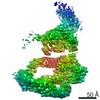
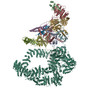
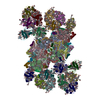
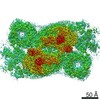
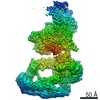
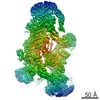
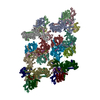
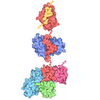
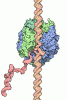
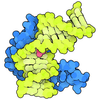
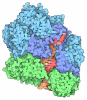
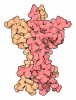
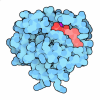
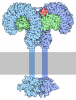
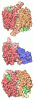
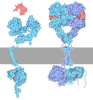
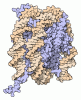
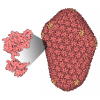
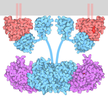
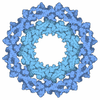
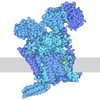
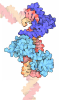
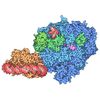
ジャーナル: Nature / 年: 2020 タイトル: Structure of SAGA and mechanism of TBP deposition on gene promoters. 著者: Gabor Papai / Alexandre Frechard / Olga Kolesnikova / Corinne Crucifix / Patrick Schultz / Adam Ben-Shem / 要旨: SAGA (Spt-Ada-Gcn5-acetyltransferase) is a 19-subunit complex that stimulates transcription via two chromatin-modifying enzymatic modules and by delivering the TATA box binding protein (TBP) to ...SAGA (Spt-Ada-Gcn5-acetyltransferase) is a 19-subunit complex that stimulates transcription via two chromatin-modifying enzymatic modules and by delivering the TATA box binding protein (TBP) to nucleate the pre-initiation complex on DNA, a pivotal event in the expression of protein-encoding genes. Here we present the structure of yeast SAGA with bound TBP. The core of the complex is resolved at 3.5 Å resolution (0.143 Fourier shell correlation). The structure reveals the intricate network of interactions that coordinate the different functional domains of SAGA and resolves an octamer of histone-fold domains at the core of SAGA. This deformed octamer deviates considerably from the symmetrical analogue in the nucleosome and is precisely tuned to establish a peripheral site for TBP, where steric hindrance represses binding of spurious DNA. Complementary biochemical analysis points to a mechanism for TBP delivery and release from SAGA that requires transcription factor IIA and whose efficiency correlates with the affinity of DNA to TBP. We provide the foundations for understanding the specific delivery of TBP to gene promoters and the multiple roles of SAGA in regulating gene expression.
 ムービー
ムービー コントローラー


 データを開く
 基本情報
基本情報 マップデータ
 試料
試料 キーワード
キーワード 機能・相同性情報
 Komagataella phaffii GS115 (菌類) /
  Homo sapiens (ヒト) /
  データ登録者
 フランス, 3件
  引用
引用 構造の表示
構造の表示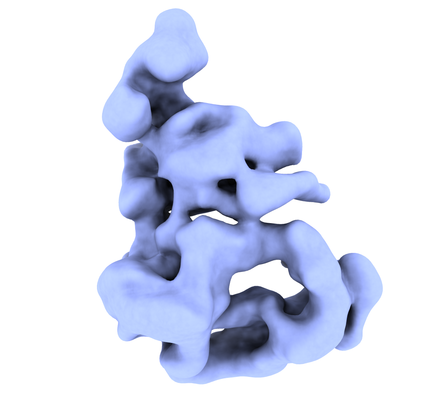
 ダウンロードとリンク
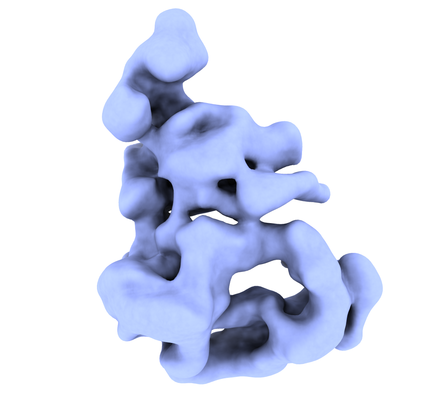 emd_10446.png
 http://ftp.pdbj.org/pub/emdb/structures/EMD-10446







 Z (Sec.)
 Y (Row.)
 X (Col.)




 試料の構成要素
 Escherichia coli (大腸菌)
 解析
解析 電子顕微鏡法
 FIELD EMISSION GUN

