 Movie
Movie Controller

[English] 日本語
 Yorodumi
- PDB-9z3q: Cryo-EM structure of KSHV glycoprotein gHgL in complex with MLKH3... -
+ Open data

- Basic information
| Entry | Database: PDB / ID: 9z3q | ||||||||||||||||||||||||
|---|---|---|---|---|---|---|---|---|---|---|---|---|---|---|---|---|---|---|---|---|---|---|---|---|---|
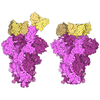
| Title | Cryo-EM structure of KSHV glycoprotein gHgL in complex with MLKH3 and MLKH10 FABs | ||||||||||||||||||||||||
 Components Components |
| ||||||||||||||||||||||||
 Keywords Keywords | IMMUNE SYSTEM / KSHV / glycoprotein / Antibody | ||||||||||||||||||||||||
| Function / homology |  Function and homology information Function and homology informationhost cell endosome membrane / host cell Golgi apparatus / fusion of virus membrane with host plasma membrane / viral envelope / symbiont entry into host cell / host cell plasma membrane / virion membrane Similarity search - Function | ||||||||||||||||||||||||
| Biological species |   Mus musculus (house mouse) Mus musculus (house mouse)  Human gammaherpesvirus 8 Human gammaherpesvirus 8 | ||||||||||||||||||||||||
| Method | ELECTRON MICROSCOPY / single particle reconstruction / cryo EM / Resolution: 3.51 Å | ||||||||||||||||||||||||
 Authors Authors | Lang, K. / Aldridge, N. / Pancera, M. | ||||||||||||||||||||||||
| Funding support |  United States, 1items United States, 1items
| ||||||||||||||||||||||||
 Citation Citation | Journal: PLoS Pathog / Year: 2026 Title: Monoclonal neutralizing antibodies elicited by infection with Kaposi sarcoma-associated herpesvirus reveal critical sites of vulnerability on gH/gL. Authors: Yu-Hsin Wan / Sara Pernikoff / Nicholas T Aldridge / Kevin Lang / Holly M Dudley / Samuel C Scharffenberger / Gargi Kher / Warren Phipps / Marie Pancera / Jim Boonyaratanakornkit / Andrew T McGuire / Abstract: Kaposi sarcoma-associated herpesvirus (KSHV) is an oncogenic virus that causes Kaposi sarcoma, primary effusion lymphoma and multicentric Castleman disease. A vaccine that prevents KSHV infection or ...Kaposi sarcoma-associated herpesvirus (KSHV) is an oncogenic virus that causes Kaposi sarcoma, primary effusion lymphoma and multicentric Castleman disease. A vaccine that prevents KSHV infection or serves in the treatment of KSHV-related diseases represents a critical unmet need, however, the types of immune responses a vaccine should elicit have not been well defined. The gH/gL glycoprotein complex is an important target of KSHV-neutralizing antibodies, but the epitope specificities targeted by these antibodies remain unknown. Here, we isolated 12 gH/gL-specific monoclonal antibodies (mAbs) from KSHV-infected donors and performed structure/function analyses. These mAbs bind recombinant gH/gL with nanomolar affinities and epitope binning analyses revealed that the mAbs bind to 5 epitope clusters on gH/gL. Seven mAbs were able to neutralize KSHV infection of epithelial cell lines. Two potent neutralizing mAbs mapped to the EphA2 binding site as determined by inhibition of the receptor-ligand interaction and negative stain electron microscopy (nsEM) of the mAb/gH/gL complex. The epitopes of other neutralizing mAbs targeting novel sites of vulnerability were determined by a combination of cryogenic electron microscopy and nsEM. Together, these mAbs help to define the relevant epitope targets for KSHV vaccine design, have utility in understanding the role of antibodies in preventing KSHV infection, enable the development of immunotherapy approaches, and provide valuable tools to understand the molecular details of the KSHV entry process. | ||||||||||||||||||||||||
| History |
|
- Structure visualization
| Structure viewer | Molecule: MolmilJmol/JSmol |
|---|
- Downloads & links
-Download
| PDBx/mmCIF format | 9z3q.cif.gz | 266.6 KB | Display | PDBx/mmCIF format |
|---|---|---|---|---|
| PDB format | pdb9z3q.ent.gz | 175 KB | Display | PDB format |
| PDBx/mmJSON format | 9z3q.json.gz | Tree view | PDBx/mmJSON format | |
| Others |  Other downloads Other downloads |
-Validation report
| Arichive directory | https://data.pdbj.org/pub/pdb/validation_reports/z3/9z3qftp://data.pdbj.org/pub/pdb/validation_reports/z3/9z3q | HTTPS FTP |
|---|
-Related structure data
| Related structure data |  73789MC M: map data used to model this data C: citing same article ( |
|---|---|
| Similar structure data |


-Links
 PDBj
PDBj
- Assembly
| Deposited unit | 
|
|---|---|
| 1 |
|
-Components
-Envelope glycoprotein ... , 2 types, 2 molecules EF
| #5: Protein | Mass: 80917.531 Da / Num. of mol.: 1 Source method: isolated from a genetically manipulated source Source: (gene. exp.) Human gammaherpesvirus 8 / Strain: gk18 / Gene: gH, ORF22 / Plasmid: pTT3 / Cell (production host): Epithelial-like / Cell line (production host): HEK293S / Organ (production host): KIDNEY / Production host:  Homo sapiens (human) / Tissue (production host): KIDNEY / References: UniProt: F5HAK9 Homo sapiens (human) / Tissue (production host): KIDNEY / References: UniProt: F5HAK9 |
|---|---|
| #6: Protein | Mass: 18815.754 Da / Num. of mol.: 1 Source method: isolated from a genetically manipulated source Source: (gene. exp.) Human gammaherpesvirus 8 / Strain: gk18 / Gene: gL, 47 / Plasmid: pTT3 / Cell (production host): Epithelial-like / Cell line (production host): HEK293S / Organ (production host): KIDNEY / Production host: Homo sapiens (human) / Tissue (production host): KIDNEY / References: UniProt: F5HDB7 |
-Antibody , 4 types, 4 molecules ABCD
| #1: Antibody | Mass: 12427.777 Da / Num. of mol.: 1 Source method: isolated from a genetically manipulated source Source: (gene. exp.) Mus musculus (house mouse) / Plasmid: pTT3 / Cell (production host): Epithelial-like / Cell line (production host): HEK293S / Organ (production host): KIDNEY / Production host: Homo sapiens (human) / Tissue (production host): KIDNEY |
|---|---|
| #2: Antibody | Mass: 13144.362 Da / Num. of mol.: 1 Source method: isolated from a genetically manipulated source Source: (gene. exp.) Mus musculus (house mouse) / Plasmid: pTT3 / Cell (production host): Epithelial-like / Cell line (production host): HEK293S / Organ (production host): KIDNEY / Production host: Homo sapiens (human) / Tissue (production host): KIDNEY |
| #3: Antibody | Mass: 11538.785 Da / Num. of mol.: 1 Source method: isolated from a genetically manipulated source Source: (gene. exp.) Mus musculus (house mouse) / Plasmid: pTT3 / Cell (production host): Epithelial-like / Cell line (production host): HEK293S / Organ (production host): KIDNEY / Production host: Homo sapiens (human) / Tissue (production host): KIDNEY |
| #4: Antibody | Mass: 13088.487 Da / Num. of mol.: 1 Source method: isolated from a genetically manipulated source Source: (gene. exp.) Mus musculus (house mouse) / Plasmid: pTT3 / Cell (production host): Epithelial-like / Cell line (production host): HEK293S / Organ (production host): KIDNEY / Production host: Homo sapiens (human) / Tissue (production host): KIDNEY |
-Details
| Has protein modification | Y |
|---|
-Experimental details
-Experiment
| Experiment | Method: ELECTRON MICROSCOPY |
|---|---|
| EM experiment | Aggregation state: PARTICLE / 3D reconstruction method: single particle reconstruction |
- Sample preparation
| Component | Name: KSHV glycoprotein heterodimer gHgL 1:1 MLKH3 and MLKH10 FABs Type: COMPLEX / Entity ID: all / Source: MULTIPLE SOURCES |
|---|---|
| Molecular weight | Value: 0.184 MDa / Experimental value: NO |
| Source (natural) | Organism: Homo sapiens (human) |
| Source (recombinant) | Organism: Homo sapiens (human) / Cell: Epithelial-like / Plasmid: pTT3 |
| Buffer solution | pH: 7 / Details: 1x TBS |
| Specimen | Conc.: 1 mg/ml / Embedding applied: NO / Shadowing applied: NO / Staining applied: NO / Vitrification applied: YES |
| Vitrification | Instrument: FEI VITROBOT MARK IV / Cryogen name: ETHANE / Humidity: 100 % / Chamber temperature: 277.15 K |
- Electron microscopy imaging
| Microscopy | Model: TFS GLACIOS |
|---|---|
| Electron gun | Electron source:  FIELD EMISSION GUN / Accelerating voltage: 200 kV / Illumination mode: FLOOD BEAM FIELD EMISSION GUN / Accelerating voltage: 200 kV / Illumination mode: FLOOD BEAM |
| Electron lens | Mode: BRIGHT FIELD / Nominal magnification: 36000 X / Nominal defocus max: 2500 nm / Nominal defocus min: 1000 nm / Cs: 2.7 mm / C2 aperture diameter: 50 µm / Alignment procedure: COMA FREE |
| Specimen holder | Cryogen: NITROGEN / Specimen holder model: OTHER |
| Image recording | Average exposure time: 6 sec. / Electron dose: 50 e/Å2 / Film or detector model: GATAN K3 (6k x 4k) / Num. of grids imaged: 2 / Num. of real images: 9372 |
- Processing
| EM software |
| ||||||||||||||||||||||||||||||||||||||||||||||||||||||||
|---|---|---|---|---|---|---|---|---|---|---|---|---|---|---|---|---|---|---|---|---|---|---|---|---|---|---|---|---|---|---|---|---|---|---|---|---|---|---|---|---|---|---|---|---|---|---|---|---|---|---|---|---|---|---|---|---|---|
| CTF correction | Type: PHASE FLIPPING AND AMPLITUDE CORRECTION | ||||||||||||||||||||||||||||||||||||||||||||||||||||||||
| Particle selection | Num. of particles selected: 19982448 | ||||||||||||||||||||||||||||||||||||||||||||||||||||||||
| 3D reconstruction | Resolution: 3.51 Å / Resolution method: FSC 0.143 CUT-OFF / Num. of particles: 75257 / Symmetry type: POINT | ||||||||||||||||||||||||||||||||||||||||||||||||||||||||
| Atomic model building | Protocol: RIGID BODY FIT / Space: REAL | ||||||||||||||||||||||||||||||||||||||||||||||||||||||||
| Atomic model building | 3D fitting-ID: 1
| ||||||||||||||||||||||||||||||||||||||||||||||||||||||||
| Refinement | Cross valid method: NONE Stereochemistry target values: GeoStd + Monomer Library + CDL v1.2 | ||||||||||||||||||||||||||||||||||||||||||||||||||||||||
| Displacement parameters | Biso mean: 103.19 Å2 | ||||||||||||||||||||||||||||||||||||||||||||||||||||||||
| Refine LS restraints |
|

