 Movie
Movie Controller


+ Open data

- Basic information
| Entry | Database: PDB / ID: 9ytf | ||||||||||||||||||||||||
|---|---|---|---|---|---|---|---|---|---|---|---|---|---|---|---|---|---|---|---|---|---|---|---|---|---|
| Title | TCR mimic antibody vAB-30 in complex with MAGE-A3 in HLA-A1 | ||||||||||||||||||||||||
 Components Components |
| ||||||||||||||||||||||||
 Keywords Keywords | IMMUNE SYSTEM / HLA / TCR mimic antibody / de novo design / immune complex | ||||||||||||||||||||||||
| Function / homology |  Function and homology information Function and homology informationcaspase binding / negative regulation of protein processing / antigen processing and presentation of peptide antigen via MHC class I / negative regulation of endoplasmic reticulum stress-induced intrinsic apoptotic signaling pathway / negative regulation of autophagy / early endosome lumen / Nef mediated downregulation of MHC class I complex cell surface expression / DAP12 interactions / T cell mediated cytotoxicity / Endosomal/Vacuolar pathway ...caspase binding / negative regulation of protein processing / antigen processing and presentation of peptide antigen via MHC class I / negative regulation of endoplasmic reticulum stress-induced intrinsic apoptotic signaling pathway / negative regulation of autophagy / early endosome lumen / Nef mediated downregulation of MHC class I complex cell surface expression / DAP12 interactions / T cell mediated cytotoxicity / Endosomal/Vacuolar pathway / Antigen Presentation: Folding, assembly and peptide loading of class I MHC / lumenal side of endoplasmic reticulum membrane / antigen processing and presentation of exogenous protein antigen via MHC class Ib, TAP-dependent / regulation of iron ion transport / cellular response to iron(III) ion / negative regulation of iron ion transport / negative regulation of forebrain neuron differentiation / response to molecule of bacterial origin / regulation of erythrocyte differentiation / peptide antigen assembly with MHC class I protein complex / ER to Golgi transport vesicle membrane / HFE-transferrin receptor complex / MHC class I peptide loading complex / transferrin transport / negative regulation of receptor-mediated endocytosis / cellular response to iron ion / positive regulation of T cell cytokine production / multicellular organismal-level iron ion homeostasis / antigen processing and presentation of endogenous peptide antigen via MHC class I / MHC class I protein complex / peptide antigen assembly with MHC class II protein complex / positive regulation of T cell mediated cytotoxicity / negative regulation of epithelial cell proliferation / cellular response to nicotine / MHC class II protein complex / positive regulation of receptor-mediated endocytosis / negative regulation of neurogenesis / specific granule lumen / antigen processing and presentation of exogenous peptide antigen via MHC class II / positive regulation of immune response / peptide antigen binding / histone deacetylase binding / recycling endosome membrane / phagocytic vesicle membrane / positive regulation of T cell activation / Interferon gamma signaling / Immunoregulatory interactions between a Lymphoid and a non-Lymphoid cell / T cell differentiation in thymus / sensory perception of smell / Modulation by Mtb of host immune system / tertiary granule lumen / positive regulation of cellular senescence / MHC class II protein complex binding / DAP12 signaling / negative regulation of neuron projection development / late endosome membrane / protein refolding / ER-Phagosome pathway / early endosome membrane / amyloid fibril formation / protein homotetramerization / intracellular iron ion homeostasis / learning or memory / endoplasmic reticulum lumen / Amyloid fiber formation / external side of plasma membrane / Golgi membrane / lysosomal membrane / focal adhesion / Neutrophil degranulation / SARS-CoV-2 activates/modulates innate and adaptive immune responses / Golgi apparatus / structural molecule activity / negative regulation of transcription by RNA polymerase II / endoplasmic reticulum / protein homodimerization activity / : / extracellular exosome / extracellular region / membrane / identical protein binding / nucleus / plasma membrane / cytosol Similarity search - Function | ||||||||||||||||||||||||
| Biological species |  Homo sapiens (human) Homo sapiens (human)synthetic construct (others) | ||||||||||||||||||||||||
| Method | ELECTRON MICROSCOPY / single particle reconstruction / cryo EM / Resolution: 2.6 Å | ||||||||||||||||||||||||
 Authors Authors | Wang, N. / Jude, K.M. | ||||||||||||||||||||||||
| Funding support |  United Kingdom, 1items United Kingdom, 1items
| ||||||||||||||||||||||||
 Citation Citation | Journal: bioRxiv / Year: 2025 Title: Targeting peptide-MHC complexes with designed T cell receptors and antibodies. Authors: Amir Motmaen / Kevin M Jude / Nan Wang / Anastasia Minervina / David Feldman / Mauriz A Lichtenstein / Abishai Ebenezer / Colin Correnti / Paul G Thomas / K Christopher Garcia / David Baker / Philip Bradley /   Abstract: Class I major histocompatibility complexes (MHCs), expressed on the surface of all nucleated cells, present peptides derived from intracellular proteins for surveillance by T cells. The precise ...Class I major histocompatibility complexes (MHCs), expressed on the surface of all nucleated cells, present peptides derived from intracellular proteins for surveillance by T cells. The precise recognition of foreign or mutated peptide-MHC (pMHC) complexes by T cell receptors (TCRs) is central to immune defense against pathogens and tumors. Although patient-derived TCRs specific for cancer-associated antigens have been used to engineer tumor-targeting therapies, their reactivity toward self- or near-self antigens may be constrained by negative selection in the thymus. Here, we introduce a structure-based deep learning framework, ADAPT (Antigen-receptor Design Against Peptide-MHC Targets), for the design of TCRs and antibodies that bind to pMHC targets of interest. We evaluate the ADAPT pipeline by designing and characterizing TCRs and antibodies against a diverse panel of pMHCs. Cryogenic electron microscopy structures of two designed antibodies bound to their respective pMHC targets demonstrate atomic-level accuracy at the recognition interface, supporting the robustness of our structure-based approach. Computationally designed TCRs and antibodies targeting pMHC complexes could enable a broad range of therapeutic applications, from cancer immunotherapy to autoimmune disease treatment, and insights gained from TCR-pMHC design should advance predictive understanding of TCR specificity with implications for basic immunology and clinical diagnostics. | ||||||||||||||||||||||||
| History |
|
- Structure visualization
| Structure viewer | Molecule: MolmilJmol/JSmol |
|---|
- Downloads & links
-Download
| PDBx/mmCIF format | 9ytf.cif.gz | 189.9 KB | Display | PDBx/mmCIF format |
|---|---|---|---|---|
| PDB format | pdb9ytf.ent.gz | 148.4 KB | Display | PDB format |
| PDBx/mmJSON format | 9ytf.json.gz | Tree view | PDBx/mmJSON format | |
| Others |  Other downloads Other downloads |
-Validation report
| Arichive directory | https://data.pdbj.org/pub/pdb/validation_reports/yt/9ytfftp://data.pdbj.org/pub/pdb/validation_reports/yt/9ytf | HTTPS FTP |
|---|
-Related structure data
| Related structure data |  73460MC  9ytdC M: map data used to model this data C: citing same article ( |
|---|---|
| Similar structure data |

-Links
 PDBj
PDBj
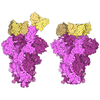
- Assembly
| Deposited unit | 
|
|---|---|
| 1 |
|
-Components
-Protein , 2 types, 2 molecules AB
| #1: Protein | Mass: 31734.070 Da / Num. of mol.: 1 Source method: isolated from a genetically manipulated source Source: (gene. exp.) Homo sapiens (human) / Gene: HLA-A / Production host: Homo sapiens (human) / References: UniProt: A0A1D3TZM3 |
|---|---|
| #2: Protein | Mass: 11879.356 Da / Num. of mol.: 1 / Fragment: UNP residues 21-119 Source method: isolated from a genetically manipulated source Source: (gene. exp.) Homo sapiens (human) / Gene: B2M, CDABP0092, HDCMA22P / Production host: Homo sapiens (human) / References: UniProt: P61769 |
-Protein/peptide , 1 types, 1 molecules C
| #3: Protein/peptide | Mass: 1043.150 Da / Num. of mol.: 1 Source method: isolated from a genetically manipulated source Source: (gene. exp.) Homo sapiens (human) / Gene: MAGEA3, MAGE3 / Production host: Homo sapiens (human) / References: UniProt: P43357 |
|---|
-Antibody , 3 types, 3 molecules DFG
| #4: Antibody | Mass: 12449.745 Da / Num. of mol.: 1 Source method: isolated from a genetically manipulated source Source: (gene. exp.) Homo sapiens (human) / Production host: Homo sapiens (human) |
|---|---|
| #5: Antibody | Mass: 22793.654 Da / Num. of mol.: 1 Source method: isolated from a genetically manipulated source Source: (gene. exp.) synthetic construct (others) / Production host:   Cricetulus griseus (Chinese hamster) Cricetulus griseus (Chinese hamster) |
| #6: Antibody | Mass: 23497.137 Da / Num. of mol.: 1 Source method: isolated from a genetically manipulated source Source: (gene. exp.) synthetic construct (others) / Production host: Cricetulus griseus (Chinese hamster) |
-Details
| Has protein modification | Y |
|---|
-Experimental details
-Experiment
| Experiment | Method: ELECTRON MICROSCOPY |
|---|---|
| EM experiment | Aggregation state: PARTICLE / 3D reconstruction method: single particle reconstruction |
- Sample preparation
| Component | Name: TCR mimic antibody vAB-30 in complex with MAGE-A3 in HLA-A1 Type: COMPLEX / Entity ID: all / Source: MULTIPLE SOURCES |
|---|---|
| Molecular weight | Value: 0.13 MDa / Experimental value: NO |
| Source (natural) | Organism: Homo sapiens (human) |
| Source (recombinant) | Organism: Homo sapiens (human) |
| Buffer solution | pH: 7.5 |
| Specimen | Embedding applied: NO / Shadowing applied: NO / Staining applied: NO / Vitrification applied: YES |
| Vitrification | Cryogen name: ETHANE |
- Electron microscopy imaging
| Microscopy | Model: TFS TITAN THEMIS |
|---|---|
| Electron gun | Electron source:  FIELD EMISSION GUN / Accelerating voltage: 300 kV / Illumination mode: FLOOD BEAM FIELD EMISSION GUN / Accelerating voltage: 300 kV / Illumination mode: FLOOD BEAM |
| Electron lens | Mode: BRIGHT FIELD / Nominal defocus max: 2000 nm / Nominal defocus min: 1000 nm |
| Image recording | Electron dose: 60 e/Å2 / Film or detector model: GATAN K2 SUMMIT (4k x 4k) |
- Processing
| EM software |
| ||||||||||||||||||||||||
|---|---|---|---|---|---|---|---|---|---|---|---|---|---|---|---|---|---|---|---|---|---|---|---|---|---|
| CTF correction | Type: NONE | ||||||||||||||||||||||||
| 3D reconstruction | Resolution: 2.6 Å / Resolution method: FSC 0.143 CUT-OFF / Num. of particles: 1317109 / Symmetry type: POINT | ||||||||||||||||||||||||
| Refine LS restraints |
|
