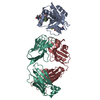
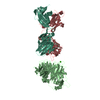
- EMDB-73458: Designed antibody vAB66 targeting PAP-HLA A*02:01 -
+
Open data
ID or keywords:
Loading...
-
Basic information
Entry
Database: EMDB / ID: EMD-73458
Title
Designed antibody vAB66 targeting PAP-HLA A*02:01
Map data
main map from nonuniform refinement, uniformly sharpened
Sample
Complex: vAB-66 Fab bound to HLA-A*02:01 displaying PAP peptide with AD01 nanobofy fiducial
Complex: HLA A*02:01 displaying PAP peptide
Complex: HLA A*02:01
Protein or peptide: HLA class I histocompatibility antigen, A alpha chain
Protein or peptide: Beta-2-microglobulin
Complex: PAP peptide
Protein or peptide: Prostatic acid phosphatase-derived peptide
Complex: vAB66 Fab
Protein or peptide: vAB66 heavy chain
Protein or peptide: vAB66 light chain
Complex: AD01 nanobody
Protein or peptide: AD01 nanobody
Ligand: water
Keywords
Fab / complex / immunology / DE NOVO PROTEIN / DE NOVO PROTEIN-IMMUNE SYSTEM complex
Function / homology
Function and homology information
thiamine phosphate phosphatase activity / positive regulation of adenosine receptor signaling pathway / thiamine metabolic process / Golgi cisterna / adenosine metabolic process / regulation of sensory perception of pain / acid phosphatase / acid phosphatase activity / lysophosphatidic acid phosphatase activity / 5'-nucleotidase ...thiamine phosphate phosphatase activity / positive regulation of adenosine receptor signaling pathway / thiamine metabolic process / Golgi cisterna / adenosine metabolic process / regulation of sensory perception of pain / acid phosphatase / acid phosphatase activity / lysophosphatidic acid phosphatase activity / 5'-nucleotidase / choline binding / 5'-nucleotidase activity / nucleotide metabolic process / vesicle membrane / azurophil granule membrane / phosphatase activity / purine nucleobase metabolic process / antigen processing and presentation of peptide antigen via MHC class I / multivesicular body / protein-tyrosine-phosphatase / protein tyrosine phosphatase activity / regulation of natural killer cell mediated immunity / early endosome lumen / Nef mediated downregulation of MHC class I complex cell surface expression / DAP12 interactions / lipid metabolic process / Endosomal/Vacuolar pathway / Antigen Presentation: Folding, assembly and peptide loading of class I MHC / filopodium / lumenal side of endoplasmic reticulum membrane / regulation of iron ion transport / negative regulation of iron ion transport / negative regulation of forebrain neuron differentiation / antigen processing and presentation of exogenous peptide antigen via MHC class Ib / peptide antigen assembly with MHC class I protein complex / ER to Golgi transport vesicle membrane / HFE-transferrin receptor complex / MHC class I peptide loading complex / transferrin transport / negative regulation of receptor-mediated endocytosis / cellular response to iron ion / positive regulation of T cell cytokine production / antigen processing and presentation of endogenous peptide antigen via MHC class I / peptide antigen assembly with MHC class II protein complex / MHC class I protein complex / negative regulation of epithelial cell proliferation / cellular response to nicotine / negative regulation of neurogenesis / MHC class II protein complex / positive regulation of receptor-mediated endocytosis / specific granule lumen / positive regulation of immune response / antigen processing and presentation of exogenous peptide antigen via MHC class II / peptide antigen binding / recycling endosome membrane / phagocytic vesicle membrane / positive regulation of T cell activation / Interferon gamma signaling / Immunoregulatory interactions between a Lymphoid and a non-Lymphoid cell / apical part of cell / sensory perception of smell / Modulation by Mtb of host immune system / tertiary granule lumen / positive regulation of cellular senescence / MHC class II protein complex binding / DAP12 signaling / late endosome membrane / ER-Phagosome pathway / early endosome membrane / amyloid fibril formation / molecular adaptor activity / protein homotetramerization / intracellular iron ion homeostasis / learning or memory / immune response / endoplasmic reticulum lumen / Amyloid fiber formation / external side of plasma membrane / Golgi membrane / focal adhesion / lysosomal membrane / Neutrophil degranulation / SARS-CoV-2 activates/modulates innate and adaptive immune responses / structural molecule activity / Golgi apparatus / endoplasmic reticulum / protein homodimerization activity / : / extracellular exosome / extracellular region / membrane / identical protein binding / nucleus / plasma membrane / cytosol Similarity search - Function
Histidine acid phosphatases active site signature. / : / Histidine acid phosphatases phosphohistidine signature. / Histidine acid phosphatase active site / Histidine phosphatase superfamily, clade-2 / Histidine phosphatase superfamily (branch 2) / Histidine phosphatase superfamily / MHC class I alpha chain, alpha1 alpha2 domains / Class I Histocompatibility antigen, domains alpha 1 and 2 / Beta-2-Microglobulin ...Histidine acid phosphatases active site signature. / : / Histidine acid phosphatases phosphohistidine signature. / Histidine acid phosphatase active site / Histidine phosphatase superfamily, clade-2 / Histidine phosphatase superfamily (branch 2) / Histidine phosphatase superfamily / MHC class I alpha chain, alpha1 alpha2 domains / Class I Histocompatibility antigen, domains alpha 1 and 2 / Beta-2-Microglobulin / : / MHC class I-like antigen recognition-like / MHC class I-like antigen recognition-like superfamily / MHC classes I/II-like antigen recognition protein / : / Immunoglobulin/major histocompatibility complex, conserved site / Immunoglobulins and major histocompatibility complex proteins signature. / Immunoglobulin C-Type / Immunoglobulin C1-set / Immunoglobulin C1-set domain / Ig-like domain profile. / Immunoglobulin-like domain / Immunoglobulin-like domain superfamily / Immunoglobulin-like fold Similarity search - Domain/homology
National Institutes of Health/National Cancer Institute (NIH/NCI)
OT2CA297242
United States
Cancer Research UK
CGCATF-2023/100006
United Kingdom
National Institutes of Health/National Institute Of Allergy and Infectious Diseases (NIH/NIAID)
AI103867 08
United States
Citation
Journal: bioRxiv / Year: 2025 Title: Targeting peptide-MHC complexes with designed T cell receptors and antibodies. Authors: Amir Motmaen / Kevin M Jude / Nan Wang / Anastasia Minervina / David Feldman / Mauriz A Lichtenstein / Abishai Ebenezer / Colin Correnti / Paul G Thomas / K Christopher Garcia / David Baker / Philip Bradley / Abstract: Class I major histocompatibility complexes (MHCs), expressed on the surface of all nucleated cells, present peptides derived from intracellular proteins for surveillance by T cells. The precise ...Class I major histocompatibility complexes (MHCs), expressed on the surface of all nucleated cells, present peptides derived from intracellular proteins for surveillance by T cells. The precise recognition of foreign or mutated peptide-MHC (pMHC) complexes by T cell receptors (TCRs) is central to immune defense against pathogens and tumors. Although patient-derived TCRs specific for cancer-associated antigens have been used to engineer tumor-targeting therapies, their reactivity toward self- or near-self antigens may be constrained by negative selection in the thymus. Here, we introduce a structure-based deep learning framework, ADAPT (Antigen-receptor Design Against Peptide-MHC Targets), for the design of TCRs and antibodies that bind to pMHC targets of interest. We evaluate the ADAPT pipeline by designing and characterizing TCRs and antibodies against a diverse panel of pMHCs. Cryogenic electron microscopy structures of two designed antibodies bound to their respective pMHC targets demonstrate atomic-level accuracy at the recognition interface, supporting the robustness of our structure-based approach. Computationally designed TCRs and antibodies targeting pMHC complexes could enable a broad range of therapeutic applications, from cancer immunotherapy to autoimmune disease treatment, and insights gained from TCR-pMHC design should advance predictive understanding of TCR specificity with implications for basic immunology and clinical diagnostics.
Macromolecule #1: HLA class I histocompatibility antigen, A alpha chain
Macromolecule
Name: HLA class I histocompatibility antigen, A alpha chain / type: protein_or_peptide / ID: 1 / Details: Met1 is a cloning artifact / Number of copies: 1 / Enantiomer: LEVO
Model: Quantifoil R1.2/1.3 / Material: GOLD / Mesh: 300 / Support film - Material: CARBON / Support film - topology: HOLEY / Pretreatment - Type: GLOW DISCHARGE / Pretreatment - Time: 30 sec. / Pretreatment - Atmosphere: OTHER / Pretreatment - Pressure: 0.00039000000000000005 kPa
Vitrification
Cryogen name: ETHANE / Chamber humidity: 100 % / Chamber temperature: 277 K / Instrument: FEI VITROBOT MARK IV
-
Electron microscopy
Microscope
TFS KRIOS
Specialist optics
Energy filter - Name: TFS Selectris X / Energy filter - Slit width: 6 eV
Image recording
Film or detector model: TFS FALCON 4i (4k x 4k) / Number grids imaged: 1 / Number real images: 12293 / Average exposure time: 5.893 sec. / Average electron dose: 50.0 e/Å2
Electron beam
Acceleration voltage: 300 kV / Electron source: FIELD EMISSION GUN
In the structure databanks used in Yorodumi, some data are registered as the other names, "COVID-19 virus" and "2019-nCoV". Here are the details of the virus and the list of structure data.
Jan 31, 2019. EMDB accession codes are about to change! (news from PDBe EMDB page)
EMDB accession codes are about to change! (news from PDBe EMDB page)
The allocation of 4 digits for EMDB accession codes will soon come to an end. Whilst these codes will remain in use, new EMDB accession codes will include an additional digit and will expand incrementally as the available range of codes is exhausted. The current 4-digit format prefixed with “EMD-” (i.e. EMD-XXXX) will advance to a 5-digit format (i.e. EMD-XXXXX), and so on. It is currently estimated that the 4-digit codes will be depleted around Spring 2019, at which point the 5-digit format will come into force.
The EM Navigator/Yorodumi systems omit the EMD- prefix.
Related info.:Q: What is EMD? / ID/Accession-code notation in Yorodumi/EM Navigator
Yorodumi is a browser for structure data from EMDB, PDB, SASBDB, etc.
This page is also the successor to EM Navigator detail page, and also detail information page/front-end page for Omokage search.
The word "yorodu" (or yorozu) is an old Japanese word meaning "ten thousand". "mi" (miru) is to see.
Related info.:EMDB / PDB / SASBDB / Comparison of 3 databanks / Yorodumi Search / Aug 31, 2016. New EM Navigator & Yorodumi / Yorodumi Papers / Jmol/JSmol / Function and homology information / Changes in new EM Navigator and Yorodumi
 Movie
Movie Controller


 Open data
 Basic information
 Map data
 Sample
 Keywords
 Function and homology information
 Homo sapiens (human) /
 Lama glama (llama)
 Authors
 United States,
  United Kingdom, 3 items
  Citation
 Structure visualization
 Downloads & links
 emd_73458.png
 https://data.pdbj.org/pub/emdb/structures/EMD-73458


 Z (Sec.)
 Y (Row.)
 X (Col.)


 Sample components
 Escherichia coli (E. coli)
 Cricetulus griseus (Chinese hamster)
 Processing
 Electron microscopy
 FIELD EMISSION GUN