 Movie
Movie Controller

[English] 日本語
 Yorodumi
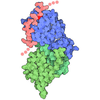
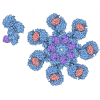
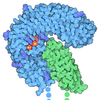
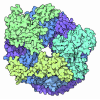
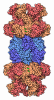
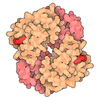
- PDB-9t66: Complex linking two repeat units of a cytoplasmic lattice filament -
+ Open data

- Basic information
| Entry | Database: PDB / ID: 9t66 | |||||||||||||||||||||||||||
|---|---|---|---|---|---|---|---|---|---|---|---|---|---|---|---|---|---|---|---|---|---|---|---|---|---|---|---|---|
| Title | Complex linking two repeat units of a cytoplasmic lattice filament | |||||||||||||||||||||||||||
 Components Components |
| |||||||||||||||||||||||||||
 Keywords Keywords | UNKNOWN FUNCTION / Ubiquitination / Complex / Filament | |||||||||||||||||||||||||||
| Function / homology |  Function and homology information Function and homology informationregulation of translation by machinery localization / cytoplasm organization / ooplasm / Prolactin receptor signaling / embryonic process involved in female pregnancy / subcortical maternal complex / establishment of organelle localization / Microtubule-dependent trafficking of connexons from Golgi to the plasma membrane / Cargo trafficking to the periciliary membrane / Sealing of the nuclear envelope (NE) by ESCRT-III ...regulation of translation by machinery localization / cytoplasm organization / ooplasm / Prolactin receptor signaling / embryonic process involved in female pregnancy / subcortical maternal complex / establishment of organelle localization / Microtubule-dependent trafficking of connexons from Golgi to the plasma membrane / Cargo trafficking to the periciliary membrane / Sealing of the nuclear envelope (NE) by ESCRT-III / Chromatin modifying enzymes / protein storage / structural constituent of cytoplasmic lattice / cytoplasmic lattice / cortical granule exocytosis / establishment or maintenance of apical/basal cell polarity / endoplasmic reticulum localization / Carboxyterminal post-translational modifications of tubulin / Intraflagellar transport / COPI-independent Golgi-to-ER retrograde traffic / SCF-beta-TrCP mediated degradation of Emi1 / HSP90 chaperone cycle for steroid hormone receptors (SHR) in the presence of ligand / Regulation of BACH1 activity / SCF(Skp2)-mediated degradation of p27/p21 / COPI-mediated anterograde transport / spermatogonial cell division / MAP3K8 (TPL2)-dependent MAPK1/3 activation / Regulation of RUNX2 expression and activity / Kinesins / Degradation of GLI1 by the proteasome / GSK3B-mediated proteasomal degradation of PD-L1(CD274) / Cyclin D associated events in G1 / FBXL7 down-regulates AURKA during mitotic entry and in early mitosis / cortical granule / Orc1 removal from chromatin / GSK3B and BTRC:CUL1-mediated-degradation of NFE2L2 / Dectin-1 mediated noncanonical NF-kB signaling / NIK-->noncanonical NF-kB signaling / PKR-mediated signaling / Aggrephagy / fertilization / regulation of establishment of protein localization / RHO GTPases activate IQGAPs / Mitotic Prometaphase / EML4 and NUDC in mitotic spindle formation / Degradation of beta-catenin by the destruction complex / COPI-dependent Golgi-to-ER retrograde traffic / Resolution of Sister Chromatid Cohesion / Activation of NF-kappaB in B cells / Iron uptake and transport / embryonic cleavage / The role of GTSE1 in G2/M progression after G2 checkpoint / apical cortex / positive regulation of meiotic nuclear division / Recycling pathway of L1 / positive regulation of embryonic development / regulation of RNA stability / intermediate filament cytoskeleton / CLEC7A (Dectin-1) signaling / FCERI mediated NF-kB activation / Interleukin-1 signaling / axonemal microtubule / F-box domain binding / Hedgehog 'off' state / RHO GTPases Activate Formins / Loss of Nlp from mitotic centrosomes / Recruitment of mitotic centrosome proteins and complexes / Loss of proteins required for interphase microtubule organization from the centrosome / Downstream TCR signaling / Separation of Sister Chromatids / Anchoring of the basal body to the plasma membrane / Recruitment of NuMA to mitotic centrosomes / AURKA Activation by TPX2 / GLI3 is processed to GLI3R by the proteasome / embryonic pattern specification / Regulation of PLK1 Activity at G2/M Transition / Ubiquitin-Mediated Degradation of Phosphorylated Cdc25A / Neddylation / PcG protein complex / MHC class II antigen presentation / gap junction / establishment of spindle localization / mitochondrion localization / maintenance of protein location in nucleus / positive regulation of epithelial cell apoptotic process / Cul7-RING ubiquitin ligase complex / Antigen processing: Ubiquitination & Proteasome degradation / positive regulation of dendrite development / positive regulation of neurogenesis / ubiquitin ligase activator activity / epigenetic programming in the zygotic pronuclei / mitotic spindle assembly checkpoint signaling / tubulin complex / SCF ubiquitin ligase complex / intercellular bridge / SCF-dependent proteasomal ubiquitin-dependent protein catabolic process / flagellated sperm motility / exocytosis / negative regulation of protein phosphorylation / positive regulation of double-strand break repair Similarity search - Function | |||||||||||||||||||||||||||
| Biological species |   Mus musculus (house mouse) Mus musculus (house mouse) | |||||||||||||||||||||||||||
| Method | ELECTRON MICROSCOPY / subtomogram averaging / cryo EM / Resolution: 5.3 Å | |||||||||||||||||||||||||||
 Authors Authors | Singh, K. / Harasimov, K. / Carter, A.P. | |||||||||||||||||||||||||||
| Funding support |  United Kingdom, European Union, 3items United Kingdom, European Union, 3items
| |||||||||||||||||||||||||||
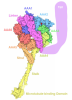
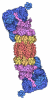
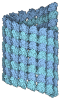
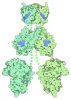
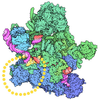
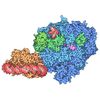
 Citation Citation | Journal: EMBO J / Year: 2026 Title: In-situ cryo-ET of mouse embryos reveals cytoplasmic lattices contain ubiquitin-charged E2-E3 ligase assemblies. Authors: Kashish Singh / Katarina Harasimov / Kathy K Niakan / Andrew P Carter / Abstract: Cytoplasmic lattices (CPLs) are filamentous assemblies essential for mammalian embryonic development. They are known to regulate organelle organization, spindle assembly, and protein homeostasis, but ...Cytoplasmic lattices (CPLs) are filamentous assemblies essential for mammalian embryonic development. They are known to regulate organelle organization, spindle assembly, and protein homeostasis, but their molecular functions remain unclear. Here, we develop a strategy combining cryo-focused ion beam milling and cryo-electron tomography to resolve macromolecular complexes directly in mammalian embryos. Using this approach, we determine the in situ structure of cytoplasmic lattices within 6/8-cell mouse embryos at ~4.7 Å resolution. CPL filaments are built from multiple copies of at least fourteen proteins arranged into a ~4.5 MDa repeating unit. The repeat contains a central cavity that is open at the back and lined with multiple FBXW-SKP1 complexes and three modules, each containing the E2 ubiquitin-conjugating enzyme UBE2D and the E3 ligase UHRF1. We resolve two CPL states: one is consistent with a ubiquitin-charged UBE2D, where ubiquitin is held in an open, inactive conformation by binding the scaffold protein PADI6; the second lacks discernible ubiquitin density and shows structural changes compatible with ubiquitin becoming available for transfer. Our findings support a model in which CPLs function as large ubiquitin ligase assemblies during early embryonic development. | |||||||||||||||||||||||||||
| History |
|
- Structure visualization
| Structure viewer | Molecule: MolmilJmol/JSmol |
|---|
- Downloads & links
-Download
| PDBx/mmCIF format | 9t66.cif.gz | 2.4 MB | Display | PDBx/mmCIF format |
|---|---|---|---|---|
| PDB format | pdb9t66.ent.gz | 1.7 MB | Display | PDB format |
| PDBx/mmJSON format | 9t66.json.gz | Tree view | PDBx/mmJSON format | |
| Others |  Other downloads Other downloads |
-Validation report
| Arichive directory | https://data.pdbj.org/pub/pdb/validation_reports/t6/9t66ftp://data.pdbj.org/pub/pdb/validation_reports/t6/9t66 | HTTPS FTP |
|---|
-Related structure data
| Related structure data |  55606MC  9t63C  9t64C  9t65C  9t67C  9t68C M: map data used to model this data C: citing same article ( |
|---|---|
| Similar structure data |


-Links
 PDBj
PDBj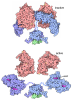

- Assembly
| Deposited unit | 
|
|---|---|
| 1 |
|
-Components
-Protein , 11 types, 40 molecules gesqABEFIJKLORZiSjcodpfhrtYnTW...
| #1: Protein | Mass: 39676.895 Da / Num. of mol.: 4 / Source method: isolated from a natural source / Source: (natural) Mus musculus (house mouse)#2: Protein | Mass: 76854.109 Da / Num. of mol.: 8 / Source method: isolated from a natural source / Source: (natural) Mus musculus (house mouse) / References: UniProt: Q8K3V4#3: Protein | Mass: 18481.295 Da / Num. of mol.: 4 / Source method: isolated from a natural source / Source: (natural) Mus musculus (house mouse) / References: UniProt: Q9CWE6#4: Protein | Mass: 48055.301 Da / Num. of mol.: 2 / Source method: isolated from a natural source / Source: (natural) Mus musculus (house mouse) / References: UniProt: Q9CWU5#5: Protein | Mass: 49962.172 Da / Num. of mol.: 2 / Source method: isolated from a natural source / Source: (natural) Mus musculus (house mouse)References: UniProt: P68373, Hydrolases; Acting on acid anhydrides; Acting on GTP to facilitate cellular and subcellular movement #6: Protein | Mass: 49877.824 Da / Num. of mol.: 2 / Source method: isolated from a natural source / Source: (natural) Mus musculus (house mouse) / References: UniProt: P68372#7: Protein | Mass: 18693.992 Da / Num. of mol.: 4 / Source method: isolated from a natural source / Source: (natural) Mus musculus (house mouse) / References: UniProt: Q9WTX5#8: Protein | Mass: 108001.281 Da / Num. of mol.: 2 / Source method: isolated from a natural source / Source: (natural) Mus musculus (house mouse) / References: UniProt: L7N1W9#9: Protein | Mass: 25643.373 Da / Num. of mol.: 4 / Source method: isolated from a natural source / Source: (natural) Mus musculus (house mouse) / References: UniProt: Q9D0L1#10: Protein | Mass: 131468.547 Da / Num. of mol.: 4 / Source method: isolated from a natural source / Source: (natural) Mus musculus (house mouse) / References: UniProt: Q9R1M5#11: Protein | Mass: 65187.332 Da / Num. of mol.: 4 / Source method: isolated from a natural source / Source: (natural) Mus musculus (house mouse) / References: UniProt: Q9WVB3 |
|---|
-Details
| Has protein modification | N |
|---|
-Experimental details
-Experiment
| Experiment | Method: ELECTRON MICROSCOPY |
|---|---|
| EM experiment | Aggregation state: FILAMENT / 3D reconstruction method: subtomogram averaging |
- Sample preparation
| Component | Name: Complex of a F-box/WD repeat-containing protein-SKP1 complex bound to NLRP14 and UHRF1 Type: COMPLEX / Entity ID: all / Source: NATURAL |
|---|---|
| Source (natural) | Organism: Mus musculus (house mouse) |
| Buffer solution | pH: 7.5 |
| Specimen | Embedding applied: NO / Shadowing applied: NO / Staining applied: NO / Vitrification applied: YES |
| Vitrification | Cryogen name: ETHANE |
- Electron microscopy imaging
| Experimental equipment |  Model: Titan Krios / Image courtesy: FEI Company |
|---|---|
| Microscopy | Model: TFS KRIOS |
| Electron gun | Electron source:  FIELD EMISSION GUN / Accelerating voltage: 300 kV / Illumination mode: FLOOD BEAM FIELD EMISSION GUN / Accelerating voltage: 300 kV / Illumination mode: FLOOD BEAM |
| Electron lens | Mode: BRIGHT FIELD / Nominal defocus max: 4000 nm / Nominal defocus min: 1000 nm |
| Image recording | Electron dose: 3.5 e/Å2 / Avg electron dose per subtomogram: 115 e/Å2 / Film or detector model: TFS FALCON 4i (4k x 4k) |
- Processing
| EM software |
| ||||||||||||
|---|---|---|---|---|---|---|---|---|---|---|---|---|---|
| CTF correction | Type: PHASE FLIPPING AND AMPLITUDE CORRECTION | ||||||||||||
| Symmetry | Point symmetry: C1 (asymmetric) | ||||||||||||
| 3D reconstruction | Resolution: 5.3 Å / Resolution method: FSC 0.143 CUT-OFF / Num. of particles: 184196 / Symmetry type: POINT | ||||||||||||
| EM volume selection | Num. of tomograms: 1153 / Num. of volumes extracted: 268774 |
