 Movie
Movie Controller

[English] 日本語
 Yorodumi
- PDB-9pzs: Native GluN1/GluN2A/GluN2B in complex with 5F11 and 3D2 Fabs (cla... -
+ Open data

- Basic information
| Entry | Database: PDB / ID: 9pzs | |||||||||||||||||||||||||||
|---|---|---|---|---|---|---|---|---|---|---|---|---|---|---|---|---|---|---|---|---|---|---|---|---|---|---|---|---|
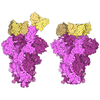
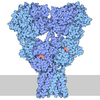
| Title | Native GluN1/GluN2A/GluN2B in complex with 5F11 and 3D2 Fabs (class 1), glycine and glutamate bound state | |||||||||||||||||||||||||||
 Components Components |
| |||||||||||||||||||||||||||
 Keywords Keywords | TRANSPORT PROTEIN / ligand-gated ion channel / NMDA / antibody / native | |||||||||||||||||||||||||||
| Function / homology |  Function and homology information Function and homology informationAssembly and cell surface presentation of NMDA receptors / EPHB-mediated forward signaling / Synaptic adhesion-like molecules / Unblocking of NMDA receptors, glutamate binding and activation / neurotransmitter receptor transport, plasma membrane to endosome / RAF/MAP kinase cascade / receptor recycling / sensory organ development / directional locomotion / regulation of cAMP/PKA signal transduction ...Assembly and cell surface presentation of NMDA receptors / EPHB-mediated forward signaling / Synaptic adhesion-like molecules / Unblocking of NMDA receptors, glutamate binding and activation / neurotransmitter receptor transport, plasma membrane to endosome / RAF/MAP kinase cascade / receptor recycling / sensory organ development / directional locomotion / regulation of cAMP/PKA signal transduction / pons maturation / positive regulation of Schwann cell migration / regulation of cell communication / fear response / sensitization / suckling behavior / olfactory learning / protein localization to postsynaptic membrane / dendritic branch / conditioned taste aversion / sleep / regulation of ARF protein signal transduction / apical dendrite / transmitter-gated monoatomic ion channel activity / serotonin metabolic process / interleukin-1 receptor binding / regulation of respiratory gaseous exchange / propylene metabolic process / response to glycine / dendritic spine organization / locomotion / regulation of NMDA receptor activity / neuromuscular process / positive regulation of inhibitory postsynaptic potential / heterocyclic compound binding / negative regulation of dendritic spine maintenance / neurotransmitter receptor complex / NMDA glutamate receptor activity / regulation of monoatomic cation transmembrane transport / cellular response to zinc ion / NMDA selective glutamate receptor complex / glutamate binding / voltage-gated monoatomic cation channel activity / regulation of axonogenesis / ligand-gated sodium channel activity / response to morphine / positive regulation of glutamate secretion / transport vesicle membrane / monoatomic ion channel complex / calcium ion transmembrane import into cytosol / regulation of synapse assembly / male mating behavior / positive regulation of reactive oxygen species biosynthetic process / startle response / protein heterotetramerization / regulation of dendrite morphogenesis / small molecule binding / dopamine metabolic process / glycine binding / receptor clustering / response to lithium ion / behavioral response to pain / parallel fiber to Purkinje cell synapse / positive regulation of calcium ion transport into cytosol / glutamate receptor signaling pathway / behavioral fear response / social behavior / regulation of neuronal synaptic plasticity / associative learning / regulation of postsynaptic membrane potential / regulation of MAPK cascade / action potential / extracellularly glutamate-gated ion channel activity / modulation of excitatory postsynaptic potential / positive regulation of dendritic spine maintenance / monoatomic cation transmembrane transport / detection of mechanical stimulus involved in sensory perception of pain / positive regulation of protein targeting to membrane / monoatomic cation transport / glutamate receptor binding / ligand-gated monoatomic ion channel activity / prepulse inhibition / positive regulation of synaptic transmission / long-term memory / calcium ion homeostasis / phosphatase binding / adult locomotory behavior / postsynaptic density, intracellular component / neurogenesis / synaptic cleft / monoatomic cation channel activity / glutamate-gated receptor activity / regulation of long-term synaptic depression / positive regulation of synaptic transmission, glutamatergic / sensory perception of pain / glutamate-gated calcium ion channel activity / presynaptic active zone membrane / cell adhesion molecule binding / D2 dopamine receptor binding / regulation of neuron apoptotic process Similarity search - Function | |||||||||||||||||||||||||||
| Biological species |   Mus musculus (house mouse) Mus musculus (house mouse) | |||||||||||||||||||||||||||
| Method | ELECTRON MICROSCOPY / single particle reconstruction / cryo EM / Resolution: 4.2 Å | |||||||||||||||||||||||||||
 Authors Authors | Kim, J. / Gouaux, E. | |||||||||||||||||||||||||||
| Funding support |  United States, 1items United States, 1items
| |||||||||||||||||||||||||||
 Citation Citation | Journal: Sci Adv / Year: 2026 Title: Cryo-EM of autoantibody-bound NMDA receptors reveals antigenic hotspots in an active immunization model of anti-NMDAR encephalitis. Authors: Junhoe Kim / Farzad Jalali-Yazdi / Brian E Jones / Gary L Westbrook / Eric Gouaux / Abstract: Autoantibodies targeting synaptic membrane proteins are associated with autoimmune encephalitis manifested by seizures, psychosis, and memory dysfunction. Anti--methyl-d-aspartate receptor (NMDAR) ...Autoantibodies targeting synaptic membrane proteins are associated with autoimmune encephalitis manifested by seizures, psychosis, and memory dysfunction. Anti--methyl-d-aspartate receptor (NMDAR) encephalitis, a prototype of these autoimmune synaptic disorders, is unexpectedly common. Unfortunately, how the native repertoire of anti-NMDAR autoantibodies recognizes NMDARs and the precise locations of antigenic epitopes remain poorly understood. Here, we used an active immunization model that closely mimics the human disease to immunize adult mice with intact GluN1/GluN2A receptors, resulting in fulminant autoimmune encephalitis. Serum was collected at 6 weeks postimmunization for single-particle cryo-electron microscopy of GluN1/GluN2A receptors complexed with purified polyclonal anti-NMDAR autoantibody fragments. Native autoantibodies recognized two distinct binding sites on the GluN1 amino-terminal domain, which we confirmed using monoclonal antibodies bound to native NMDARs purified from mouse brain. Structural analysis of autoantibody-bound NMDAR complexes identified antigenic hotspots within the GluN1 amino-terminal domain. These hotspots provide potential targets for therapeutic intervention. | |||||||||||||||||||||||||||
| History |
|
- Structure visualization
| Structure viewer | Molecule: MolmilJmol/JSmol |
|---|
- Downloads & links
-Download
| PDBx/mmCIF format | 9pzs.cif.gz | 636.5 KB | Display | PDBx/mmCIF format |
|---|---|---|---|---|
| PDB format | pdb9pzs.ent.gz | 470 KB | Display | PDB format |
| PDBx/mmJSON format | 9pzs.json.gz | Tree view | PDBx/mmJSON format | |
| Others |  Other downloads Other downloads |
-Validation report
| Arichive directory | https://data.pdbj.org/pub/pdb/validation_reports/pz/9pzsftp://data.pdbj.org/pub/pdb/validation_reports/pz/9pzs | HTTPS FTP |
|---|
-Related structure data
| Related structure data |  72078MC  9pzqC  9pzrC  9pztC  9pzuC  9pzvC  9pzwC  9pzxC M: map data used to model this data C: citing same article ( |
|---|---|
| Similar structure data |


-Links
 PDBj
PDBj
- Assembly
| Deposited unit | 
|
|---|---|
| 1 |
|
-Components
-Glutamate receptor ionotropic, NMDA ... , 3 types, 4 molecules DACB
| #1: Protein | Mass: 166162.062 Da / Num. of mol.: 1 / Source method: isolated from a natural source / Source: (natural) Mus musculus (house mouse) / References: UniProt: Q01097 | ||
|---|---|---|---|
| #2: Protein | Mass: 105617.820 Da / Num. of mol.: 2 / Source method: isolated from a natural source / Source: (natural) Mus musculus (house mouse) / References: UniProt: P35438#5: Protein | | Mass: 165619.891 Da / Num. of mol.: 1 / Source method: isolated from a natural source / Source: (natural) Mus musculus (house mouse) / References: UniProt: P35436 |
-Antibody , 4 types, 6 molecules FHGIJK
| #3: Antibody | Mass: 29432.527 Da / Num. of mol.: 2 Source method: isolated from a genetically manipulated source Source: (gene. exp.) Mus musculus (house mouse) / Production host:   Spodoptera frugiperda (fall armyworm) Spodoptera frugiperda (fall armyworm)#4: Antibody | Mass: 26909.961 Da / Num. of mol.: 2 Source method: isolated from a genetically manipulated source Source: (gene. exp.) Mus musculus (house mouse) / Production host: Spodoptera frugiperda (fall armyworm)#6: Antibody | | Mass: 15448.522 Da / Num. of mol.: 1 Source method: isolated from a genetically manipulated source Source: (gene. exp.) Mus musculus (house mouse) / Production host:  Homo sapiens (human) Homo sapiens (human)#7: Antibody | | Mass: 13989.831 Da / Num. of mol.: 1 Source method: isolated from a genetically manipulated source Source: (gene. exp.) Mus musculus (house mouse) / Production host: Homo sapiens (human) |
|---|
-Sugars , 3 types, 9 molecules 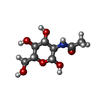
| #8: Polysaccharide | 2-acetamido-2-deoxy-beta-D-glucopyranose-(1-4)-2-acetamido-2-deoxy-beta-D-glucopyranose #9: Polysaccharide | beta-D-mannopyranose-(1-4)-2-acetamido-2-deoxy-beta-D-glucopyranose-(1-4)-2-acetamido-2-deoxy-beta- ...beta-D-mannopyranose-(1-4)-2-acetamido-2-deoxy-beta-D-glucopyranose-(1-4)-2-acetamido-2-deoxy-beta-D-glucopyranose | Source method: isolated from a genetically manipulated source #10: Sugar | 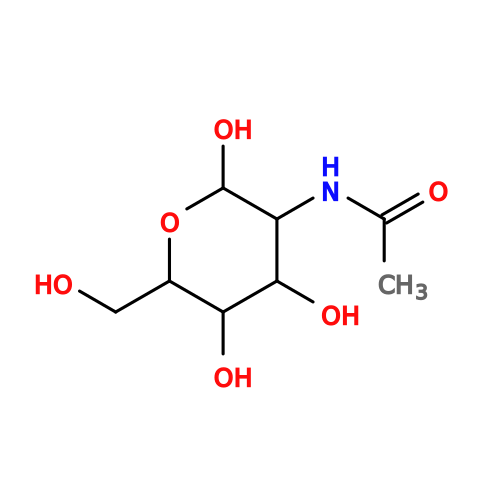 Type: D-saccharide, beta linking / Mass: 221.208 Da / Num. of mol.: 3 / Source method: obtained synthetically / Formula: C8H15NO6 / Feature type: SUBJECT OF INVESTIGATION Type: D-saccharide, beta linking / Mass: 221.208 Da / Num. of mol.: 3 / Source method: obtained synthetically / Formula: C8H15NO6 / Feature type: SUBJECT OF INVESTIGATION |
|---|
-Details
| Has ligand of interest | Y |
|---|---|
| Has protein modification | Y |
-Experimental details
-Experiment
| Experiment | Method: ELECTRON MICROSCOPY |
|---|---|
| EM experiment | Aggregation state: PARTICLE / 3D reconstruction method: single particle reconstruction |
- Sample preparation
| Component | Name: Native GluN1/GluN2A/GluN2B in complex with 5F11 and 3D2 Fabs (class 1), glycine and glutamate-bound state Type: COMPLEX / Entity ID: #1-#7 / Source: NATURAL |
|---|---|
| Molecular weight | Value: 0.667 MDa / Experimental value: NO |
| Source (natural) | Organism: Mus musculus (house mouse) |
| Source (recombinant) | Organism: Homo sapiens (human) |
| Buffer solution | pH: 8 |
| Specimen | Conc.: 0.05 mg/ml / Embedding applied: NO / Shadowing applied: NO / Staining applied: NO / Vitrification applied: YES |
| Vitrification | Instrument: FEI VITROBOT MARK IV / Cryogen name: ETHANE / Humidity: 100 % / Chamber temperature: 290 K |
- Electron microscopy imaging
| Experimental equipment |  Model: Titan Krios / Image courtesy: FEI Company |
|---|---|
| Microscopy | Model: TFS KRIOS |
| Electron gun | Electron source:  FIELD EMISSION GUN / Accelerating voltage: 300 kV / Illumination mode: FLOOD BEAM FIELD EMISSION GUN / Accelerating voltage: 300 kV / Illumination mode: FLOOD BEAM |
| Electron lens | Mode: BRIGHT FIELD / Nominal defocus max: 3000 nm / Nominal defocus min: 1000 nm |
| Specimen holder | Cryogen: NITROGEN |
| Image recording | Electron dose: 65 e/Å2 / Film or detector model: GATAN K3 BIOQUANTUM (6k x 4k) / Num. of real images: 9851 |
| EM imaging optics | Energyfilter name: GIF Bioquantum / Energyfilter slit width: 20 eV |
- Processing
| EM software |
| ||||||||||||||||||||||||
|---|---|---|---|---|---|---|---|---|---|---|---|---|---|---|---|---|---|---|---|---|---|---|---|---|---|
| CTF correction | Type: NONE | ||||||||||||||||||||||||
| Symmetry | Point symmetry: C1 (asymmetric) | ||||||||||||||||||||||||
| 3D reconstruction | Resolution: 4.2 Å / Resolution method: FSC 0.143 CUT-OFF / Num. of particles: 296585 / Symmetry type: POINT | ||||||||||||||||||||||||
| Refinement | Highest resolution: 4.2 Å Stereochemistry target values: REAL-SPACE (WEIGHTED MAP SUM AT ATOM CENTERS) |
