 Movie
Movie Controller

[English] 日本語
 Yorodumi
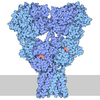
- EMDB-72081: Native GluN1/GluN2B in complex with 5F11 Fab (class 4), glycine a... -
+ Open data

- Basic information
| Entry |  | |||||||||
|---|---|---|---|---|---|---|---|---|---|---|
| Title | Native GluN1/GluN2B in complex with 5F11 Fab (class 4), glycine and glutamate-bound state | |||||||||
 Map data Map data | ||||||||||
 Sample Sample |
| |||||||||
 Keywords Keywords | ligand-gated ion channel / NMDA / antibody / native / TRANSPORT PROTEIN | |||||||||
| Function / homology |  Function and homology information Function and homology informationAssembly and cell surface presentation of NMDA receptors / EPHB-mediated forward signaling / Synaptic adhesion-like molecules / Unblocking of NMDA receptors, glutamate binding and activation / RAF/MAP kinase cascade / sensory organ development / sensitization / pons maturation / positive regulation of Schwann cell migration / regulation of cell communication ...Assembly and cell surface presentation of NMDA receptors / EPHB-mediated forward signaling / Synaptic adhesion-like molecules / Unblocking of NMDA receptors, glutamate binding and activation / RAF/MAP kinase cascade / sensory organ development / sensitization / pons maturation / positive regulation of Schwann cell migration / regulation of cell communication / protein localization to postsynaptic membrane / conditioned taste aversion / regulation of cAMP/PKA signal transduction / fear response / suckling behavior / olfactory learning / dendritic branch / regulation of ARF protein signal transduction / transmitter-gated monoatomic ion channel activity / apical dendrite / interleukin-1 receptor binding / regulation of respiratory gaseous exchange / propylene metabolic process / response to glycine / positive regulation of inhibitory postsynaptic potential / heterocyclic compound binding / neuromuscular process / neurotransmitter receptor complex / negative regulation of dendritic spine maintenance / NMDA glutamate receptor activity / regulation of monoatomic cation transmembrane transport / NMDA selective glutamate receptor complex / glutamate binding / regulation of axonogenesis / ligand-gated sodium channel activity / startle response / behavioral fear response / voltage-gated monoatomic cation channel activity / response to morphine / monoatomic ion channel complex / positive regulation of glutamate secretion / calcium ion transmembrane import into cytosol / transport vesicle membrane / regulation of synapse assembly / male mating behavior / positive regulation of reactive oxygen species biosynthetic process / protein heterotetramerization / regulation of dendrite morphogenesis / small molecule binding / behavioral response to pain / receptor clustering / glycine binding / parallel fiber to Purkinje cell synapse / positive regulation of calcium ion transport into cytosol / social behavior / regulation of neuronal synaptic plasticity / associative learning / regulation of postsynaptic membrane potential / regulation of MAPK cascade / extracellularly glutamate-gated ion channel activity / positive regulation of dendritic spine maintenance / monoatomic cation transmembrane transport / action potential / detection of mechanical stimulus involved in sensory perception of pain / glutamate receptor binding / monoatomic cation transport / ligand-gated monoatomic ion channel activity / prepulse inhibition / positive regulation of synaptic transmission / phosphatase binding / long-term memory / adult locomotory behavior / calcium ion homeostasis / regulation of long-term neuronal synaptic plasticity / postsynaptic density, intracellular component / monoatomic cation channel activity / sensory perception of pain / glutamate-gated receptor activity / regulation of long-term synaptic depression / positive regulation of synaptic transmission, glutamatergic / response to amphetamine / glutamate-gated calcium ion channel activity / in utero embryonic development / presynaptic active zone membrane / visual learning / cell adhesion molecule binding / D2 dopamine receptor binding / synaptic cleft / regulation of neuron apoptotic process / ionotropic glutamate receptor binding / ionotropic glutamate receptor signaling pathway / learning / excitatory synapse / ligand-gated monoatomic ion channel activity involved in regulation of presynaptic membrane potential / dendrite membrane / protein tyrosine kinase binding / excitatory postsynaptic potential / positive regulation of excitatory postsynaptic potential / hippocampal mossy fiber to CA3 synapse / protein serine/threonine kinase binding Similarity search - Function | |||||||||
| Biological species |   Mus musculus (house mouse) Mus musculus (house mouse) | |||||||||
| Method | single particle reconstruction / cryo EM / Resolution: 5.36 Å | |||||||||
 Authors Authors | Kim J / Gouaux E | |||||||||
| Funding support |  United States, 1 items United States, 1 items
| |||||||||
 Citation Citation | Journal: Sci Adv / Year: 2026 Title: Cryo-EM of autoantibody-bound NMDA receptors reveals antigenic hotspots in an active immunization model of anti-NMDAR encephalitis. Authors: Junhoe Kim / Farzad Jalali-Yazdi / Brian E Jones / Gary L Westbrook / Eric Gouaux / Abstract: Autoantibodies targeting synaptic membrane proteins are associated with autoimmune encephalitis manifested by seizures, psychosis, and memory dysfunction. Anti--methyl-d-aspartate receptor (NMDAR) ...Autoantibodies targeting synaptic membrane proteins are associated with autoimmune encephalitis manifested by seizures, psychosis, and memory dysfunction. Anti--methyl-d-aspartate receptor (NMDAR) encephalitis, a prototype of these autoimmune synaptic disorders, is unexpectedly common. Unfortunately, how the native repertoire of anti-NMDAR autoantibodies recognizes NMDARs and the precise locations of antigenic epitopes remain poorly understood. Here, we used an active immunization model that closely mimics the human disease to immunize adult mice with intact GluN1/GluN2A receptors, resulting in fulminant autoimmune encephalitis. Serum was collected at 6 weeks postimmunization for single-particle cryo-electron microscopy of GluN1/GluN2A receptors complexed with purified polyclonal anti-NMDAR autoantibody fragments. Native autoantibodies recognized two distinct binding sites on the GluN1 amino-terminal domain, which we confirmed using monoclonal antibodies bound to native NMDARs purified from mouse brain. Structural analysis of autoantibody-bound NMDAR complexes identified antigenic hotspots within the GluN1 amino-terminal domain. These hotspots provide potential targets for therapeutic intervention. | |||||||||
| History |
|
- Structure visualization
| Supplemental images |
|---|

- Downloads & links
-EMDB archive
| Map data | emd_72081.map.gz | 71.7 MB | EMDB map data format | |
|---|---|---|---|---|
| Header (meta data) | emd-72081-v30.xmlemd-72081.xml | 27.5 KB 27.5 KB | Display Display | EMDB header |
| FSC (resolution estimation) | emd_72081_fsc.xml | 11.2 KB | Display | FSC data file |
| Images |  emd_72081.png emd_72081.png | 18.8 KB | ||
| Filedesc metadata | emd-72081.cif.gz | 8.7 KB | ||
| Others | emd_72081_additional_1.map.gzemd_72081_half_map_1.map.gzemd_72081_half_map_2.map.gz | 136.5 MB 134.2 MB 134.3 MB | ||
| Archive directory |  http://ftp.pdbj.org/pub/emdb/structures/EMD-72081ftp://ftp.pdbj.org/pub/emdb/structures/EMD-72081 http://ftp.pdbj.org/pub/emdb/structures/EMD-72081ftp://ftp.pdbj.org/pub/emdb/structures/EMD-72081 | HTTPS FTP |
-Related structure data
| Related structure data |  9pzuMC  9pzqC  9pzrC  9pzsC  9pztC  9pzvC  9pzwC  9pzxC M: atomic model generated by this map C: citing same article ( |
|---|---|
| Similar structure data |


-Links
| EMDB pages | EMDB (EBI/PDBe) / EMDataResource |
|---|---|
| Related items in Molecule of the Month |
-Map
| File | Download / File: emd_72081.map.gz / Format: CCP4 / Size: 144.7 MB / Type: IMAGE STORED AS FLOATING POINT NUMBER (4 BYTES) | ||||||||||||||||||||||||||||||||||||
|---|---|---|---|---|---|---|---|---|---|---|---|---|---|---|---|---|---|---|---|---|---|---|---|---|---|---|---|---|---|---|---|---|---|---|---|---|---|
| Projections & slices | Image control
Images are generated by Spider. | ||||||||||||||||||||||||||||||||||||
| Voxel size | X=Y=Z: 1.394 Å | ||||||||||||||||||||||||||||||||||||
| Density |
| ||||||||||||||||||||||||||||||||||||
| Symmetry | Space group: 1 | ||||||||||||||||||||||||||||||||||||
| Details | EMDB XML:
|
 Z (Sec.)
 Y (Row.)
 X (Col.)


-Supplemental data
-Additional map: Sharpen map
| File | emd_72081_additional_1.map | ||||||||||||
|---|---|---|---|---|---|---|---|---|---|---|---|---|---|
| Annotation | Sharpen map | ||||||||||||
| Projections & Slices |
| ||||||||||||
| Density Histograms |


-Half map: #2
| File | emd_72081_half_map_1.map | ||||||||||||
|---|---|---|---|---|---|---|---|---|---|---|---|---|---|
| Projections & Slices |
| ||||||||||||
| Density Histograms |


-Half map: #1
| File | emd_72081_half_map_2.map | ||||||||||||
|---|---|---|---|---|---|---|---|---|---|---|---|---|---|
| Projections & Slices |
| ||||||||||||
| Density Histograms |


- Sample components
-Entire : Native GluN1/GluN2B in complex with 5F11 Fab (class 4), glycine a...
| Entire | Name: Native GluN1/GluN2B in complex with 5F11 Fab (class 4), glycine and glutamate-bound state |
|---|---|
| Components |
|
-Supramolecule #1: Native GluN1/GluN2B in complex with 5F11 Fab (class 4), glycine a...
| Supramolecule | Name: Native GluN1/GluN2B in complex with 5F11 Fab (class 4), glycine and glutamate-bound state type: complex / ID: 1 / Parent: 0 / Macromolecule list: #1-#4 |
|---|---|
| Source (natural) | Organism: Mus musculus (house mouse) |
| Molecular weight | Theoretical: 617 KDa |
-Macromolecule #1: Heavy chain of GluN1-specific monoclonal Fab fragment, termed 5F11
| Macromolecule | Name: Heavy chain of GluN1-specific monoclonal Fab fragment, termed 5F11 type: protein_or_peptide / ID: 1 / Number of copies: 2 / Enantiomer: LEVO |
|---|---|
| Source (natural) | Organism: Mus musculus (house mouse) |
| Molecular weight | Theoretical: 29.432527 KDa |
| Recombinant expression | Organism:   Spodoptera frugiperda (fall armyworm) Spodoptera frugiperda (fall armyworm) |
| Sequence | String: MVSAIVLYVL LAAAAHSAFA QGQMQQSGAE LVKPGASVKL SCKTSGFSFS TSYINWLKQK PGQSLEWIAW IYAGTDGTSY NQKFTDKAQ LTVDTSSSTA YMQFSSLTTD DSAIYYCARE GIYYGNYAGF TYWGQGTLVT VSAAKTTPPS VYPLAPGSAA Q TNSMVTLG ...String: MVSAIVLYVL LAAAAHSAFA QGQMQQSGAE LVKPGASVKL SCKTSGFSFS TSYINWLKQK PGQSLEWIAW IYAGTDGTSY NQKFTDKAQ LTVDTSSSTA YMQFSSLTTD DSAIYYCARE GIYYGNYAGF TYWGQGTLVT VSAAKTTPPS VYPLAPGSAA Q TNSMVTLG CLVKGYFPEP VTVTWNSGSL SSGVHTFPAV LQSDLYTLSS SVTVPSSTWP SETVTCNVAH PASSTKVDKK LV PRGSAAA AGTGSGGGDY KDHDGDYKDH DIDYKDDDDK |
-Macromolecule #2: Light chain of GluN1-specific monoclonal Fab fragment, termed 5F11
| Macromolecule | Name: Light chain of GluN1-specific monoclonal Fab fragment, termed 5F11 type: protein_or_peptide / ID: 2 / Number of copies: 2 / Enantiomer: LEVO |
|---|---|
| Source (natural) | Organism: Mus musculus (house mouse) |
| Molecular weight | Theoretical: 26.909961 KDa |
| Recombinant expression | Organism: Spodoptera frugiperda (fall armyworm) |
| Sequence | String: MVSAIVLYVL LAAAAHSAFA DIVMTQSPSS LAVTAGEKVT MRCKSSQSLL WSVNQNNYLS WYQQKQGQPP KLLIYGASIR ESWVPDRFT GSGSGTDFTL TISNVHAEDL AVYYCQHNHG SFLPYTFGGG TKLEIKRADA APTVSIFPPS SEQLTSGGAS V VCFLNNFY ...String: MVSAIVLYVL LAAAAHSAFA DIVMTQSPSS LAVTAGEKVT MRCKSSQSLL WSVNQNNYLS WYQQKQGQPP KLLIYGASIR ESWVPDRFT GSGSGTDFTL TISNVHAEDL AVYYCQHNHG SFLPYTFGGG TKLEIKRADA APTVSIFPPS SEQLTSGGAS V VCFLNNFY PKDINVKWKI DGSERQNGVL NSWTDQDSKD STYSMSSTLT LTKDEYERHN SYTCEATHKT STSPIVKSFN RN ECSN |
-Macromolecule #3: Glutamate receptor ionotropic, NMDA 1
| Macromolecule | Name: Glutamate receptor ionotropic, NMDA 1 / type: protein_or_peptide / ID: 3 / Number of copies: 2 / Enantiomer: LEVO |
|---|---|
| Source (natural) | Organism: Mus musculus (house mouse) |
| Molecular weight | Theoretical: 105.61782 KDa |
| Sequence | String: MSTMHLLTFA LLFSCSFARA ACDPKIVNIG AVLSTRKHEQ MFREAVNQAN KRHGSWKIQL NATSVTHKPN AIQMALSVCE DLISSQVYA ILVSHPPTPN DHFTPTPVSY TAGFYRIPVL GLTTRMSIYS DKSIHLSFLR TVPPYSHQSS VWFEMMRVYN W NHIILLVS ...String: MSTMHLLTFA LLFSCSFARA ACDPKIVNIG AVLSTRKHEQ MFREAVNQAN KRHGSWKIQL NATSVTHKPN AIQMALSVCE DLISSQVYA ILVSHPPTPN DHFTPTPVSY TAGFYRIPVL GLTTRMSIYS DKSIHLSFLR TVPPYSHQSS VWFEMMRVYN W NHIILLVS DDHEGRAAQK RLETLLEERE SKAEKVLQFD PGTKNVTALL MEARDLEARV IILSASEDDA ATVYRAAAML NM TGSGYVW LVGEREISGN ALRYAPDGII GLQLINGKNE SAHISDAVGV VAQAVHELLE KENITDPPRG CVGNTNIWKT GPL FKRVLM SSKYADGVTG RVEFNEDGDR KFANYSIMNL QNRKLVQVGI YNGTHVIPND RKIIWPGGET EKPRGYQMST RLKI VTIHQ EPFVYVKPTM SDGTCKEEFT VNGDPVKKVI CTGPNDTSPG SPRHTVPQCC YGFCVDLLIK LARTMNFTYE VHLVA DGKF GTQERVNNSN KKEWNGMMGE LLSGQADMIV APLTINNERA QYIEFSKPFK YQGLTILVKK EIPRSTLDSF MQPFQS TLW LLVGLSVHVV AVMLYLLDRF SPFGRFKVNS EEEEEDALTL SSAMWFSWGV LLNSGIGEGA PRSFSARILG MVWAGFA MI IVASYTANLA AFLVLDRPEE RITGINDPRL RNPSDKFIYA TVKQSSVDIY FRRQVELSTM YRHMEKHNYE SAAEAIQA V RDNKLHAFIW DSAVLEFEAS QKCDLVTTGE LFFRSGFGIG MRKDSPWKQN VSLSILKSHE NGFMEDLDKT WVRYQECDS RSNAPATLTF ENMAGVFMLV AGGIVAGIFL IFIEIAYKRH KDARRKQMQL AFAAVNVWRK NLQDRKSGRA EPDPKKKATF RAITSTLAS SFKRRRSSKD TSTGGGRGAL QNQKDTVLPR RAIEREEGQL QLCSRHRES UniProtKB: Glutamate receptor ionotropic, NMDA 1 |
-Macromolecule #4: Glutamate receptor ionotropic, NMDA 2B
| Macromolecule | Name: Glutamate receptor ionotropic, NMDA 2B / type: protein_or_peptide / ID: 4 / Number of copies: 2 / Enantiomer: LEVO |
|---|---|
| Source (natural) | Organism: Mus musculus (house mouse) |
| Molecular weight | Theoretical: 166.162062 KDa |
| Sequence | String: MKPSAECCSP KFWLVLAVLA VSGSKARSQK SAPSIGIAVI LVGTSDEVAI KDAHEKDDFH HLSVVPRVEL VAMNETDPKS IITRICDLM SDRKIQGVVL ADDTDQEAIA QILDFISAQT LTPILGIHGG SSMIMADKDE SSMFFQFGPS IEQQASVMLN I MEEYDWYI ...String: MKPSAECCSP KFWLVLAVLA VSGSKARSQK SAPSIGIAVI LVGTSDEVAI KDAHEKDDFH HLSVVPRVEL VAMNETDPKS IITRICDLM SDRKIQGVVL ADDTDQEAIA QILDFISAQT LTPILGIHGG SSMIMADKDE SSMFFQFGPS IEQQASVMLN I MEEYDWYI FSIVTTYFPG YQDFVNKIRS TIENSFVGWE LEEVLLLDMS LDDGDSKIQN QLKKLQSPII LLYCTKEEAT YI FEVANSV GLTGYGYTWI VPSLVAGDTD TVPSEFPTGL ISVSYDEWDY GLPARVRDGI AIITTAASDM LSEHSFIPEP KSS CYNTHE KRIYQSNMLN RYLINVTFEG RNLSFSEDGY QMHPKLVIIL LNKERKWERV GKWKDKSLQM KYYVWPRMCP ETEE QEDDH LSIVTLEEAP FVIVESVDPL SGTCMRNTVP CQKRIISENK TDEEPGYIKK CCKGFCIDIL KKISKSVKFT YDLYL VTNG KHGKKINGTW NGMIGEVVMK RAYMAVGSLT INEERSEVVD FSVPFIETGI SVMVSRSNGT VSPSAFLEPF SADVWV MMF VMLLIVSAVA VFVFEYFSPV GYNRCLADGR EPGGPSFTIG KAIWLLWGLV FNNSVPVQNP KGTTSKIMVS VWAFFAV IF LASYTANLAA FMIQEEYVDQ VSGLSDKKFQ RPNDFSPPFR FGTVPNGSTE RNIRNNYAEM HAYMGKFNQR GVDDALLS L KTGKLDAFIY DAAVLNYMAG RDEGCKLVTI GSGKVFASTG YGIAIQKDSG WKRQVDLAIL QLFGDGEMEE LEALWLTGI CHNEKNEVMS SQLDIDNMAG VFYMLGAAMA LSLITFICEH LFYWQFRHCF MGVCSGKPGM VFSISRGIYS CIHGVAIEER QSVMNSPTA TMNNTHSNIL RLLRTAKNMA NLSGVNGSPQ SALDFIRRES SVYDISEHRR SFTHSDCKSY NNPPCEENLF S DYISEVER TFGNLQLKDS NVYQDHYHHH HRPHSIGSTS SIDGLYDCDN PPFTTQPRSI SKKPLDIGLP SSKHSQLSDL YG KFSFKSD RYSGHDDLIR SDVSDISTHT VTYGNIEGNA AKRRKQQYKD SLKKRPASAK SRREFDEIEL AYRRRPPRSP DHK RYFRDK EGLRDFYLDQ FRTKENSPHW EHVDLTDIYK ERSDDFKRDS VSGGGPCTNR SHLKHGTGDK HGVVGGVPAP WEKN LTNVD WEDRSGGNFC RSCPSKLHNY SSTVAGQNSG RQACIRCEAC KKAGNLYDIS EDNSLQELDQ PAAPVAVSSN ASTTK YPQS PTNSKAQKKN RNKLRRQHSY DTFVDLQKEE AALAPRSVSL KDKGRFMDGS PYAHMFEMPA GESSFANKSS VTTAGH HHN NPGSGYMLSK SLYPDRVTQN PFIPTFGDDQ CLLHGSKSYF FRQPTVAGAS KTRPDFRALV TNKPVVSALH GAVPGRF QK DICIGNQSNP CVPNNKNPRA FNGSSNGHVY EKLSSIESDV UniProtKB: Glutamate receptor ionotropic, NMDA 2B |
-Macromolecule #6: 2-acetamido-2-deoxy-beta-D-glucopyranose
| Macromolecule | Name: 2-acetamido-2-deoxy-beta-D-glucopyranose / type: ligand / ID: 6 / Number of copies: 4 / Formula: NAG |
|---|---|
| Molecular weight | Theoretical: 221.208 Da |
| Chemical component information | 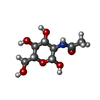 ChemComp-NAG: |
-Experimental details
-Structure determination
| Method | cryo EM |
|---|---|
 Processing Processing | single particle reconstruction |
| Aggregation state | particle |
-Sample preparation
| Concentration | 0.05 mg/mL |
|---|---|
| Buffer | pH: 8 |
| Vitrification | Cryogen name: ETHANE / Chamber humidity: 100 % / Chamber temperature: 290 K / Instrument: FEI VITROBOT MARK IV |
- Electron microscopy
| Microscope | TFS KRIOS |
|---|---|
| Specialist optics | Energy filter - Name: GIF Bioquantum / Energy filter - Slit width: 20 eV |
| Image recording | Film or detector model: GATAN K3 BIOQUANTUM (6k x 4k) / Number real images: 9851 / Average electron dose: 65.0 e/Å2 |
| Electron beam | Acceleration voltage: 300 kV / Electron source:  FIELD EMISSION GUN FIELD EMISSION GUN |
| Electron optics | Illumination mode: FLOOD BEAM / Imaging mode: BRIGHT FIELD / Nominal defocus max: 3.0 µm / Nominal defocus min: 1.0 µm |
| Sample stage | Cooling holder cryogen: NITROGEN |
| Experimental equipment |  Model: Titan Krios / Image courtesy: FEI Company |

