 Movie
Movie Controller


+ Open data

- Basic information
| Entry |  | |||||||||
|---|---|---|---|---|---|---|---|---|---|---|
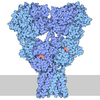
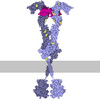
| Title | GluN1/GluN2A in complex with 3D2 Fab, local ATD dimer | |||||||||
 Map data Map data | ||||||||||
 Sample Sample |
| |||||||||
 Keywords Keywords | ligand-gated ion channel / NMDA / antibody / complex / TRANSPORT PROTEIN | |||||||||
| Function / homology |  Function and homology information Function and homology informationregulation of response to alcohol / response to ammonium ion / response to environmental enrichment / neurotransmitter receptor transport, plasma membrane to endosome / directional locomotion / receptor recycling / auditory behavior / pons maturation / EPHB-mediated forward signaling / positive regulation of Schwann cell migration ...regulation of response to alcohol / response to ammonium ion / response to environmental enrichment / neurotransmitter receptor transport, plasma membrane to endosome / directional locomotion / receptor recycling / auditory behavior / pons maturation / EPHB-mediated forward signaling / positive regulation of Schwann cell migration / Assembly and cell surface presentation of NMDA receptors / regulation of cell communication / protein localization to postsynaptic membrane / conditioned taste aversion / response to carbohydrate / sleep / suckling behavior / cellular response to magnesium ion / olfactory learning / response to other organism / serotonin metabolic process / response to methylmercury / response to hydrogen sulfide / dendritic branch / regulation of ARF protein signal transduction / response to glycoside / locomotion / transmitter-gated monoatomic ion channel activity / response to manganese ion / cellular response to dsRNA / regulation of respiratory gaseous exchange / cellular response to lipid / propylene metabolic process / response to glycine / dendritic spine organization / RAF/MAP kinase cascade / positive regulation of inhibitory postsynaptic potential / neuromuscular process / neurotransmitter receptor complex / regulation of NMDA receptor activity / response to amine / Synaptic adhesion-like molecules / NMDA glutamate receptor activity / regulation of monoatomic cation transmembrane transport / cellular response to zinc ion / NMDA selective glutamate receptor complex / glutamate binding / spinal cord development / regulation of axonogenesis / ligand-gated sodium channel activity / startle response / voltage-gated monoatomic cation channel activity / response to morphine / calcium ion transmembrane import into cytosol / dopamine metabolic process / regulation of synapse assembly / male mating behavior / positive regulation of reactive oxygen species biosynthetic process / protein heterotetramerization / regulation of dendrite morphogenesis / glycine binding / glutamate receptor signaling pathway / response to lithium ion / parallel fiber to Purkinje cell synapse / positive regulation of calcium ion transport into cytosol / social behavior / regulation of neuronal synaptic plasticity / associative learning / neuron development / regulation of postsynaptic membrane potential / multicellular organismal response to stress / response to light stimulus / positive regulation of dendritic spine maintenance / monoatomic cation transmembrane transport / modulation of excitatory postsynaptic potential / action potential / cellular response to glycine / positive regulation of protein targeting to membrane / Unblocking of NMDA receptors, glutamate binding and activation / glutamate receptor binding / monoatomic cation transport / ligand-gated monoatomic ion channel activity / prepulse inhibition / conditioned place preference / neurogenesis / phosphatase binding / long-term memory / adult locomotory behavior / calcium ion homeostasis / regulation of long-term neuronal synaptic plasticity / postsynaptic density, intracellular component / response to fungicide / monoatomic cation channel activity / sensory perception of pain / glutamate-gated receptor activity / cellular response to manganese ion / positive regulation of synaptic transmission, glutamatergic / response to amphetamine / glutamate-gated calcium ion channel activity / presynaptic active zone membrane Similarity search - Function | |||||||||
| Biological species |   Rattus norvegicus (Norway rat) / Rattus norvegicus (Norway rat) /  Mus musculus (house mouse) Mus musculus (house mouse) | |||||||||
| Method | single particle reconstruction / cryo EM / Resolution: 2.76 Å | |||||||||
 Authors Authors | Kim J / Gouaux E | |||||||||
| Funding support |  United States, 1 items United States, 1 items
| |||||||||
 Citation Citation | Journal: Sci Adv / Year: 2026 Title: Cryo-EM of autoantibody-bound NMDA receptors reveals antigenic hotspots in an active immunization model of anti-NMDAR encephalitis. Authors: Junhoe Kim / Farzad Jalali-Yazdi / Brian E Jones / Gary L Westbrook / Eric Gouaux / Abstract: Autoantibodies targeting synaptic membrane proteins are associated with autoimmune encephalitis manifested by seizures, psychosis, and memory dysfunction. Anti--methyl-d-aspartate receptor (NMDAR) ...Autoantibodies targeting synaptic membrane proteins are associated with autoimmune encephalitis manifested by seizures, psychosis, and memory dysfunction. Anti--methyl-d-aspartate receptor (NMDAR) encephalitis, a prototype of these autoimmune synaptic disorders, is unexpectedly common. Unfortunately, how the native repertoire of anti-NMDAR autoantibodies recognizes NMDARs and the precise locations of antigenic epitopes remain poorly understood. Here, we used an active immunization model that closely mimics the human disease to immunize adult mice with intact GluN1/GluN2A receptors, resulting in fulminant autoimmune encephalitis. Serum was collected at 6 weeks postimmunization for single-particle cryo-electron microscopy of GluN1/GluN2A receptors complexed with purified polyclonal anti-NMDAR autoantibody fragments. Native autoantibodies recognized two distinct binding sites on the GluN1 amino-terminal domain, which we confirmed using monoclonal antibodies bound to native NMDARs purified from mouse brain. Structural analysis of autoantibody-bound NMDAR complexes identified antigenic hotspots within the GluN1 amino-terminal domain. These hotspots provide potential targets for therapeutic intervention. | |||||||||
| History |
|
- Structure visualization
| Supplemental images |
|---|

- Downloads & links
-EMDB archive
| Map data | emd_72085.map.gz | 257 MB | EMDB map data format | |
|---|---|---|---|---|
| Header (meta data) | emd-72085-v30.xmlemd-72085.xml | 26.7 KB 26.7 KB | Display Display | EMDB header |
| FSC (resolution estimation) | emd_72085_fsc.xml | 16.9 KB | Display | FSC data file |
| Images |  emd_72085.png emd_72085.png | 30 KB | ||
| Filedesc metadata | emd-72085.cif.gz | 7.9 KB | ||
| Others | emd_72085_additional_1.map.gzemd_72085_half_map_1.map.gzemd_72085_half_map_2.map.gz | 2.2 MB 474.9 MB 474.9 MB | ||
| Archive directory |  http://ftp.pdbj.org/pub/emdb/structures/EMD-72085ftp://ftp.pdbj.org/pub/emdb/structures/EMD-72085 http://ftp.pdbj.org/pub/emdb/structures/EMD-72085ftp://ftp.pdbj.org/pub/emdb/structures/EMD-72085 | HTTPS FTP |
-Related structure data
| Related structure data |  9pzxMC  9pzqC  9pzrC  9pzsC  9pztC  9pzuC  9pzvC  9pzwC M: atomic model generated by this map C: citing same article ( |
|---|---|
| Similar structure data |


-Links
| EMDB pages | EMDB (EBI/PDBe) / EMDataResource |
|---|---|
| Related items in Molecule of the Month |
-Map
| File | Download / File: emd_72085.map.gz / Format: CCP4 / Size: 512 MB / Type: IMAGE STORED AS FLOATING POINT NUMBER (4 BYTES) | ||||||||||||||||||||||||||||||||||||
|---|---|---|---|---|---|---|---|---|---|---|---|---|---|---|---|---|---|---|---|---|---|---|---|---|---|---|---|---|---|---|---|---|---|---|---|---|---|
| Projections & slices | Image control
Images are generated by Spider. | ||||||||||||||||||||||||||||||||||||
| Voxel size | X=Y=Z: 0.83 Å | ||||||||||||||||||||||||||||||||||||
| Density |
| ||||||||||||||||||||||||||||||||||||
| Symmetry | Space group: 1 | ||||||||||||||||||||||||||||||||||||
| Details | EMDB XML:
|
 Z (Sec.)
 Y (Row.)
 X (Col.)


-Supplemental data
-Additional map: local filtered map
| File | emd_72085_additional_1.map | ||||||||||||
|---|---|---|---|---|---|---|---|---|---|---|---|---|---|
| Annotation | local filtered map | ||||||||||||
| Projections & Slices |
| ||||||||||||
| Density Histograms |


-Half map: #2
| File | emd_72085_half_map_1.map | ||||||||||||
|---|---|---|---|---|---|---|---|---|---|---|---|---|---|
| Projections & Slices |
| ||||||||||||
| Density Histograms |


-Half map: #1
| File | emd_72085_half_map_2.map | ||||||||||||
|---|---|---|---|---|---|---|---|---|---|---|---|---|---|
| Projections & Slices |
| ||||||||||||
| Density Histograms |


- Sample components
-Entire : GluN1/GluN2A in complex with 3D2 Fab, local ATD dimer
| Entire | Name: GluN1/GluN2A in complex with 3D2 Fab, local ATD dimer |
|---|---|
| Components |
|
-Supramolecule #1: GluN1/GluN2A in complex with 3D2 Fab, local ATD dimer
| Supramolecule | Name: GluN1/GluN2A in complex with 3D2 Fab, local ATD dimer / type: complex / ID: 1 / Parent: 0 / Macromolecule list: #1-#4 |
|---|---|
| Source (natural) | Organism: Rattus norvegicus (Norway rat) |
| Molecular weight | Theoretical: 110 KDa |
-Macromolecule #1: Glutamate receptor ionotropic, NMDA 1
| Macromolecule | Name: Glutamate receptor ionotropic, NMDA 1 / type: protein_or_peptide / ID: 1 / Number of copies: 1 / Enantiomer: LEVO |
|---|---|
| Source (natural) | Organism: Rattus norvegicus (Norway rat) |
| Molecular weight | Theoretical: 95.372164 KDa |
| Recombinant expression | Organism:  Homo sapiens (human) Homo sapiens (human) |
| Sequence | String: MSTMHLLTFA LLFSCSFARA ACDPKIVNIG AVLSTRKHEQ MFREAVNQAN KRHGSWKIQL NATSVTHKPN AIQMALSVCE DLISSQVYA ILVSHPPTPN DHFTPTPVSY TAGFYRIPVL GLTTRMSIYS DKSIHLSFLR TVPPYSHQSS VWFEMMRVYN W NHIILLVS ...String: MSTMHLLTFA LLFSCSFARA ACDPKIVNIG AVLSTRKHEQ MFREAVNQAN KRHGSWKIQL NATSVTHKPN AIQMALSVCE DLISSQVYA ILVSHPPTPN DHFTPTPVSY TAGFYRIPVL GLTTRMSIYS DKSIHLSFLR TVPPYSHQSS VWFEMMRVYN W NHIILLVS DDHEGRAAQK RLETLLEERE SKAEKVLQFD PGTKNVTALL MEARELEARV IILSASEDDA ATVYRAAAML NM TGSGYVW LVGEREISGN ALRYAPDGII GLQLINGKNE SAHISDAVGV VAQAVHELLE KENITDPPRG CVGNTNIWKT GPL FKRVLM SSKYADGVTG RVEFNEDGDR KFANYSIMNL QNRKLVQVGI YNGTHVIPND RKIIWPGGET EKPRGYQMST RLKI VTIHQ EPFVYVKPTM SDGTCKEEFT VNGDPVKKVI CTGPNDTSPG SPRHTVPQCC YGFCIDLLIK LARTMNFTYE VHLVA DGKF GTQERVNNSN KKEWNGMMGE LLSGQADMIV APLTINNERA QYIEFSKPFK YQGLTILVKK EIPRSTLDSF MQPFQS TLW LLVGLSVHVV AVMLYLLDRF SPFGRFKVNS EEEEEDALTL SSAMWFSWGV LLNSGIGEGA PRSFSARILG MVWAGFA MI IVASYTANLA AFLVLDRPEE RITGINDPRL RNPSDKFIYA TVKQSSVDIY FRRQVELSTM YRHMEKHNYE SAAEAIQA V RDNKLHAFIW DSAVLEFEAS QKCDLVTTGE LFFRSGFGIG MRKDSPWKQN VSLSILKSHE NGFMEDLDKT WVRYQECDS RSNAPATLTF ENMAGVFMLV AGGIVAGIFL IFIEIAYKRH KDARRKQ UniProtKB: Glutamate receptor ionotropic, NMDA 1 |
-Macromolecule #2: Glutamate receptor ionotropic, NMDA 2A
| Macromolecule | Name: Glutamate receptor ionotropic, NMDA 2A / type: protein_or_peptide / ID: 2 / Number of copies: 1 / Enantiomer: LEVO |
|---|---|
| Source (natural) | Organism: Rattus norvegicus (Norway rat) |
| Molecular weight | Theoretical: 97.163359 KDa |
| Recombinant expression | Organism: Homo sapiens (human) |
| Sequence | String: MGRLGYWTLL VLPALLVWRD PAQNAAAEKG PPALNIAVLL GHSHDVTERE LRNLWGPEQA TGLPLDVNVV ALLMNRTDPK SLITHVCDL MSGARIHGLV FGDDTDQEAV AQMLDFISSQ TFIPILGIHG GASMIMADKD PTSTFFQFGA SIQQQATVML K IMQDYDWH ...String: MGRLGYWTLL VLPALLVWRD PAQNAAAEKG PPALNIAVLL GHSHDVTERE LRNLWGPEQA TGLPLDVNVV ALLMNRTDPK SLITHVCDL MSGARIHGLV FGDDTDQEAV AQMLDFISSQ TFIPILGIHG GASMIMADKD PTSTFFQFGA SIQQQATVML K IMQDYDWH VFSLVTTIFP GYRDFISFIK TTVDNSFVGW DMQNVITLDT SFEDAKTQVQ LKKIHSSVIL LYCSKDEAVL IL SEARSLG LTGYDFFWIV PSLVSGNTEL IPKEFPSGLI SVSYDDWDYS LEARVRDGLG ILTTAASSML EKFSYIPEAK ASC YGQAEK PETPLHTLHQ FMVNVTWDGK DLSFTEEGYQ VHPRLVVIVL NKDREWEKVG KWENQTLSLR HAVWPRYKSF SDCE PDDNH LSIVTLEEAP FVIVEDIDPL TETCVRNTVP CRKFVKINNS TNEGMNVKKC CKGFCIDILK KLSRTVKFTY DLYLV TNGK HGKKVNNVWN GMIGEVVYQR AVMAVGSLTI NEERSEVVDF SVPFVETGIS VMVSRSNGTV SPSAFLEPFS ASVWVM MFV MLLIVSAIAV FVFEYFSPVG YNRNLAKGKA PHGPSFTIGK AIWLLWGLVF NNSVPVQNPK GTTSKIMVSV WAFFAVI FL ASYTANLAAF MIQEEFVDQV TGLSDKKFQR PHDYSPPFRF GTVPNGSTER NIRNNYPYMH QYMTRFNQRG VEDALVSL K TGKLDAFIYD AAVLNYKAGR DEGCKLVTIG SGYIFATTGY GIALQKGSPW KRQIDLALLQ FVGDGEMEEL ETLWLTGIC HNEKNEVMSS QLDIDNMAGV FYMLAAAMAL SLITFIWEHL FYWKLRFCFT GVCSDRPGLL FSISRG UniProtKB: Glutamate receptor ionotropic, NMDA 2A |
-Macromolecule #3: Heavy chain of GluN2A-specific monoclonal Fab fragment, termed 3D2
| Macromolecule | Name: Heavy chain of GluN2A-specific monoclonal Fab fragment, termed 3D2 type: protein_or_peptide / ID: 3 / Number of copies: 1 / Enantiomer: LEVO |
|---|---|
| Source (natural) | Organism: Mus musculus (house mouse) |
| Molecular weight | Theoretical: 15.448522 KDa |
| Recombinant expression | Organism: Homo sapiens (human) |
| Sequence | String: MVSAIVLYVL LAAAAHSAFA QVQLQQSGAE LMKPGASVKI SCKATGYTFR SYWIEWLKQR PGHGLEWIGE ILPGSGRTNY NEKFKGKAT ITADTSSNTA YMQLSSLTSE DSAVYYCTRS RGTMITREFT YWGQGALVTV SA |
-Macromolecule #4: Light chain of GluN2A-specific monoclonal Fab fragment, termed 3D2
| Macromolecule | Name: Light chain of GluN2A-specific monoclonal Fab fragment, termed 3D2 type: protein_or_peptide / ID: 4 / Number of copies: 1 / Enantiomer: LEVO |
|---|---|
| Source (natural) | Organism: Mus musculus (house mouse) |
| Molecular weight | Theoretical: 13.989831 KDa |
| Recombinant expression | Organism: Homo sapiens (human) |
| Sequence | String: MVSAIVLYVL LAAAAHSAFA DIVLTQSPAS LAVSLGQRAT ISCRASESVE YYGTTLMQWY QQKPGQPPKL LIYAASNVDS GVPARFSGS GSGTDFSLNI HPVEEDDIAM YFCQQSRKVP STFGGGTKLE IK |
-Macromolecule #6: 2-acetamido-2-deoxy-beta-D-glucopyranose
| Macromolecule | Name: 2-acetamido-2-deoxy-beta-D-glucopyranose / type: ligand / ID: 6 / Number of copies: 4 / Formula: NAG |
|---|---|
| Molecular weight | Theoretical: 221.208 Da |
| Chemical component information | 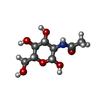 ChemComp-NAG: |
-Experimental details
-Structure determination
| Method | cryo EM |
|---|---|
 Processing Processing | single particle reconstruction |
| Aggregation state | particle |
-Sample preparation
| Concentration | 0.05 mg/mL |
|---|---|
| Buffer | pH: 8 |
| Vitrification | Cryogen name: ETHANE / Chamber humidity: 100 % / Chamber temperature: 290 K / Instrument: FEI VITROBOT MARK IV |
- Electron microscopy
| Microscope | TFS KRIOS |
|---|---|
| Specialist optics | Energy filter - Name: GIF Bioquantum / Energy filter - Slit width: 20 eV |
| Image recording | Film or detector model: GATAN K3 BIOQUANTUM (6k x 4k) / Number real images: 6721 / Average electron dose: 50.0 e/Å2 |
| Electron beam | Acceleration voltage: 300 kV / Electron source:  FIELD EMISSION GUN FIELD EMISSION GUN |
| Electron optics | Illumination mode: FLOOD BEAM / Imaging mode: BRIGHT FIELD / Nominal defocus max: 3.0 µm / Nominal defocus min: 1.0 µm |
| Sample stage | Cooling holder cryogen: NITROGEN |
| Experimental equipment |  Model: Titan Krios / Image courtesy: FEI Company |

