 Movie
Movie Controller


+ Open data

- Basic information
| Entry | Database: PDB / ID: 9og9 | ||||||||||||||||||||||||
|---|---|---|---|---|---|---|---|---|---|---|---|---|---|---|---|---|---|---|---|---|---|---|---|---|---|
| Title | Cryo-EM structure of human full-length XPO1 (unliganded) | ||||||||||||||||||||||||
 Components Components | Exportin-1 | ||||||||||||||||||||||||
 Keywords Keywords | PROTEIN TRANSPORT / nuclear export / HEAT repeat | ||||||||||||||||||||||||
| Function / homology |  Function and homology information Function and homology informationcellular response to triglyceride / cellular response to salt / HuR (ELAVL1) binds and stabilizes mRNA / annulate lamellae / nuclear export signal receptor activity / regulation of proteasomal ubiquitin-dependent protein catabolic process / Rev-mediated nuclear export of HIV RNA / NEP/NS2 Interacts with the Cellular Export Machinery / nucleocytoplasmic transport / Maturation of hRSV A proteins ...cellular response to triglyceride / cellular response to salt / HuR (ELAVL1) binds and stabilizes mRNA / annulate lamellae / nuclear export signal receptor activity / regulation of proteasomal ubiquitin-dependent protein catabolic process / Rev-mediated nuclear export of HIV RNA / NEP/NS2 Interacts with the Cellular Export Machinery / nucleocytoplasmic transport / Maturation of hRSV A proteins / Estrogen-dependent nuclear events downstream of ESR-membrane signaling / ribosomal large subunit export from nucleus / protein export from nucleus / Cajal body / ribosomal subunit export from nucleus / mRNA export from nucleus / Cyclin A/B1/B2 associated events during G2/M transition / NPAS4 regulates expression of target genes / ribosomal small subunit export from nucleus / Transcriptional and post-translational regulation of MITF-M expression and activity / Amplification of signal from unattached kinetochores via a MAD2 inhibitory signal / Mitotic Prometaphase / EML4 and NUDC in mitotic spindle formation / Resolution of Sister Chromatid Cohesion / Downregulation of TGF-beta receptor signaling / Heme signaling / Maturation of DENV proteins / RHO GTPases Activate Formins / Deactivation of the beta-catenin transactivating complex / MAPK6/MAPK4 signaling / kinetochore / small GTPase binding / Separation of Sister Chromatids / nuclear envelope / ribosome biogenesis / DNA-binding transcription factor binding / response to xenobiotic stimulus / ribonucleoprotein complex / protein domain specific binding / nucleolus / negative regulation of transcription by RNA polymerase II / protein-containing complex / nucleoplasm / membrane / cytosol / cytoplasm Similarity search - Function | ||||||||||||||||||||||||
| Biological species |  Homo sapiens (human) Homo sapiens (human) | ||||||||||||||||||||||||
| Method | ELECTRON MICROSCOPY / single particle reconstruction / cryo EM / Resolution: 2.93 Å | ||||||||||||||||||||||||
 Authors Authors | Wing, C.E. / Fung, H.Y.J. / Chook, Y.M. | ||||||||||||||||||||||||
| Funding support |  United States, 7items United States, 7items
| ||||||||||||||||||||||||
 Citation Citation | Journal: Nat Chem Biol / Year: 2025 Title: SINE compounds activate exportin 1 degradation through an allosteric mechanism. Authors: Casey E Wing / Ho Yee Joyce Fung / Bert Kwanten / Tolga Cagatay / Ashley B Niesman / Maarten Jacquemyn / Mehdi Gharghabi / Brecht Permentier / Binita Shakya / Rhituparna Nandi / Joseph M ...Authors: Casey E Wing / Ho Yee Joyce Fung / Bert Kwanten / Tolga Cagatay / Ashley B Niesman / Maarten Jacquemyn / Mehdi Gharghabi / Brecht Permentier / Binita Shakya / Rhituparna Nandi / Joseph M Ready / Trinayan Kashyap / Sharon Shacham / Yosef Landesman / Rosa Lapalombella / Dirk Daelemans / Yuh Min Chook /  Abstract: Overexpression of exportin 1 (XPO1/CRM1) in cancer cells mislocalizes numerous cancer-related nuclear export cargoes. Covalent selective inhibitors of nuclear export (SINEs), including the cancer ...Overexpression of exportin 1 (XPO1/CRM1) in cancer cells mislocalizes numerous cancer-related nuclear export cargoes. Covalent selective inhibitors of nuclear export (SINEs), including the cancer drug selinexor, restore proper nuclear localization by blocking XPO1-cargo interaction. These inhibitors also induce XPO1 degradation through the Cullin-RING E3 ligase (CRL) substrate receptor ASB8. Here we present cryo-electron microscopy structures revealing ASB8 binding to a cryptic XPO1 site that is exposed upon SINE conjugation. Unlike typical molecular glue degraders that directly bridge CRLs and substrates, SINEs bind XPO1 independently of ASB8, triggering an allosteric mechanism that enables high-affinity ASB8 recruitment, leading to XPO1 ubiquitination and degradation. ASB8-mediated degradation is also triggered by the endogenous itaconate derivative 4-octyl itaconate, suggesting that synthetic XPO1 inhibitors exploit a native cellular mechanism. This allosteric XPO1 degradation mechanism expands known modes of targeted protein degradation beyond molecular glue degraders and proteolysis-targeting chimeras of CRL4. | ||||||||||||||||||||||||
| History |
|
- Structure visualization
| Structure viewer | Molecule: MolmilJmol/JSmol |
|---|
- Downloads & links
-Download
| PDBx/mmCIF format | 9og9.cif.gz | 321.6 KB | Display | PDBx/mmCIF format |
|---|---|---|---|---|
| PDB format | pdb9og9.ent.gz | 253.5 KB | Display | PDB format |
| PDBx/mmJSON format | 9og9.json.gz | Tree view | PDBx/mmJSON format | |
| Others |  Other downloads Other downloads |
-Validation report
| Arichive directory | https://data.pdbj.org/pub/pdb/validation_reports/og/9og9ftp://data.pdbj.org/pub/pdb/validation_reports/og/9og9 | HTTPS FTP |
|---|
-Related structure data
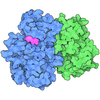
| Related structure data |  70458MC  9ogaC  9ogbC  9ogcC  9ogdC  9ogeC  9ogfC  9ognC  9ogoC M: map data used to model this data C: citing same article ( |
|---|---|
| Similar structure data |


-Links
 PDBj
PDBj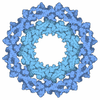


- Assembly
| Deposited unit | 
|
|---|---|
| 1 |
|
-Components
| #1: Protein | Mass: 123662.484 Da / Num. of mol.: 1 Source method: isolated from a genetically manipulated source Details: GS remaining after TEV cleavage / Source: (gene. exp.) Homo sapiens (human) / Gene: XPO1, CRM1 / Plasmid: pGEX4TT3 / Production host:   Escherichia coli BL21(DE3) (bacteria) / References: UniProt: O14980 Escherichia coli BL21(DE3) (bacteria) / References: UniProt: O14980 |
|---|---|
| Has protein modification | N |
-Experimental details
-Experiment
| Experiment | Method: ELECTRON MICROSCOPY |
|---|---|
| EM experiment | Aggregation state: PARTICLE / 3D reconstruction method: single particle reconstruction |
- Sample preparation
| Component | Name: Human full-length unliganded exportin-1 (XPO1) / Type: COMPLEX / Entity ID: all / Source: RECOMBINANT |
|---|---|
| Molecular weight | Value: 0.123 MDa / Experimental value: NO |
| Source (natural) | Organism: Homo sapiens (human) |
| Source (recombinant) | Organism: Escherichia coli (E. coli) / Strain: BL21(DE3) / Plasmid: pGEX4TT3 |
| Buffer solution | pH: 7.4 Details: 20 mM HEPES pH 7.4, 110 mM KOAc, 2 mM Mg(OAc)2, 2 mM TCEP |
| Specimen | Conc.: 3.4 mg/ml / Embedding applied: NO / Shadowing applied: NO / Staining applied: NO / Vitrification applied: YES |
| Specimen support | Grid material: COPPER / Grid mesh size: 300 divisions/in. / Grid type: Quantifoil R1.2/1.3 |
| Vitrification | Instrument: FEI VITROBOT MARK IV / Cryogen name: ETHANE / Humidity: 95 % / Chamber temperature: 377 K |
- Electron microscopy imaging
| Experimental equipment |  Model: Titan Krios / Image courtesy: FEI Company |
|---|---|
| Microscopy | Model: TFS KRIOS |
| Electron gun | Electron source:  FIELD EMISSION GUN / Accelerating voltage: 300 kV / Illumination mode: FLOOD BEAM FIELD EMISSION GUN / Accelerating voltage: 300 kV / Illumination mode: FLOOD BEAM |
| Electron lens | Mode: BRIGHT FIELD / Nominal magnification: 165000 X / Nominal defocus max: 2200 nm / Nominal defocus min: 900 nm |
| Specimen holder | Specimen holder model: FEI TITAN KRIOS AUTOGRID HOLDER |
| Image recording | Electron dose: 60 e/Å2 / Film or detector model: FEI FALCON IV (4k x 4k) / Num. of grids imaged: 1 / Num. of real images: 8568 |
| EM imaging optics | Energyfilter name: TFS Selectris X / Energyfilter slit width: 10 eV |
- Processing
| EM software |
| |||||||||||||||||||||||||||||||||||||||
|---|---|---|---|---|---|---|---|---|---|---|---|---|---|---|---|---|---|---|---|---|---|---|---|---|---|---|---|---|---|---|---|---|---|---|---|---|---|---|---|---|
| CTF correction | Type: PHASE FLIPPING AND AMPLITUDE CORRECTION | |||||||||||||||||||||||||||||||||||||||
| Particle selection | Num. of particles selected: 1245354 / Details: blob picking followed by Topaz picking | |||||||||||||||||||||||||||||||||||||||
| 3D reconstruction | Resolution: 2.93 Å / Resolution method: FSC 0.143 CUT-OFF / Num. of particles: 365756 / Symmetry type: POINT | |||||||||||||||||||||||||||||||||||||||
| Atomic model building | B value: 124.05 / Protocol: OTHER / Space: REAL Details: Initial model was docked into maps using UCSF ChimeraX then manually built using Isolde and Coot and refined in PHENIX | |||||||||||||||||||||||||||||||||||||||
| Atomic model building | PDB-ID: 3GB8 Pdb chain-ID: A / Accession code: 3GB8 / Source name: PDB / Type: experimental model | |||||||||||||||||||||||||||||||||||||||
| Refinement | Cross valid method: NONE Stereochemistry target values: GeoStd + Monomer Library + CDL v1.2 | |||||||||||||||||||||||||||||||||||||||
| Displacement parameters | Biso mean: 124.05 Å2 | |||||||||||||||||||||||||||||||||||||||
| Refine LS restraints |
|

