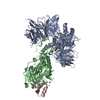
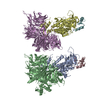
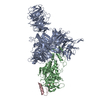
Movie
Movie Controller

[English] 日本語
 Yorodumi
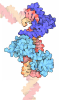
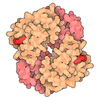
- PDB-9nwt: Cryo-EM structure of DDB1dB:CRBN:mezigdomide:SALL4(392-449;G416A) -
+ Open data

- Basic information
| Entry | Database: PDB / ID: 9nwt | |||||||||||||||||||||||||||||||||
|---|---|---|---|---|---|---|---|---|---|---|---|---|---|---|---|---|---|---|---|---|---|---|---|---|---|---|---|---|---|---|---|---|---|---|
| Title | Cryo-EM structure of DDB1dB:CRBN:mezigdomide:SALL4(392-449;G416A) | |||||||||||||||||||||||||||||||||
 Components Components |
| |||||||||||||||||||||||||||||||||
 Keywords Keywords | LIGASE / DDB1 / cereblon / mezigdomide / SALL4 | |||||||||||||||||||||||||||||||||
| Function / homology |  Function and homology information Function and homology informationPOU5F1 (OCT4), SOX2, NANOG activate genes related to proliferation / Transcriptional regulation of pluripotent stem cells / negative regulation of monoatomic ion transmembrane transport / positive regulation by virus of viral protein levels in host cell / spindle assembly involved in female meiosis / embryonic limb morphogenesis / epigenetic programming in the zygotic pronuclei / UV-damage excision repair / inner cell mass cell proliferation / ventricular septum development ...POU5F1 (OCT4), SOX2, NANOG activate genes related to proliferation / Transcriptional regulation of pluripotent stem cells / negative regulation of monoatomic ion transmembrane transport / positive regulation by virus of viral protein levels in host cell / spindle assembly involved in female meiosis / embryonic limb morphogenesis / epigenetic programming in the zygotic pronuclei / UV-damage excision repair / inner cell mass cell proliferation / ventricular septum development / biological process involved in interaction with symbiont / limb development / regulation of mitotic cell cycle phase transition / WD40-repeat domain binding / Cul4A-RING E3 ubiquitin ligase complex / Cul4-RING E3 ubiquitin ligase complex / Cul4B-RING E3 ubiquitin ligase complex / ubiquitin ligase complex scaffold activity / negative regulation of reproductive process / negative regulation of developmental process / locomotory exploration behavior / somatic stem cell population maintenance / viral release from host cell / cullin family protein binding / ectopic germ cell programmed cell death / positive regulation of Wnt signaling pathway / positive regulation of viral genome replication / negative regulation of protein-containing complex assembly / heterochromatin / proteasomal protein catabolic process / positive regulation of gluconeogenesis / Regulation of PTEN gene transcription / nucleotide-excision repair / neural tube closure / sperm end piece / positive regulation of protein-containing complex assembly / regulation of circadian rhythm / Recognition of DNA damage by PCNA-containing replication complex / DNA Damage Recognition in GG-NER / Dual Incision in GG-NER / Transcription-Coupled Nucleotide Excision Repair (TC-NER) / Formation of TC-NER Pre-Incision Complex / Wnt signaling pathway / Formation of Incision Complex in GG-NER / Dual incision in TC-NER / Gap-filling DNA repair synthesis and ligation in TC-NER / positive regulation of protein catabolic process / cellular response to UV / rhythmic process / site of double-strand break / sperm principal piece / Neddylation / sperm midpiece / Potential therapeutics for SARS / ubiquitin-dependent protein catabolic process / damaged DNA binding / transmembrane transporter binding / proteasome-mediated ubiquitin-dependent protein catabolic process / protein-macromolecule adaptor activity / DNA-binding transcription factor activity, RNA polymerase II-specific / chromosome, telomeric region / protein ubiquitination / DNA repair / apoptotic process / DNA damage response / regulation of transcription by RNA polymerase II / negative regulation of apoptotic process / protein-containing complex binding / nucleolus / perinuclear region of cytoplasm / negative regulation of transcription by RNA polymerase II / positive regulation of transcription by RNA polymerase II / protein-containing complex / : / DNA binding / extracellular exosome / zinc ion binding / nucleoplasm / membrane / metal ion binding / nucleus / cytoplasm / cytosol Similarity search - Function | |||||||||||||||||||||||||||||||||
| Biological species |  Homo sapiens (human) Homo sapiens (human) | |||||||||||||||||||||||||||||||||
| Method | ELECTRON MICROSCOPY / single particle reconstruction / cryo EM / Resolution: 2.7 Å | |||||||||||||||||||||||||||||||||
 Authors Authors | Park, J. / Hunkeler, M. / Roy Burman, S.S. / Fischer, E.S. | |||||||||||||||||||||||||||||||||
| Funding support |  United States, 1items United States, 1items
| |||||||||||||||||||||||||||||||||
 Citation Citation | Journal: Mol Cell / Year: 2025 Title: Expanding the druggable zinc-finger proteome defines properties of drug-induced degradation. Authors: Mikołaj Słabicki / Jiho Park / Radosław P Nowak / Shourya S Roy Burman / Jesse Pellman / Charles Zou / Hlib Razumkov / Jeannie Carreiro / Simran Rastogi / Anna Goldstein / Marek M Nagiec ...Authors: Mikołaj Słabicki / Jiho Park / Radosław P Nowak / Shourya S Roy Burman / Jesse Pellman / Charles Zou / Hlib Razumkov / Jeannie Carreiro / Simran Rastogi / Anna Goldstein / Marek M Nagiec / Katherine A Donovan / Jianwei Che / Moritz Hunkeler / Qixiang Geng / Chi-Lin Hsu / Megha Lakshminarayan / Chelsea Shu / Rebecca L Zon / Zuzanna Kozicka / Paul M C Park / Jonathan M Tsai / Hojong Yoon / Lyn H Jones / Adam S Sperling / Nathanael S Gray / Eric S Fischer / Benjamin L Ebert /  Abstract: Glutarimide analogs, such as thalidomide, redirect the E3 ubiquitin ligase CRL4 to induce degradation of certain zinc finger (ZF) proteins. Although the core structural motif recognized by CRBN has ...Glutarimide analogs, such as thalidomide, redirect the E3 ubiquitin ligase CRL4 to induce degradation of certain zinc finger (ZF) proteins. Although the core structural motif recognized by CRBN has been characterized, it does not fully explain substrate specificity. To explore the role of residues adjacent to this core motif, we constructed a comprehensive ZF reporter library of 9,097 reporters derived from 1,655 human ZF proteins and conducted a library-on-library screen with 29 glutarimide analogs to identify compounds that collectively degrade 38 ZF reporters. Cryo-electron microscopy and crystal structures of ZFs in complex with CRBN revealed the importance of interactions beyond the core ZF degron. We used systematic mutagenesis of ZFs and CRBN to identify modes of neosubstrate recruitment requiring distinct amino acids. Finally, we found subtle chemical variations in glutarimide analogs that alter target scope and selectivity, thus providing a roadmap for their rational design. | |||||||||||||||||||||||||||||||||
| History |
|
- Structure visualization
| Structure viewer | Molecule: MolmilJmol/JSmol |
|---|
- Downloads & links
-Download
| PDBx/mmCIF format | 9nwt.cif.gz | 587.6 KB | Display | PDBx/mmCIF format |
|---|---|---|---|---|
| PDB format | pdb9nwt.ent.gz | 385.7 KB | Display | PDB format |
| PDBx/mmJSON format | 9nwt.json.gz | Tree view | PDBx/mmJSON format | |
| Others |  Other downloads Other downloads |
-Validation report
| Arichive directory | https://data.pdbj.org/pub/pdb/validation_reports/nw/9nwtftp://data.pdbj.org/pub/pdb/validation_reports/nw/9nwt | HTTPS FTP |
|---|
-Related structure data
| Related structure data |  49893MC  9e2uC  9nwsC M: map data used to model this data C: citing same article ( |
|---|---|
| Similar structure data |


-Links
 PDBj
PDBj

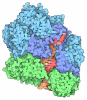
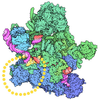
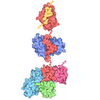
- Assembly
| Deposited unit | 
|
|---|---|
| 1 |
|
-Components
| #1: Protein | Mass: 11507.800 Da / Num. of mol.: 1 / Mutation: G416A Source method: isolated from a genetically manipulated source Details: StrepII-Avi-TEV-SALL4(392-449;G416A) / Source: (gene. exp.) Homo sapiens (human) / Gene: SALL4, ZNF797 / Cell line (production host): High Five / Production host:  Trichoplusia ni (cabbage looper) / References: UniProt: Q9UJQ4 Trichoplusia ni (cabbage looper) / References: UniProt: Q9UJQ4 | ||||||
|---|---|---|---|---|---|---|---|
| #2: Protein | Mass: 96033.945 Da / Num. of mol.: 1 Source method: isolated from a genetically manipulated source Details: His6-TEV-DDB1(1-1140), with residues 396-705 replaced with a GNGNSG linker,His6-TEV-DDB1(1-1140), with residues 396-705 replaced with a GNGNSG linker,His6-TEV-DDB1(1-1140), with residues 396- ...Details: His6-TEV-DDB1(1-1140), with residues 396-705 replaced with a GNGNSG linker,His6-TEV-DDB1(1-1140), with residues 396-705 replaced with a GNGNSG linker,His6-TEV-DDB1(1-1140), with residues 396-705 replaced with a GNGNSG linker,His6-TEV-DDB1(1-1140), with residues 396-705 replaced with a GNGNSG linker Source: (gene. exp.) Homo sapiens (human) / Gene: DDB1, XAP1 / Cell line (production host): High Five / Production host: Trichoplusia ni (cabbage looper) / References: UniProt: Q16531 | ||||||
| #3: Protein | Mass: 55144.594 Da / Num. of mol.: 1 Source method: isolated from a genetically manipulated source Details: FLAG-Spy-TEV-CRBN(1-442) / Source: (gene. exp.) Homo sapiens (human) / Gene: CRBN / Cell line (production host): High Five / Production host: Trichoplusia ni (cabbage looper) / References: UniProt: Q96SW2 | ||||||
| #4: Chemical |  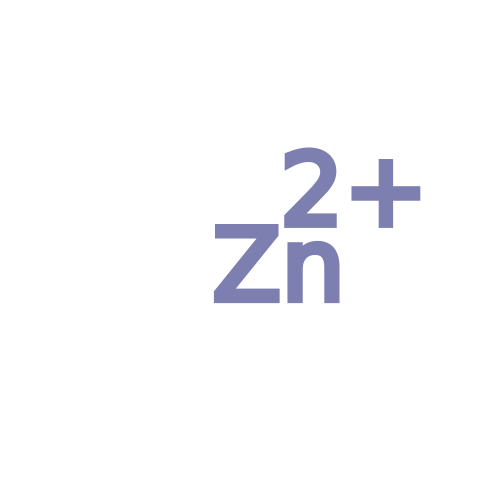 Mass: 65.409 Da / Num. of mol.: 2 / Source method: obtained synthetically / Formula: Zn Mass: 65.409 Da / Num. of mol.: 2 / Source method: obtained synthetically / Formula: Zn#5: Chemical | ChemComp-QFC / |  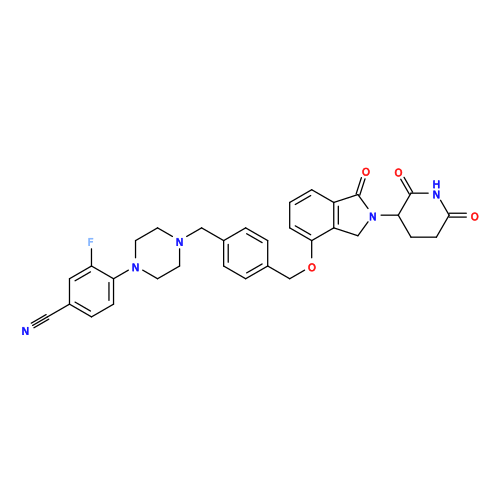 Mass: 567.610 Da / Num. of mol.: 1 / Source method: obtained synthetically / Formula: C32H30FN5O4 / Feature type: SUBJECT OF INVESTIGATION Mass: 567.610 Da / Num. of mol.: 1 / Source method: obtained synthetically / Formula: C32H30FN5O4 / Feature type: SUBJECT OF INVESTIGATIONHas ligand of interest | Y | Has protein modification | N | |
-Experimental details
-Experiment
| Experiment | Method: ELECTRON MICROSCOPY |
|---|---|
| EM experiment | Aggregation state: PARTICLE / 3D reconstruction method: single particle reconstruction |
- Sample preparation
| Component | Name: Ternary complex of DDB1dB:CRBN:mezigdomide:SALL4(392-449;G416A) Type: COMPLEX / Entity ID: #1-#3 / Source: RECOMBINANT | ||||||||||||||||||||
|---|---|---|---|---|---|---|---|---|---|---|---|---|---|---|---|---|---|---|---|---|---|
| Source (natural) | Organism: Homo sapiens (human) | ||||||||||||||||||||
| Source (recombinant) | Organism: Trichoplusia ni (cabbage looper) / Strain: High Five | ||||||||||||||||||||
| Buffer solution | pH: 7.4 / Details: 50 mM HEPES/NaOH pH 7.4, 150 mM NaCl, 3 mM TCEP | ||||||||||||||||||||
| Buffer component |
| ||||||||||||||||||||
| Specimen | Embedding applied: NO / Shadowing applied: NO / Staining applied: NO / Vitrification applied: YES Details: 10 uM His6-DDB1dB:FLAG-Spy-CRBN, 100 uM mezigdomide, and 20 uM StrepII-Avi-SALL4(392-449;G416A) were mixed in dilution buffer (50 mM HEPES/NaOH pH 7.4, 150 mM NaCl, 3 mM TCEP) and incubated ...Details: 10 uM His6-DDB1dB:FLAG-Spy-CRBN, 100 uM mezigdomide, and 20 uM StrepII-Avi-SALL4(392-449;G416A) were mixed in dilution buffer (50 mM HEPES/NaOH pH 7.4, 150 mM NaCl, 3 mM TCEP) and incubated for 1 hr. Additional dilution buffer was added to the mixture to achieve final concentrations of 1.6 uM DDB1dB:CRBN, 16.0 uM mezigdomide, and 3.2 uM SALL4(392-449;G416A), and 4 uL of the diluted mixture were applied to the grid. | ||||||||||||||||||||
| Specimen support | Grid material: GOLD / Grid mesh size: 300 divisions/in. / Grid type: Quantifoil R0.6/1 | ||||||||||||||||||||
| Vitrification | Instrument: LEICA EM GP / Cryogen name: ETHANE / Humidity: 90 % / Chamber temperature: 283 K Details: UltrAuFoil R 0.6/1 300 mesh grids were glow-discharged for 2 min at 20 mA and 39 Pa, pre-incubated with 4 uL of 10 uM FLAG-IKZF1(140-196;Q146A/G151N) for 1 min, and blotted from behind for 4 ...Details: UltrAuFoil R 0.6/1 300 mesh grids were glow-discharged for 2 min at 20 mA and 39 Pa, pre-incubated with 4 uL of 10 uM FLAG-IKZF1(140-196;Q146A/G151N) for 1 min, and blotted from behind for 4 s. 4 uL of the sample was then applied to the grid. Grids were vitrified using an EM GP plunge freezer operated at 90% humidity and 10 C with 0 s pre-blot, 4 s blot, and 0 s post-blot. |
- Electron microscopy imaging
| Experimental equipment |  Model: Titan Krios / Image courtesy: FEI Company |
|---|---|
| Microscopy | Model: TFS KRIOS |
| Electron gun | Electron source:  FIELD EMISSION GUN / Accelerating voltage: 300 kV / Illumination mode: FLOOD BEAM FIELD EMISSION GUN / Accelerating voltage: 300 kV / Illumination mode: FLOOD BEAM |
| Electron lens | Mode: BRIGHT FIELD / Nominal magnification: 105000 X / Nominal defocus max: 2400 nm / Nominal defocus min: 1000 nm / Cs: 2.7 mm / C2 aperture diameter: 50 µm / Alignment procedure: COMA FREE |
| Specimen holder | Cryogen: HELIUM / Specimen holder model: FEI TITAN KRIOS AUTOGRID HOLDER |
| Image recording | Average exposure time: 2.8 sec. / Electron dose: 55.3 e/Å2 / Film or detector model: GATAN K3 BIOQUANTUM (6k x 4k) / Num. of grids imaged: 1 / Num. of real images: 12502 Details: One movie was recorded per hole with 25 holes per stage position |
| EM imaging optics | Energyfilter name: GIF Bioquantum / Energyfilter slit width: 20 eV |
- Processing
| EM software |
| ||||||||||||||||||||||||||||||||||||||||
|---|---|---|---|---|---|---|---|---|---|---|---|---|---|---|---|---|---|---|---|---|---|---|---|---|---|---|---|---|---|---|---|---|---|---|---|---|---|---|---|---|---|
| CTF correction | Type: PHASE FLIPPING AND AMPLITUDE CORRECTION | ||||||||||||||||||||||||||||||||||||||||
| Particle selection | Num. of particles selected: 9479675 Details: Particles were picked using Topaz (v0.2.5) trained on templates from on-the-fly 2D classification | ||||||||||||||||||||||||||||||||||||||||
| Symmetry | Point symmetry: C1 (asymmetric) | ||||||||||||||||||||||||||||||||||||||||
| 3D reconstruction | Resolution: 2.7 Å / Resolution method: FSC 0.143 CUT-OFF / Num. of particles: 479953 / Algorithm: FOURIER SPACE Details: Particles were re-extracted at 0.83 A/pixel, and subsequently processed by reference-based motion correction and global CTF refinement (per-group beam tilt and trefoil). Homogeneous ...Details: Particles were re-extracted at 0.83 A/pixel, and subsequently processed by reference-based motion correction and global CTF refinement (per-group beam tilt and trefoil). Homogeneous refinement of these processed particles followed by local refinement with a mask encompassing the full particle yielded a final reconstruction at 2.7 A. A local refinement using the CRBN:drug:ZF-focused mask further improved drug and ZF density. Symmetry type: POINT | ||||||||||||||||||||||||||||||||||||||||
| Atomic model building | Space: REAL Details: Sharpened and unsharpened maps processed by cryoSPARC, in addition to maps post-processed with DeepEMhancer (v0.16), were used for model building. A previously-built model of DDB1dB:CRBN: ...Details: Sharpened and unsharpened maps processed by cryoSPARC, in addition to maps post-processed with DeepEMhancer (v0.16), were used for model building. A previously-built model of DDB1dB:CRBN:mezigdomide:SALL4(392-449) was fit into the density as individual chains using ChimeraX (v1.6.1). Using the same ligand restraint file described above, the model was relaxed into the density using Rosetta (v3.13) followed by manual adjustment in Coot. The model was prepared for refinement using phenix.ready_set (v1.21-5207) and refined using phenix.real_space_refine (v1.21-5207). | ||||||||||||||||||||||||||||||||||||||||
| Atomic model building | 3D fitting-ID: 1 / Source name: PDB / Type: experimental model
| ||||||||||||||||||||||||||||||||||||||||
| Refinement | Cross valid method: NONE Stereochemistry target values: GeoStd + Monomer Library + CDL v1.2 | ||||||||||||||||||||||||||||||||||||||||
| Displacement parameters | Biso mean: 131.59 Å2 | ||||||||||||||||||||||||||||||||||||||||
| Refine LS restraints |
|