 Movie
Movie Controller


+ Open data

- Basic information
| Entry | Database: PDB / ID: 8qr1 | ||||||
|---|---|---|---|---|---|---|---|
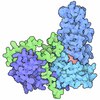
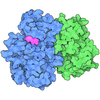
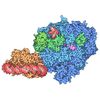
| Title | Cryo-EM structure of the human Tip60 complex | ||||||
 Components Components |
| ||||||
 Keywords Keywords | TRANSCRIPTION / Eukaryotic transcription / Histone acetyltransferase / chromatin remodeling / Complex | ||||||
| Function / homology |  Function and homology information Function and homology informationpiccolo histone acetyltransferase complex / promoter-enhancer loop anchoring activity / telomerase RNA localization to Cajal body / sperm DNA condensation / regulation of DNA strand elongation / positive regulation of telomere maintenance in response to DNA damage / positive regulation of norepinephrine uptake / bBAF complex / GBAF complex / histone chaperone activity ...piccolo histone acetyltransferase complex / promoter-enhancer loop anchoring activity / telomerase RNA localization to Cajal body / sperm DNA condensation / regulation of DNA strand elongation / positive regulation of telomere maintenance in response to DNA damage / positive regulation of norepinephrine uptake / bBAF complex / GBAF complex / histone chaperone activity / R2TP complex / brahma complex / dynein axonemal particle / cellular response to cytochalasin B / RPAP3/R2TP/prefoldin-like complex / neural retina development / Formation of the embryonic stem cell BAF (esBAF) complex / npBAF complex / nBAF complex / regulation of transepithelial transport / Formation of the canonical BAF (cBAF) complex / Swr1 complex / morphogenesis of a polarized epithelium / Formation of annular gap junctions / Formation of the dystrophin-glycoprotein complex (DGC) / structural constituent of postsynaptic actin cytoskeleton / protein antigen binding / establishment of protein localization to chromatin / Formation of the polybromo-BAF (pBAF) complex / Gap junction degradation / protein localization to adherens junction / Formation of neuronal progenitor and neuronal BAF (npBAF and nBAF) / Formation of the non-canonical BAF (ncBAF) complex / Cell-extracellular matrix interactions / regulation of G0 to G1 transition / dense body / RSC-type complex / Folding of actin by CCT/TriC / Tat protein binding / Ino80 complex / postsynaptic actin cytoskeleton / Regulation of CDH1 Function / apical protein localization / regulation of double-strand break repair / Prefoldin mediated transfer of substrate to CCT/TriC / Adherens junctions interactions / box C/D snoRNP assembly / adherens junction assembly / RHOF GTPase cycle / regulation of nucleotide-excision repair / Sensory processing of sound by outer hair cells of the cochlea / chromatin-protein adaptor activity / tight junction / SWI/SNF complex / Sensory processing of sound by inner hair cells of the cochlea / regulation of mitotic metaphase/anaphase transition / Interaction between L1 and Ankyrins / spermatid development / Formation of Senescence-Associated Heterochromatin Foci (SAHF) / positive regulation of T cell differentiation / apical junction complex / maintenance of blood-brain barrier / negative regulation of gene expression, epigenetic / spinal cord development / positive regulation of stem cell population maintenance / regulation of chromosome organization / NuA4 histone acetyltransferase complex / regulation of norepinephrine uptake / transporter regulator activity / Transcriptional Regulation by E2F6 / positive regulation of double-strand break repair / Recycling pathway of L1 / MLL1 complex / cortical cytoskeleton / Regulation of MITF-M-dependent genes involved in pigmentation / establishment or maintenance of cell polarity / regulation of DNA replication / TFIID-class transcription factor complex binding / RUNX1 interacts with co-factors whose precise effect on RUNX1 targets is not known / nitric-oxide synthase binding / brush border / EPH-ephrin mediated repulsion of cells / protein folding chaperone complex / Telomere Extension By Telomerase / regulation of embryonic development / regulation of synaptic vesicle endocytosis / negative regulation of cell differentiation / positive regulation of myoblast differentiation / RHO GTPases Activate WASPs and WAVEs / enzyme-substrate adaptor activity / kinesin binding / RNA polymerase II core promoter sequence-specific DNA binding / regulation of protein localization to plasma membrane / RHO GTPases activate IQGAPs / positive regulation of double-strand break repair via homologous recombination / regulation of G1/S transition of mitotic cell cycle / axonogenesis / cytoskeleton organization / EPHB-mediated forward signaling / substantia nigra development Similarity search - Function | ||||||
| Biological species |  Homo sapiens (human) Homo sapiens (human) | ||||||
| Method | ELECTRON MICROSCOPY / single particle reconstruction / cryo EM / Resolution: 2.4 Å | ||||||
 Authors Authors | Li, C. / Smirnova, E. / Schnitzler, C. / Crucifix, C. / Concordet, J.P. / Brion, A. / Poterszman, A. / Schultz, P. / Papai, G. / Ben-Shem, A. | ||||||
| Funding support |  France, 1items France, 1items
| ||||||
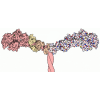
 Citation Citation | Journal: Nature / Year: 2024 Title: Structure of the human TIP60-C histone exchange and acetyltransferase complex. Authors: Changqing Li / Ekaterina Smirnova / Charlotte Schnitzler / Corinne Crucifix / Jean Paul Concordet / Alice Brion / Arnaud Poterszman / Patrick Schultz / Gabor Papai / Adam Ben-Shem / Abstract: Chromatin structure is a key regulator of DNA transcription, replication and repair. In humans, the TIP60-EP400 complex (TIP60-C) is a 20-subunit assembly that affects chromatin structure through two ...Chromatin structure is a key regulator of DNA transcription, replication and repair. In humans, the TIP60-EP400 complex (TIP60-C) is a 20-subunit assembly that affects chromatin structure through two enzymatic activities: ATP-dependent exchange of histone H2A-H2B for H2A.Z-H2B, and histone acetylation. In yeast, however, these activities are performed by two independent complexes-SWR1 and NuA4, respectively. How the activities of the two complexes are merged into one supercomplex in humans, and what this association entails for the structure and mechanism of the proteins and their recruitment to chromatin, are unknown. Here we describe the structure of the endogenous human TIP60-C. We find a three-lobed architecture composed of SWR1-like (SWR1L) and NuA4-like (NuA4L) parts, which associate with a TRRAP activator-binding module. The huge EP400 subunit contains the ATPase motor, traverses the junction between SWR1L and NuA4L twice and constitutes the scaffold of the three-lobed architecture. NuA4L is completely rearranged compared with its yeast counterpart. TRRAP is flexibly tethered to NuA4L-in stark contrast to its robust connection to the completely opposite side of NuA4 in yeast. A modelled nucleosome bound to SWR1L, supported by tests of TIP60-C activity, suggests that some aspects of the histone exchange mechanism diverge from what is seen in yeast. Furthermore, a fixed actin module (as opposed to the mobile actin subcomplex in SWR1; ref. ), the flexibility of TRRAP and the weak effect of extranucleosomal DNA on exchange activity lead to a different, activator-based mode of enlisting TIP60-C to chromatin. | ||||||
| History |
|
- Structure visualization
| Structure viewer | Molecule: MolmilJmol/JSmol |
|---|
- Downloads & links
-Download
| PDBx/mmCIF format | 8qr1.cif.gz | 1 MB | Display | PDBx/mmCIF format |
|---|---|---|---|---|
| PDB format | pdb8qr1.ent.gz | Display | PDB format | |
| PDBx/mmJSON format | 8qr1.json.gz | Tree view | PDBx/mmJSON format | |
| Others |  Other downloads Other downloads |
-Validation report
| Arichive directory | https://data.pdbj.org/pub/pdb/validation_reports/qr/8qr1ftp://data.pdbj.org/pub/pdb/validation_reports/qr/8qr1 | HTTPS FTP |
|---|
-Related structure data
| Related structure data |  18611MC 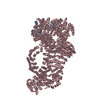 8qriC C: citing same article ( M: map data used to model this data |
|---|---|
| Similar structure data |




-Links
 PDBj
PDBj





- Assembly
| Deposited unit | 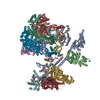
|
|---|---|
| 1 |
|
-Components
-Protein , 8 types, 13 molecules ACFSBGKLIEHDJ
| #1: Protein | Mass: 343867.312 Da / Num. of mol.: 1 / Source method: isolated from a natural source / Source: (natural) Homo sapiens (human) / Cell line: K562References: UniProt: Q96L91, Hydrolases; Acting on acid anhydrides; Acting on acid anhydrides to facilitate cellular and subcellular movement | ||||||
|---|---|---|---|---|---|---|---|
| #2: Protein | Mass: 93589.172 Da / Num. of mol.: 1 / Source method: isolated from a natural source / Source: (natural) Homo sapiens (human) / Cell line: K562 / References: UniProt: Q9H2F5 | ||||||
| #3: Protein | Mass: 53090.699 Da / Num. of mol.: 1 / Source method: isolated from a natural source / Source: (natural) Homo sapiens (human) / Cell line: K562 / References: UniProt: Q9NPF5 | ||||||
| #4: Protein | Mass: 40658.363 Da / Num. of mol.: 1 / Source method: isolated from a natural source / Source: (natural) Homo sapiens (human) / Cell line: K562 / References: UniProt: Q15906 | ||||||
| #5: Protein | Mass: 41782.660 Da / Num. of mol.: 2 / Source method: isolated from a natural source / Source: (natural) Homo sapiens (human) / Cell line: K562 / References: UniProt: P60709#6: Protein | | Mass: 47509.812 Da / Num. of mol.: 1 / Source method: isolated from a natural source / Source: (natural) Homo sapiens (human) / Cell line: K562 / References: UniProt: O96019#7: Protein | Mass: 50296.914 Da / Num. of mol.: 3 / Source method: isolated from a natural source / Source: (natural) Homo sapiens (human) / Cell line: K562 / References: UniProt: Q9Y265, DNA helicase#8: Protein | Mass: 51222.465 Da / Num. of mol.: 3 / Source method: isolated from a natural source / Source: (natural) Homo sapiens (human) / Cell line: K562 / References: UniProt: Q9Y230, DNA helicase |
-Details
| Has protein modification | N |
|---|
-Experimental details
-Experiment
| Experiment | Method: ELECTRON MICROSCOPY |
|---|---|
| EM experiment | Aggregation state: PARTICLE / 3D reconstruction method: single particle reconstruction |
- Sample preparation
| Component | Name: Tip60 complex / Type: CELL / Entity ID: all / Source: NATURAL | ||||||||||||||||||||||||||||||||
|---|---|---|---|---|---|---|---|---|---|---|---|---|---|---|---|---|---|---|---|---|---|---|---|---|---|---|---|---|---|---|---|---|---|
| Source (natural) | Organism: Homo sapiens (human) / Strain: K562 / Cellular location: nucleus | ||||||||||||||||||||||||||||||||
| Buffer solution | pH: 8 | ||||||||||||||||||||||||||||||||
| Buffer component |
| ||||||||||||||||||||||||||||||||
| Specimen | Conc.: 0.2 mg/ml / Embedding applied: NO / Shadowing applied: NO / Staining applied: NO / Vitrification applied: YES | ||||||||||||||||||||||||||||||||
| Vitrification | Instrument: FEI VITROBOT MARK IV / Cryogen name: ETHANE / Humidity: 95 % / Chamber temperature: 279 K |
- Electron microscopy imaging
| Experimental equipment |  Model: Titan Krios / Image courtesy: FEI Company | ||||||||||||
|---|---|---|---|---|---|---|---|---|---|---|---|---|---|
| Microscopy | Model: FEI TITAN KRIOS | ||||||||||||
| Electron gun | Electron source:  FIELD EMISSION GUN / Accelerating voltage: 300 kV / Illumination mode: FLOOD BEAM FIELD EMISSION GUN / Accelerating voltage: 300 kV / Illumination mode: FLOOD BEAM | ||||||||||||
| Electron lens | Mode: BRIGHT FIELD / Nominal defocus max: 2800 nm / Nominal defocus min: 1200 nm / Cs: 2.7 mm / Alignment procedure: COMA FREE | ||||||||||||
| Specimen holder | Cryogen: NITROGEN / Specimen holder model: FEI TITAN KRIOS AUTOGRID HOLDER | ||||||||||||
| Image recording |
|
- Processing
| EM software |
| ||||||||||||||||||||||||||||||
|---|---|---|---|---|---|---|---|---|---|---|---|---|---|---|---|---|---|---|---|---|---|---|---|---|---|---|---|---|---|---|---|
| CTF correction | Type: PHASE FLIPPING AND AMPLITUDE CORRECTION | ||||||||||||||||||||||||||||||
| Particle selection | Num. of particles selected: 284286 | ||||||||||||||||||||||||||||||
| 3D reconstruction | Resolution: 2.4 Å / Resolution method: FSC 0.143 CUT-OFF / Num. of particles: 180397 / Symmetry type: POINT | ||||||||||||||||||||||||||||||
| Atomic model building | Protocol: RIGID BODY FIT / Space: REAL |
