 Movie
Movie Controller

[English] 日本語
 Yorodumi
- PDB-8jd4: Cryo-EM structure of G protein-free mGlu2-mGlu4 heterodimer in Ac... -
+ Open data

- Basic information
| Entry | Database: PDB / ID: 8jd4 | |||||||||
|---|---|---|---|---|---|---|---|---|---|---|
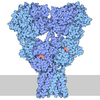
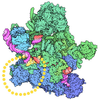
| Title | Cryo-EM structure of G protein-free mGlu2-mGlu4 heterodimer in Acc state | |||||||||
 Components Components |
| |||||||||
 Keywords Keywords | MEMBRANE PROTEIN / Complex structure / mGlu2-mGlu4 heterodimer | |||||||||
| Function / homology |  Function and homology information Function and homology informationpositive regulation of biosynthetic process / adenylate cyclase-inhibiting G protein-coupled glutamate receptor signaling pathway / positive regulation of multicellular organismal process / regulation of response to drug / regulation of glutamate secretion / group II metabotropic glutamate receptor activity / adenylate cyclase inhibiting G protein-coupled glutamate receptor activity / regulation of phosphatidylinositol 3-kinase/protein kinase B signal transduction / macrolide binding / activin receptor binding ...positive regulation of biosynthetic process / adenylate cyclase-inhibiting G protein-coupled glutamate receptor signaling pathway / positive regulation of multicellular organismal process / regulation of response to drug / regulation of glutamate secretion / group II metabotropic glutamate receptor activity / adenylate cyclase inhibiting G protein-coupled glutamate receptor activity / regulation of phosphatidylinositol 3-kinase/protein kinase B signal transduction / macrolide binding / activin receptor binding / TORC1 complex / regulation of skeletal muscle contraction by regulation of release of sequestered calcium ion / cytoplasmic side of membrane / transforming growth factor beta receptor binding / TGFBR1 LBD Mutants in Cancer / behavioral response to nicotine / heart trabecula formation / regulation of cellular response to stress / negative regulation of adenylate cyclase activity / type I transforming growth factor beta receptor binding / negative regulation of activin receptor signaling pathway / signaling receptor inhibitor activity / G protein-coupled glutamate receptor signaling pathway / glutamate secretion / neurotransmitter secretion / I-SMAD binding / Class C/3 (Metabotropic glutamate/pheromone receptors) / regulation of amyloid precursor protein catabolic process / terminal cisterna / ryanodine receptor complex / glutamate receptor activity / regulation of cell size / astrocyte projection / 'de novo' protein folding / FK506 binding / ventricular cardiac muscle tissue morphogenesis / TGF-beta receptor signaling activates SMADs / regulation of dopamine secretion / regulation of lipid metabolic process / heart morphogenesis / mTORC1-mediated signalling / Calcineurin activates NFAT / regulation of immune response / regulation of synaptic transmission, glutamatergic / phagocytic vesicle / regulation of cardiac muscle contraction by regulation of the release of sequestered calcium ion / supramolecular fiber organization / presynaptic modulation of chemical synaptic transmission / sarcoplasmic reticulum membrane / regulation of neuron apoptotic process / negative regulation of autophagy / T cell activation / peptidylprolyl isomerase / sarcoplasmic reticulum / peptidyl-prolyl cis-trans isomerase activity / TGF-beta receptor signaling in EMT (epithelial to mesenchymal transition) / response to cocaine / positive regulation of cell differentiation / calcium channel regulator activity / protein maturation / negative regulation of transforming growth factor beta receptor signaling pathway / non-membrane spanning protein tyrosine kinase activity / protein refolding / PML body / Z disc / G protein-coupled receptor activity / SARS-CoV-1 activates/modulates innate immune responses / Sensory perception of sweet, bitter, and umami (glutamate) taste / regulation of protein localization / presynapse / protein folding / presynaptic membrane / scaffold protein binding / cytoplasmic vesicle / chemical synaptic transmission / Potential therapeutics for SARS / amyloid fibril formation / positive regulation of phosphatidylinositol 3-kinase/protein kinase B signal transduction / G alpha (i) signalling events / positive regulation of MAPK cascade / transmembrane transporter binding / positive regulation of canonical NF-kappaB signal transduction / mitochondrial outer membrane / non-specific serine/threonine protein kinase / postsynaptic membrane / Golgi membrane / axon / lysosomal membrane / protein serine/threonine kinase activity / dendrite / endoplasmic reticulum membrane / protein-containing complex binding / glutamatergic synapse / ATP binding / membrane / plasma membrane / cytosol / cytoplasm Similarity search - Function | |||||||||
| Biological species |  Homo sapiens (human) Homo sapiens (human) | |||||||||
| Method | ELECTRON MICROSCOPY / single particle reconstruction / cryo EM / Resolution: 2.9 Å | |||||||||
 Authors Authors | Wang, X. / Wang, M. / Xu, T. / Feng, Y. / Han, S. / Lin, S. / Zhao, Q. / Wu, B. | |||||||||
| Funding support |  China, 2items China, 2items
| |||||||||
 Citation Citation | Journal: Cell Res / Year: 2023 Title: Structural insights into dimerization and activation of the mGlu2-mGlu3 and mGlu2-mGlu4 heterodimers. Authors: Xinwei Wang / Mu Wang / Tuo Xu / Ye Feng / Qiang Shao / Shuo Han / Xiaojing Chu / Yechun Xu / Shuling Lin / Qiang Zhao / Beili Wu / Abstract: Heterodimerization of the metabotropic glutamate receptors (mGlus) has shown importance in the functional modulation of the receptors and offers potential drug targets for treating central nervous ...Heterodimerization of the metabotropic glutamate receptors (mGlus) has shown importance in the functional modulation of the receptors and offers potential drug targets for treating central nervous system diseases. However, due to a lack of molecular details of the mGlu heterodimers, understanding of the mechanisms underlying mGlu heterodimerization and activation is limited. Here we report twelve cryo-electron microscopy (cryo-EM) structures of the mGlu2-mGlu3 and mGlu2-mGlu4 heterodimers in different conformational states, including inactive, intermediate inactive, intermediate active and fully active conformations. These structures provide a full picture of conformational rearrangement of mGlu2-mGlu3 upon activation. The Venus flytrap domains undergo a sequential conformational change, while the transmembrane domains exhibit a substantial rearrangement from an inactive, symmetric dimer with diverse dimerization patterns to an active, asymmetric dimer in a conserved dimerization mode. Combined with functional data, these structures reveal that stability of the inactive conformations of the subunits and the subunit-G protein interaction pattern are determinants of asymmetric signal transduction of the heterodimers. Furthermore, a novel binding site for two mGlu4 positive allosteric modulators was observed in the asymmetric dimer interfaces of the mGlu2-mGlu4 heterodimer and mGlu4 homodimer, and may serve as a drug recognition site. These findings greatly extend our knowledge about signal transduction of the mGlus. | |||||||||
| History |
|
- Structure visualization
| Structure viewer | Molecule: MolmilJmol/JSmol |
|---|
- Downloads & links
-Download
| PDBx/mmCIF format | 8jd4.cif.gz | 277.8 KB | Display | PDBx/mmCIF format |
|---|---|---|---|---|
| PDB format | pdb8jd4.ent.gz | 202 KB | Display | PDB format |
| PDBx/mmJSON format | 8jd4.json.gz | Tree view | PDBx/mmJSON format | |
| Others |  Other downloads Other downloads |
-Validation report
| Arichive directory | https://data.pdbj.org/pub/pdb/validation_reports/jd/8jd4ftp://data.pdbj.org/pub/pdb/validation_reports/jd/8jd4 | HTTPS FTP |
|---|
-Related structure data
| Related structure data |  36175MC 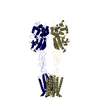 8jcuC  8jcvC  8jcwC  8jcxC  8jcyC 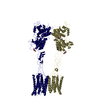 8jczC  8jd0C  8jd1C  8jd2C 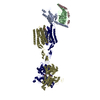 8jd3C 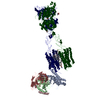 8jd5C 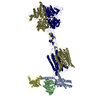 8jd6C M: map data used to model this data C: citing same article ( |
|---|---|
| Similar structure data |







-Links
 PDBj
PDBj

- Assembly
| Deposited unit | 
|
|---|---|
| 1 |
|
-Components
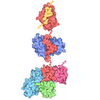
| #1: Protein | Mass: 109398.914 Da / Num. of mol.: 1 Source method: isolated from a genetically manipulated source Source: (gene. exp.) Homo sapiens (human) / Gene: GRM2, GPRC1B, MGLUR2, FKBP1A, FKBP1, FKBP12Production host:   mammal environmental sample (environmental samples) mammal environmental sample (environmental samples)References: UniProt: Q14416, UniProt: P62942, peptidylprolyl isomerase | ||||||
|---|---|---|---|---|---|---|---|
| #2: Protein | Mass: 114187.086 Da / Num. of mol.: 1 Source method: isolated from a genetically manipulated source Source: (gene. exp.) Homo sapiens (human) / Gene: GRM4, GPRC1D, MGLUR4, MTORProduction host: mammal environmental sample (environmental samples)References: UniProt: Q14833, UniProt: A0A8V8TRG9, non-specific serine/threonine protein kinase | ||||||
| #3: Sugar | 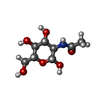 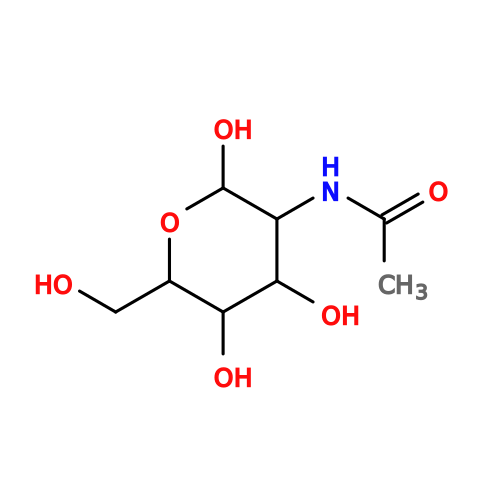 Type: D-saccharide, beta linking / Mass: 221.208 Da / Num. of mol.: 3 / Source method: obtained synthetically / Formula: C8H15NO6 Type: D-saccharide, beta linking / Mass: 221.208 Da / Num. of mol.: 3 / Source method: obtained synthetically / Formula: C8H15NO6#4: Chemical | 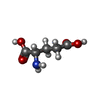 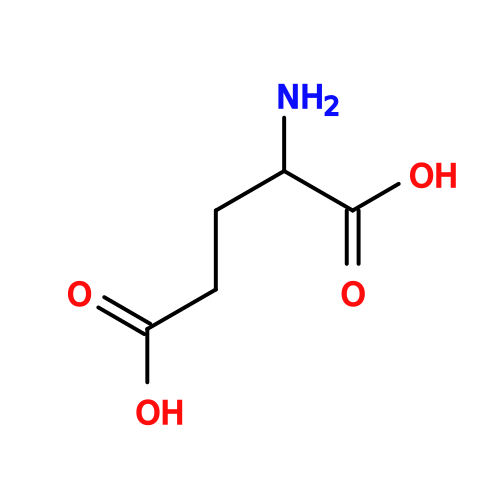 Type: L-peptide linking / Mass: 147.129 Da / Num. of mol.: 2 / Source method: obtained synthetically / Formula: C5H9NO4 / Feature type: SUBJECT OF INVESTIGATION Type: L-peptide linking / Mass: 147.129 Da / Num. of mol.: 2 / Source method: obtained synthetically / Formula: C5H9NO4 / Feature type: SUBJECT OF INVESTIGATIONHas ligand of interest | Y | Has protein modification | Y | |
-Experimental details
-Experiment
| Experiment | Method: ELECTRON MICROSCOPY |
|---|---|
| EM experiment | Aggregation state: PARTICLE / 3D reconstruction method: single particle reconstruction |
- Sample preparation
| Component | Name: mGlu2-mGlu4 heterodimer in presence of glutamate, JNJ-40411813, and ADX88178 Type: COMPLEX / Entity ID: #1-#2 / Source: MULTIPLE SOURCES |
|---|---|
| Source (natural) | Organism: Homo sapiens (human) |
| Source (recombinant) | Organism: mammal environmental sample (environmental samples) |
| Buffer solution | pH: 7.5 |
| Specimen | Embedding applied: NO / Shadowing applied: NO / Staining applied: NO / Vitrification applied: YES |
| Vitrification | Cryogen name: ETHANE |
- Electron microscopy imaging
| Experimental equipment |  Model: Titan Krios / Image courtesy: FEI Company |
|---|---|
| Microscopy | Model: FEI TITAN KRIOS |
| Electron gun | Electron source:  FIELD EMISSION GUN / Accelerating voltage: 300 kV / Illumination mode: SPOT SCAN FIELD EMISSION GUN / Accelerating voltage: 300 kV / Illumination mode: SPOT SCAN |
| Electron lens | Mode: BRIGHT FIELD / Nominal defocus max: 1500 nm / Nominal defocus min: 800 nm |
| Image recording | Electron dose: 70 e/Å2 / Film or detector model: GATAN K3 BIOQUANTUM (6k x 4k) |
- Processing
| CTF correction | Type: NONE | ||||||||||||||||||||||||
|---|---|---|---|---|---|---|---|---|---|---|---|---|---|---|---|---|---|---|---|---|---|---|---|---|---|
| 3D reconstruction | Resolution: 2.9 Å / Resolution method: FSC 0.143 CUT-OFF / Num. of particles: 653804 / Symmetry type: POINT | ||||||||||||||||||||||||
| Refinement | Stereochemistry target values: GeoStd + Monomer Library + CDL v1.2 | ||||||||||||||||||||||||
| Displacement parameters | Biso mean: 82.66 Å2 | ||||||||||||||||||||||||
| Refine LS restraints |
|
