 Movie
Movie Controller


+ Open data

- Basic information
| Entry | Database: PDB / ID: 7z8f | ||||||||||||
|---|---|---|---|---|---|---|---|---|---|---|---|---|---|
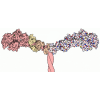
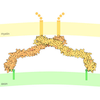
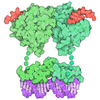
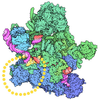
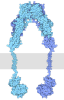
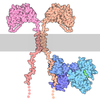
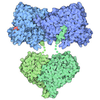
| Title | Composite structure of dynein-dynactin-BICDR on microtubules | ||||||||||||
 Components Components |
| ||||||||||||
 Keywords Keywords | STRUCTURAL PROTEIN / Dynein / dynactin / cargo transport / activating adaptor / cytoskeleton | ||||||||||||
| Function / homology |  Function and homology information Function and homology informationGolgi to secretory granule transport / Advanced glycosylation endproduct receptor signaling / sterol sensor activity / retrograde axonal transport of mitochondrion / Regulation of actin dynamics for phagocytic cup formation / EPHB-mediated forward signaling / Adherens junctions interactions / VEGFA-VEGFR2 Pathway / Cell-extracellular matrix interactions / RHO GTPases Activate WASPs and WAVEs ...Golgi to secretory granule transport / Advanced glycosylation endproduct receptor signaling / sterol sensor activity / retrograde axonal transport of mitochondrion / Regulation of actin dynamics for phagocytic cup formation / EPHB-mediated forward signaling / Adherens junctions interactions / VEGFA-VEGFR2 Pathway / Cell-extracellular matrix interactions / RHO GTPases Activate WASPs and WAVEs / MAP2K and MAPK activation / RHOF GTPase cycle / Formation of the canonical BAF (cBAF) complex / Formation of the polybromo-BAF (pBAF) complex / Formation of the embryonic stem cell BAF (esBAF) complex / Formation of the non-canonical BAF (ncBAF) complex / GBP-mediated host defense / UCH proteinases / Platelet degranulation / visual behavior / Gap junction degradation / Formation of annular gap junctions / Clathrin-mediated endocytosis / dynactin complex / centriolar subdistal appendage / centriole-centriole cohesion / positive regulation of neuromuscular junction development / Regulation of PLK1 Activity at G2/M Transition / Loss of Nlp from mitotic centrosomes / Loss of proteins required for interphase microtubule organization from the centrosome / Anchoring of the basal body to the plasma membrane / AURKA Activation by TPX2 / microtubule anchoring at centrosome / Recruitment of mitotic centrosome proteins and complexes / intraciliary retrograde transport / F-actin capping protein complex / WASH complex / lysosome to ER cholesterol transport / Regulation of CDH1 Function / Formation of the dystrophin-glycoprotein complex (DGC) / dynein light chain binding / transport along microtubule / ventral spinal cord development / dynein heavy chain binding / retromer complex / cytoskeleton-dependent cytokinesis / dynein complex / microtubule plus-end / mitotic nuclear membrane disassembly / cellular response to cytochalasin B / Intraflagellar transport / positive regulation of microtubule nucleation / positive regulation of intracellular transport / regulation of transepithelial transport / positive regulation of spindle assembly / morphogenesis of a polarized epithelium / regulation of metaphase plate congression / structural constituent of postsynaptic actin cytoskeleton / protein localization to adherens junction / establishment of spindle localization / barbed-end actin filament capping / non-motile cilium assembly / dense body / Tat protein binding / Neutrophil degranulation / postsynaptic actin cytoskeleton / motor behavior / positive regulation of mitotic cell cycle spindle assembly checkpoint / apical protein localization / vesicle transport along microtubule / retrograde transport, endosome to Golgi / retrograde axonal transport / adherens junction assembly / neuromuscular process / COPI-independent Golgi-to-ER retrograde traffic / minus-end-directed microtubule motor activity / RHO GTPases activate IQGAPs / RHO GTPases Activate Formins / microtubule associated complex / P-body assembly / HSP90 chaperone cycle for steroid hormone receptors (SHR) in the presence of ligand / dynein light intermediate chain binding / cytoplasmic dynein complex / MHC class II antigen presentation / nuclear migration / Recruitment of NuMA to mitotic centrosomes / tight junction / microtubule motor activity / COPI-mediated anterograde transport / microtubule-based movement / apical junction complex / intercellular bridge / establishment of mitotic spindle orientation / dynein intermediate chain binding / NuA4 histone acetyltransferase complex / regulation of norepinephrine uptake / transporter regulator activity / cell leading edge / cortical cytoskeleton / neuromuscular junction development Similarity search - Function | ||||||||||||
| Biological species |   Mus musculus (house mouse) Mus musculus (house mouse) Homo sapiens (human) Homo sapiens (human) Sus scrofa (pig) Sus scrofa (pig) | ||||||||||||
| Method | ELECTRON MICROSCOPY / single particle reconstruction / cryo EM / Resolution: 20 Å | ||||||||||||
 Authors Authors | Chaaban, S. / Carter, A.P. | ||||||||||||
| Funding support |  United Kingdom, European Union, 3items United Kingdom, European Union, 3items
| ||||||||||||
 Citation Citation | Journal: Nature / Year: 2022 Title: Structure of dynein-dynactin on microtubules shows tandem adaptor binding. Authors: Sami Chaaban / Andrew P Carter / Abstract: Cytoplasmic dynein is a microtubule motor that is activated by its cofactor dynactin and a coiled-coil cargo adaptor. Up to two dynein dimers can be recruited per dynactin, and interactions between ...Cytoplasmic dynein is a microtubule motor that is activated by its cofactor dynactin and a coiled-coil cargo adaptor. Up to two dynein dimers can be recruited per dynactin, and interactions between them affect their combined motile behaviour. Different coiled-coil adaptors are linked to different cargos, and some share motifs known to contact sites on dynein and dynactin. There is limited structural information on how the resulting complex interacts with microtubules and how adaptors are recruited. Here we develop a cryo-electron microscopy processing pipeline to solve the high-resolution structure of dynein-dynactin and the adaptor BICDR1 bound to microtubules. This reveals the asymmetric interactions between neighbouring dynein motor domains and how they relate to motile behaviour. We found that two adaptors occupy the complex. Both adaptors make similar interactions with the dyneins but diverge in their contacts with each other and dynactin. Our structure has implications for the stability and stoichiometry of motor recruitment by cargos. | ||||||||||||
| History |
|
- Structure visualization
| Structure viewer | Molecule: MolmilJmol/JSmol |
|---|
- Downloads & links
-Download
| PDBx/mmCIF format | 7z8f.cif.gz | 3.7 MB | Display | PDBx/mmCIF format |
|---|---|---|---|---|
| PDB format | pdb7z8f.ent.gz | Display | PDB format | |
| PDBx/mmJSON format | 7z8f.json.gz | Tree view | PDBx/mmJSON format | |
| Others |  Other downloads Other downloads |
-Validation report
| Arichive directory | https://data.pdbj.org/pub/pdb/validation_reports/z8/7z8fftp://data.pdbj.org/pub/pdb/validation_reports/z8/7z8f | HTTPS FTP |
|---|
-Related structure data
| Related structure data | 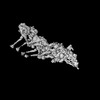 14549MC  7z8gC  7z8hC 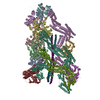 7z8iC  7z8jC  7z8kC  7z8lC  7z8mC M: map data used to model this data C: citing same article ( |
|---|---|
| Similar structure data |

-Links
 PDBj
PDBj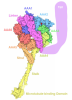



- Assembly
| Deposited unit | 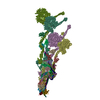
|
|---|---|
| 1 |
|
-Components
-Protein , 8 types, 21 molecules ABCDEFGIHJKLUWXwxklst
| #1: Protein | Mass: 42670.688 Da / Num. of mol.: 8 / Source method: isolated from a natural source / Source: (natural) Sus scrofa (pig) / References: UniProt: F2Z5G5#2: Protein | | Mass: 41782.660 Da / Num. of mol.: 1 / Source method: isolated from a natural source / Source: (natural) Sus scrofa (pig) / References: UniProt: Q6QAQ1#3: Protein | | Mass: 46250.785 Da / Num. of mol.: 1 / Source method: isolated from a natural source / Source: (natural) Sus scrofa (pig) / References: UniProt: I3LHK5#4: Protein | | Mass: 33059.848 Da / Num. of mol.: 1 / Source method: isolated from a natural source / Source: (natural) Sus scrofa (pig) / References: UniProt: A0PFK5#5: Protein | | Mass: 30669.768 Da / Num. of mol.: 1 / Source method: isolated from a natural source / Source: (natural) Sus scrofa (pig) / References: UniProt: A9XFX6#9: Protein | | Mass: 20703.910 Da / Num. of mol.: 1 / Source method: isolated from a natural source / Source: (natural) Sus scrofa (pig) / References: UniProt: D0G6S1#11: Protein | Mass: 65377.035 Da / Num. of mol.: 4 Source method: isolated from a genetically manipulated source Source: (gene. exp.) Mus musculus (house mouse) / Gene: Bicdl1, Bicdr1, Ccdc64 / Production host:   Spodoptera frugiperda (fall armyworm) / References: UniProt: A0JNT9 Spodoptera frugiperda (fall armyworm) / References: UniProt: A0JNT9#16: Protein | Mass: 10934.576 Da / Num. of mol.: 4 Source method: isolated from a genetically manipulated source Source: (gene. exp.) Homo sapiens (human) / Gene: DYNLRB1, BITH, DNCL2A, DNLC2A, ROBLD1, HSPC162 / Production host: Spodoptera frugiperda (fall armyworm) / References: UniProt: Q9NP97 |
|---|
-Dynactin subunit ... , 5 types, 10 molecules MNPQORSTVY
| #6: Protein | Mass: 44704.414 Da / Num. of mol.: 4 / Source method: isolated from a natural source / Source: (natural) Sus scrofa (pig) / References: UniProt: A0A5G2QD80#7: Protein | Mass: 21192.477 Da / Num. of mol.: 2 / Source method: isolated from a natural source / Source: (natural) Sus scrofa (pig) / References: UniProt: F1SEC0#8: Protein | Mass: 142015.484 Da / Num. of mol.: 2 / Source method: isolated from a natural source / Source: (natural) Sus scrofa (pig) / References: UniProt: A0A8D1D718#10: Protein | | Mass: 20150.533 Da / Num. of mol.: 1 / Source method: isolated from a natural source / Source: (natural) Sus scrofa (pig) / References: UniProt: A0A286ZK88#12: Protein | | Mass: 52920.434 Da / Num. of mol.: 1 / Source method: isolated from a natural source / Source: (natural) Sus scrofa (pig) / References: UniProt: A0A4X1TB62 |
|---|
-Cytoplasmic dynein 1 ... , 3 types, 12 molecules efmnghopijqr
| #13: Protein | Mass: 533055.125 Da / Num. of mol.: 4 / Mutation: R1567E, K1610E Source method: isolated from a genetically manipulated source Source: (gene. exp.) Homo sapiens (human) / Gene: DYNC1H1, DHC1, DNCH1, DNCL, DNECL, DYHC, KIAA0325 / Production host: Spodoptera frugiperda (fall armyworm) / References: UniProt: Q14204#14: Protein | Mass: 71546.445 Da / Num. of mol.: 4 Source method: isolated from a genetically manipulated source Source: (gene. exp.) Homo sapiens (human) / Gene: DYNC1I2, DNCI2, DNCIC2 / Production host: Spodoptera frugiperda (fall armyworm) / References: UniProt: Q13409#15: Protein | Mass: 54173.156 Da / Num. of mol.: 4 Source method: isolated from a genetically manipulated source Source: (gene. exp.) Homo sapiens (human) / Gene: DYNC1LI2, DNCLI2, LIC2 / Production host: Spodoptera frugiperda (fall armyworm) / References: UniProt: O43237 |
|---|
-Non-polymers , 5 types, 43 molecules 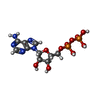

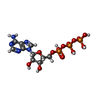

| #17: Chemical | ChemComp-ADP / 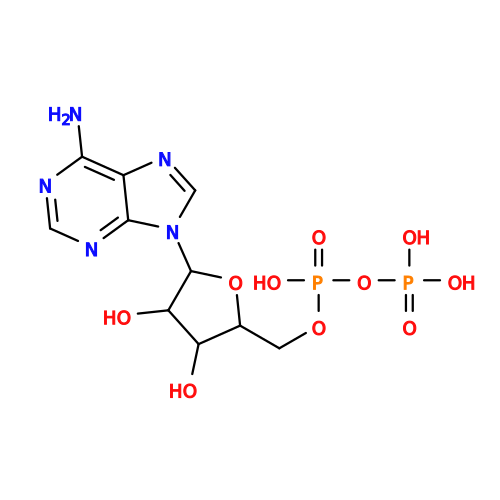 Mass: 427.201 Da / Num. of mol.: 13 / Source method: obtained synthetically / Formula: C10H15N5O10P2 / Comment: ADP, energy-carrying molecule*YM Mass: 427.201 Da / Num. of mol.: 13 / Source method: obtained synthetically / Formula: C10H15N5O10P2 / Comment: ADP, energy-carrying molecule*YM#18: Chemical | ChemComp-MG /  Mass: 24.305 Da / Num. of mol.: 14 / Source method: obtained synthetically / Formula: Mg Mass: 24.305 Da / Num. of mol.: 14 / Source method: obtained synthetically / Formula: Mg#19: Chemical | ChemComp-ATP / 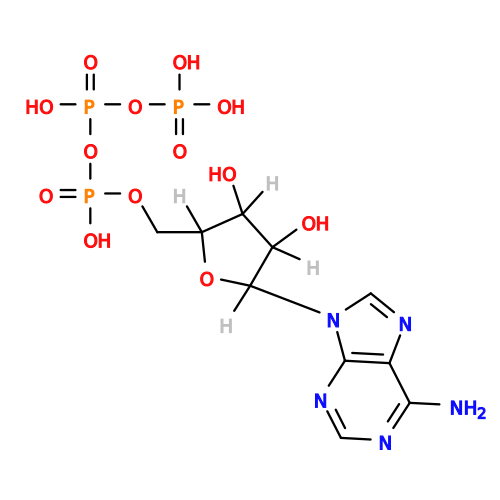 Mass: 507.181 Da / Num. of mol.: 5 / Source method: obtained synthetically / Formula: C10H16N5O13P3 / Comment: ATP, energy-carrying molecule*YM Mass: 507.181 Da / Num. of mol.: 5 / Source method: obtained synthetically / Formula: C10H16N5O13P3 / Comment: ATP, energy-carrying molecule*YM#20: Chemical |  Mass: 65.409 Da / Num. of mol.: 3 / Source method: obtained synthetically / Formula: Zn Mass: 65.409 Da / Num. of mol.: 3 / Source method: obtained synthetically / Formula: Zn#21: Chemical | ChemComp-ANP / 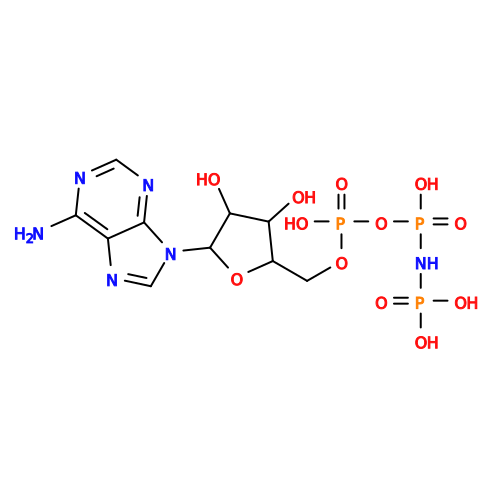 Mass: 506.196 Da / Num. of mol.: 8 / Source method: obtained synthetically / Formula: C10H17N6O12P3 / Comment: AMP-PNP, energy-carrying molecule analogue*YM Mass: 506.196 Da / Num. of mol.: 8 / Source method: obtained synthetically / Formula: C10H17N6O12P3 / Comment: AMP-PNP, energy-carrying molecule analogue*YM |
|---|
-Details
| Has ligand of interest | N |
|---|
-Experimental details
-Experiment
| Experiment | Method: ELECTRON MICROSCOPY |
|---|---|
| EM experiment | Aggregation state: PARTICLE / 3D reconstruction method: single particle reconstruction |
- Sample preparation
| Component |
| |||||||||||||||||||||||||||||||||||||||||||||
|---|---|---|---|---|---|---|---|---|---|---|---|---|---|---|---|---|---|---|---|---|---|---|---|---|---|---|---|---|---|---|---|---|---|---|---|---|---|---|---|---|---|---|---|---|---|---|
| Molecular weight |
| |||||||||||||||||||||||||||||||||||||||||||||
| Source (natural) |
| |||||||||||||||||||||||||||||||||||||||||||||
| Source (recombinant) |
| |||||||||||||||||||||||||||||||||||||||||||||
| Buffer solution | pH: 7.2 | |||||||||||||||||||||||||||||||||||||||||||||
| Buffer component |
| |||||||||||||||||||||||||||||||||||||||||||||
| Specimen | Embedding applied: NO / Shadowing applied: NO / Staining applied: NO / Vitrification applied: YES | |||||||||||||||||||||||||||||||||||||||||||||
| Vitrification | Instrument: FEI VITROBOT MARK IV / Cryogen name: ETHANE / Humidity: 100 % / Chamber temperature: 293.15 K / Details: 20 second incubation |
- Electron microscopy imaging
| Experimental equipment |  Model: Titan Krios / Image courtesy: FEI Company |
|---|---|
| Microscopy | Model: FEI TITAN KRIOS |
| Electron gun | Electron source:  FIELD EMISSION GUN / Accelerating voltage: 300 kV / Illumination mode: FLOOD BEAM FIELD EMISSION GUN / Accelerating voltage: 300 kV / Illumination mode: FLOOD BEAM |
| Electron lens | Mode: BRIGHT FIELD / Nominal magnification: 81000 X / Nominal defocus max: 4000 nm / Nominal defocus min: 1200 nm / Cs: 2.7 mm / C2 aperture diameter: 50 µm |
| Specimen holder | Cryogen: NITROGEN / Specimen holder model: FEI TITAN KRIOS AUTOGRID HOLDER |
| Image recording | Average exposure time: 3 sec. / Electron dose: 53 e/Å2 / Film or detector model: GATAN K3 BIOQUANTUM (6k x 4k) / Num. of grids imaged: 14 / Num. of real images: 88715 Details: Images were collected in movie-mode and fractionated into 53 movie frames |
| EM imaging optics | Energyfilter name: GIF Quantum LS / Energyfilter slit width: 20 eV |
| Image scans | Width: 5760 / Height: 4092 |
- Processing
| EM software |
| |||||||||||||||||||||
|---|---|---|---|---|---|---|---|---|---|---|---|---|---|---|---|---|---|---|---|---|---|---|
| CTF correction | Type: PHASE FLIPPING AND AMPLITUDE CORRECTION | |||||||||||||||||||||
| 3D reconstruction | Resolution: 20 Å / Resolution method: OTHER / Num. of particles: 628033 Details: This is a composite of multiple maps with resolutions ranging from 3.3-12.2 A, resampled on a grid of 2.5 A/pix Symmetry type: POINT | |||||||||||||||||||||
| Atomic model building | Protocol: FLEXIBLE FIT / Space: REAL |
