Myeloid differentiation primary response protein MyD88
キーワード
SIGNALING PROTEIN / helix / filament / TLR
機能・相同性
機能・相同性情報
regulation of chemokine (C-X-C motif) ligand 1 production / MyD88 deficiency (TLR5) / Toll binding / toll-like receptor 5 signaling pathway / induced systemic resistance / ATP-dependent histone chaperone activity / TIR domain binding / regulation of chemokine (C-X-C motif) ligand 2 production / neutrophil-mediated killing of bacterium / leukocyte activation involved in inflammatory response ...regulation of chemokine (C-X-C motif) ligand 1 production / MyD88 deficiency (TLR5) / Toll binding / toll-like receptor 5 signaling pathway / induced systemic resistance / ATP-dependent histone chaperone activity / TIR domain binding / regulation of chemokine (C-X-C motif) ligand 2 production / neutrophil-mediated killing of bacterium / leukocyte activation involved in inflammatory response / response to molecule of fungal origin / toll-like receptor 8 signaling pathway / response to peptidoglycan / positive regulation of lymphocyte proliferation / positive regulation of interleukin-23 production / regulation of neutrophil migration / IRAK4 deficiency (TLR5) / establishment of endothelial intestinal barrier / MyD88 dependent cascade initiated on endosome / DEx/H-box helicases activate type I IFN and inflammatory cytokines production / cellular response to oxidised low-density lipoprotein particle stimulus / TRAF6 mediated induction of NFkB and MAP kinases upon TLR7/8 or 9 activation / MyD88 cascade initiated on plasma membrane / Toll-like receptor binding / Toll signaling pathway / toll-like receptor TLR6:TLR2 signaling pathway / neutrophil activation involved in immune response / interleukin-33-mediated signaling pathway / microglia differentiation / RIP-mediated NFkB activation via ZBP1 / MyD88 deficiency (TLR2/4) / interleukin-1 receptor binding / death receptor binding / positive regulation of cytokine production involved in inflammatory response / response to amine / interleukin-1-mediated signaling pathway / IRAK4 deficiency (TLR2/4) / MyD88:MAL(TIRAP) cascade initiated on plasma membrane / 3'-UTR-mediated mRNA stabilization / positive regulation of macrophage cytokine production / MyD88-dependent toll-like receptor signaling pathway / extrinsic component of plasma membrane / toll-like receptor 4 signaling pathway / extrinsic component of cytoplasmic side of plasma membrane / skin development / type I interferon-mediated signaling pathway / defense response to protozoan / positive regulation of interleukin-17 production / immunoglobulin mediated immune response / positive regulation of NLRP3 inflammasome complex assembly / response to amino acid / immune system process / phagocytosis / JNK cascade / positive regulation of chemokine production / positive regulation of type I interferon production / signaling adaptor activity / positive regulation of smooth muscle cell proliferation / p75NTR recruits signalling complexes / lipopolysaccharide-mediated signaling pathway / TRAF6 mediated IRF7 activation in TLR7/8 or 9 signaling / response to interleukin-1 / : / positive regulation of interleukin-1 beta production / positive regulation of interleukin-8 production / cellular response to mechanical stimulus / positive regulation of interleukin-6 production / positive regulation of JNK cascade / Interleukin-1 signaling / positive regulation of tumor necrosis factor production / PIP3 activates AKT signaling / ER-Phagosome pathway / PI5P, PP2A and IER3 Regulate PI3K/AKT Signaling / cellular response to lipopolysaccharide / regulation of inflammatory response / gene expression / molecular adaptor activity / defense response to virus / response to ethanol / positive regulation of canonical NF-kappaB signal transduction / cell surface receptor signaling pathway / endosome membrane / defense response to bacterium / defense response to Gram-positive bacterium / inflammatory response / innate immune response / apoptotic process / positive regulation of gene expression / cell surface / signal transduction / positive regulation of transcription by RNA polymerase II / protein-containing complex / identical protein binding / nucleus / plasma membrane / cytoplasm / cytosol 類似検索 - 分子機能
Myeloid differentiation primary response protein MyD88 / MyD88, death domain / Death Domain, Fas / Death Domain, Fas / TIR domain / TIR domain / Death domain profile. / DEATH domain, found in proteins involved in cell death (apoptosis). / Death domain / Death domain ...Myeloid differentiation primary response protein MyD88 / MyD88, death domain / Death Domain, Fas / Death Domain, Fas / TIR domain / TIR domain / Death domain profile. / DEATH domain, found in proteins involved in cell death (apoptosis). / Death domain / Death domain / Toll - interleukin 1 - resistance / TIR domain profile. / Toll/interleukin-1 receptor homology (TIR) domain / Toll/interleukin-1 receptor homology (TIR) domain superfamily / Death-like domain superfamily / Orthogonal Bundle / Mainly Alpha 類似検索 - ドメイン・相同性
Myeloid differentiation primary response protein MyD88 / Myeloid differentiation primary response protein MyD88 類似検索 - 構成要素
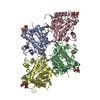
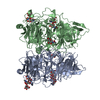
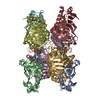
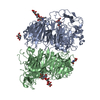
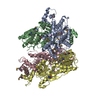
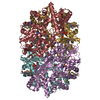
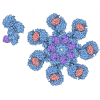
ジャーナル: Structure / 年: 2020 タイトル: MyD88 Death-Domain Oligomerization Determines Myddosome Architecture: Implications for Toll-like Receptor Signaling. 著者: Martin C Moncrieffe / Daniel Bollschweiler / Bing Li / Pawel A Penczek / Lee Hopkins / Clare E Bryant / David Klenerman / Nicholas J Gay / 要旨: Toll-like receptors (TLRs) are pivotal in triggering the innate immune response to pathogen infection. Ligand binding induces receptor dimerization which facilitates the recruitment of other post- ...Toll-like receptors (TLRs) are pivotal in triggering the innate immune response to pathogen infection. Ligand binding induces receptor dimerization which facilitates the recruitment of other post-receptor signal transducers into a complex signalosome, the Myddosome. Central to this process is Myeloid differentiation primary response 88 (MyD88), which is required by almost all TLRs, and signaling is thought to proceed via the stepwise, sequential assembly of individual components. Here, we show that the death domains of human MyD88 spontaneously and reversibly associate to form helical filaments in vitro. A 3.1-Å cryoelectron microscopy structure reveals that the architecture of the filament is identical to that of the 6:4 MyD88-IRAK4-IRAK2 hetero-oligomeric Myddosome. Additionally, the death domain of IRAK4 interacts with the filaments to reconstitute the non-stoichiometric 6:4 MyD88-IRAK4 complex. Together, these data suggest that intracellularly, the MyD88 scaffold may be pre-formed and poised for recruitment of IRAKs on receptor activation and TIR engagement.
 ムービー
ムービー コントローラー


 データを開く
 基本情報
基本情報 要素
要素 キーワード
キーワード 機能・相同性情報
 Homo sapiens (ヒト)
 データ登録者
 引用
引用

 構造の表示
構造の表示 ダウンロードとリンク
 その他のダウンロード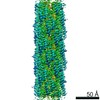


 PDBj
PDBj

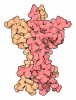
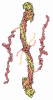
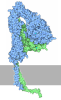
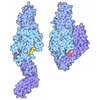

 集合体
集合体

 Escherichia coli (大腸菌) / 参照: UniProt: H0Y4G9, UniProt: Q99836*PLUS
 試料調製
試料調製 電子顕微鏡撮影
 FIELD EMISSION GUN / 加速電圧: 300 kV / 照射モード: FLOOD BEAM
 解析
解析
