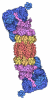
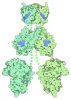
- EMDB-55607: Cytoplasmic lattice filament repeat unit with ubiquitin -
+
Open data
ID or keywords:
Loading...
-
Basic information
Entry
Database: EMDB / ID: EMD-55607
Title
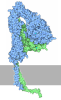
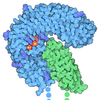
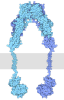
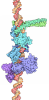
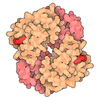
Cytoplasmic lattice filament repeat unit with ubiquitin
Map data
Sample
Complex: Multi-subunit complex of cytoplasmic lattice repeat unit with bound ubiquitin
Protein or peptide: x 15 types
Keywords
Ubiquitination / Complex / Filament / UNKNOWN FUNCTION
Function / homology
Function and homology information
regulation of translation by machinery localization / cytoplasm organization / ooplasm / Signaling by BMP / Prolactin receptor signaling / embryonic process involved in female pregnancy / subcortical maternal complex / establishment of organelle localization / Microtubule-dependent trafficking of connexons from Golgi to the plasma membrane / Cargo trafficking to the periciliary membrane ...regulation of translation by machinery localization / cytoplasm organization / ooplasm / Signaling by BMP / Prolactin receptor signaling / embryonic process involved in female pregnancy / subcortical maternal complex / establishment of organelle localization / Microtubule-dependent trafficking of connexons from Golgi to the plasma membrane / Cargo trafficking to the periciliary membrane / Sealing of the nuclear envelope (NE) by ESCRT-III / APC/C:Cdc20 mediated degradation of Cyclin B / APC-Cdc20 mediated degradation of Nek2A / Chromatin modifying enzymes / ER Quality Control Compartment (ERQC) / protein storage / structural constituent of cytoplasmic lattice / cytoplasmic lattice / Regulation of PTEN localization / cortical granule exocytosis / Downregulation of ERBB2:ERBB3 signaling / establishment or maintenance of apical/basal cell polarity / IRAK2 mediated activation of TAK1 complex / SMAD2/SMAD3:SMAD4 heterotrimer regulates transcription / PTK6 Regulates RTKs and Their Effectors AKT1 and DOK1 / endoplasmic reticulum localization / Gap-filling DNA repair synthesis and ligation in GG-NER / Fanconi Anemia Pathway / Endosomal Sorting Complex Required For Transport (ESCRT) / Negative regulation of FLT3 / Synthesis of active ubiquitin: roles of E1 and E2 enzymes / Regulation of expression of SLITs and ROBOs / IRAK1 recruits IKK complex / IRAK1 recruits IKK complex upon TLR7/8 or 9 stimulation / Downregulation of ERBB4 signaling / Stabilization of p53 / NOTCH3 Activation and Transmission of Signal to the Nucleus / Negative regulators of DDX58/IFIH1 signaling / Alpha-protein kinase 1 signaling pathway / Regulation of pyruvate metabolism / Downregulation of TGF-beta receptor signaling / TGF-beta receptor signaling in EMT (epithelial to mesenchymal transition) / JNK (c-Jun kinases) phosphorylation and activation mediated by activated human TAK1 / PD-L1(CD274) glycosylation and translocation to plasma membrane / Translesion synthesis by REV1 / Negative regulation of FGFR3 signaling / Negative regulation of FGFR4 signaling / Translesion synthesis by POLK / Pexophagy / Regulation of NF-kappa B signaling / Negative regulation of FGFR1 signaling / Negative regulation of FGFR2 signaling / Regulation of TP53 Activity through Methylation / Carboxyterminal post-translational modifications of tubulin / Intraflagellar transport / Translesion synthesis by POLI / Recognition of DNA damage by PCNA-containing replication complex / NRIF signals cell death from the nucleus / Interferon alpha/beta signaling / p75NTR recruits signalling complexes / Negative regulation of MAPK pathway / Spry regulation of FGF signaling / Regulation of TP53 Degradation / Translesion Synthesis by POLH / Activated NOTCH1 Transmits Signal to the Nucleus / Formation of TC-NER Pre-Incision Complex / Negative regulation of MET activity / TRAF6-mediated induction of TAK1 complex within TLR4 complex / IRAK2 mediated activation of TAK1 complex upon TLR7/8 or 9 stimulation / Termination of translesion DNA synthesis / COPI-independent Golgi-to-ER retrograde traffic / Autodegradation of Cdh1 by Cdh1:APC/C / APC/C:Cdc20 mediated degradation of Securin / Senescence-Associated Secretory Phenotype (SASP) / Josephin domain DUBs / DNA Damage Recognition in GG-NER / Dual Incision in GG-NER / Ubiquitin-dependent degradation of Cyclin D / Regulation of TBK1, IKKε (IKBKE)-mediated activation of IRF3, IRF7 / SCF-beta-TrCP mediated degradation of Emi1 / AUF1 (hnRNP D0) binds and destabilizes mRNA / Downregulation of ERBB2 signaling / Dual incision in TC-NER / E3 ubiquitin ligases ubiquitinate target proteins / Oncogene Induced Senescence / Degradation of CRY and PER proteins / Cdc20:Phospho-APC/C mediated degradation of Cyclin A / N-glycan trimming in the ER and Calnexin/Calreticulin cycle / Assembly of the pre-replicative complex / CDK-mediated phosphorylation and removal of Cdc6 / Downregulation of SMAD2/3:SMAD4 transcriptional activity / TNFR1-induced NF-kappa-B signaling pathway / HDR through Homologous Recombination (HRR) / Gap-filling DNA repair synthesis and ligation in TC-NER / Metalloprotease DUBs / Formation of Incision Complex in GG-NER / Activation of IRF3, IRF7 mediated by TBK1, IKKε (IKBKE) / mRNA Polyadenylation / EGFR downregulation / ZNF598 and the Ribosome-associated Quality Trigger (RQT) complex dissociate a ribosome stalled on a no-go mRNA Similarity search - Function
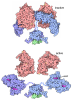
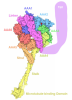
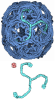
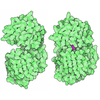
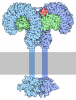
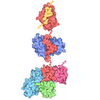
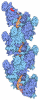
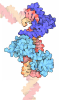
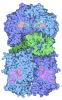
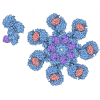
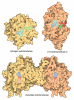
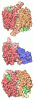
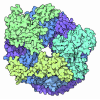
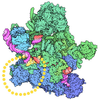
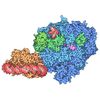
Journal: EMBO J / Year: 2026 Title: In-situ cryo-ET of mouse embryos reveals cytoplasmic lattices contain ubiquitin-charged E2-E3 ligase assemblies. Authors: Kashish Singh / Katarina Harasimov / Kathy K Niakan / Andrew P Carter / Abstract: Cytoplasmic lattices (CPLs) are filamentous assemblies essential for mammalian embryonic development. They are known to regulate organelle organization, spindle assembly, and protein homeostasis, but ...Cytoplasmic lattices (CPLs) are filamentous assemblies essential for mammalian embryonic development. They are known to regulate organelle organization, spindle assembly, and protein homeostasis, but their molecular functions remain unclear. Here, we develop a strategy combining cryo-focused ion beam milling and cryo-electron tomography to resolve macromolecular complexes directly in mammalian embryos. Using this approach, we determine the in situ structure of cytoplasmic lattices within 6/8-cell mouse embryos at ~4.7 Å resolution. CPL filaments are built from multiple copies of at least fourteen proteins arranged into a ~4.5 MDa repeating unit. The repeat contains a central cavity that is open at the back and lined with multiple FBXW-SKP1 complexes and three modules, each containing the E2 ubiquitin-conjugating enzyme UBE2D and the E3 ligase UHRF1. We resolve two CPL states: one is consistent with a ubiquitin-charged UBE2D, where ubiquitin is held in an open, inactive conformation by binding the scaffold protein PADI6; the second lacks discernible ubiquitin density and shows structural changes compatible with ubiquitin becoming available for transfer. Our findings support a model in which CPLs function as large ubiquitin ligase assemblies during early embryonic development.
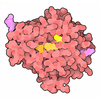
Name: Tubulin alpha-1C chain / type: protein_or_peptide / ID: 11 / Number of copies: 3 / Enantiomer: LEVO EC number: Hydrolases; Acting on acid anhydrides; Acting on GTP to facilitate cellular and subcellular movement
In the structure databanks used in Yorodumi, some data are registered as the other names, "COVID-19 virus" and "2019-nCoV". Here are the details of the virus and the list of structure data.
Jan 31, 2019. EMDB accession codes are about to change! (news from PDBe EMDB page)
EMDB accession codes are about to change! (news from PDBe EMDB page)
The allocation of 4 digits for EMDB accession codes will soon come to an end. Whilst these codes will remain in use, new EMDB accession codes will include an additional digit and will expand incrementally as the available range of codes is exhausted. The current 4-digit format prefixed with “EMD-” (i.e. EMD-XXXX) will advance to a 5-digit format (i.e. EMD-XXXXX), and so on. It is currently estimated that the 4-digit codes will be depleted around Spring 2019, at which point the 5-digit format will come into force.
The EM Navigator/Yorodumi systems omit the EMD- prefix.
Related info.:Q: What is EMD? / ID/Accession-code notation in Yorodumi/EM Navigator
Yorodumi is a browser for structure data from EMDB, PDB, SASBDB, etc.
This page is also the successor to EM Navigator detail page, and also detail information page/front-end page for Omokage search.
The word "yorodu" (or yorozu) is an old Japanese word meaning "ten thousand". "mi" (miru) is to see.
Related info.:EMDB / PDB / SASBDB / Comparison of 3 databanks / Yorodumi Search / Aug 31, 2016. New EM Navigator & Yorodumi / Yorodumi Papers / Jmol/JSmol / Function and homology information / Changes in new EM Navigator and Yorodumi
 Movie
Movie Controller


 Open data
 Basic information
 Map data
 Sample
 Keywords
 Function and homology information
 Mus musculus (house mouse)
 Authors
 United Kingdom, European Union, 3 items
  Citation
 Structure visualization
 Downloads & links
 emd_55607.png
 http://ftp.pdbj.org/pub/emdb/structures/EMD-55607



 Z (Sec.)
 Y (Row.)
 X (Col.)






 Sample components
 Processing
 Electron microscopy
 FIELD EMISSION GUN

