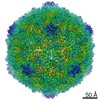
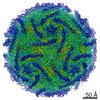
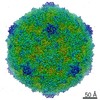
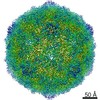
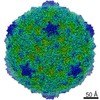
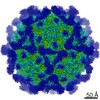
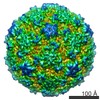
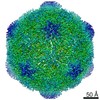
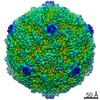
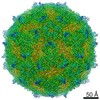
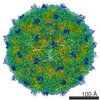
- EMDB-30318: E30 F-particle in complex with FcRn -
+
データを開く
IDまたはキーワード:
読み込み中...
-
基本情報
登録情報
データベース: EMDB / ID: EMD-30318
タイトル
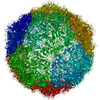
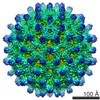
E30 F-particle in complex with FcRn
マップデータ
試料
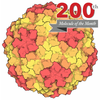
複合体: Echovirus E30
複合体: E30 F-particle in complex with FcRn
タンパク質・ペプチド: VP1
タンパク質・ペプチド: VP2
タンパク質・ペプチド: VP3
タンパク質・ペプチド: VP4
複合体: E30 F-particle in complex with FcRn
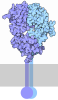
タンパク質・ペプチド: IgG receptor FcRn large subunit p51
タンパク質・ペプチド: Beta-2-microglobulin
リガンド: MYRISTIC ACID
キーワード
Echovirus B / mature / receptor / VIRUS
機能・相同性
機能・相同性情報
IgG immunoglobulin transcytosis in epithelial cells mediated by FcRn immunoglobulin receptor / IgG binding / symbiont-mediated suppression of host cytoplasmic pattern recognition receptor signaling pathway via inhibition of RIG-I activity / beta-2-microglobulin binding / early endosome lumen / Nef mediated downregulation of MHC class I complex cell surface expression / DAP12 interactions / Endosomal/Vacuolar pathway / T cell mediated cytotoxicity / Antigen Presentation: Folding, assembly and peptide loading of class I MHC ...IgG immunoglobulin transcytosis in epithelial cells mediated by FcRn immunoglobulin receptor / IgG binding / symbiont-mediated suppression of host cytoplasmic pattern recognition receptor signaling pathway via inhibition of RIG-I activity / beta-2-microglobulin binding / early endosome lumen / Nef mediated downregulation of MHC class I complex cell surface expression / DAP12 interactions / Endosomal/Vacuolar pathway / T cell mediated cytotoxicity / Antigen Presentation: Folding, assembly and peptide loading of class I MHC / picornain 2A / symbiont-mediated suppression of host mRNA export from nucleus / regulation of iron ion transport / cellular response to iron(III) ion / negative regulation of iron ion transport / negative regulation of forebrain neuron differentiation / antigen processing and presentation of exogenous protein antigen via MHC class Ib, TAP-dependent / symbiont genome entry into host cell via pore formation in plasma membrane / picornain 3C / ER to Golgi transport vesicle membrane / peptide antigen assembly with MHC class I protein complex / regulation of erythrocyte differentiation / response to molecule of bacterial origin / HFE-transferrin receptor complex / transferrin transport / MHC class I peptide loading complex / cellular response to iron ion / negative regulation of receptor-mediated endocytosis / T=pseudo3 icosahedral viral capsid / positive regulation of T cell cytokine production / antigen processing and presentation of endogenous peptide antigen via MHC class I / MHC class I protein complex / peptide antigen assembly with MHC class II protein complex / negative regulation of neurogenesis / cellular response to nicotine / MHC class II protein complex / positive regulation of receptor-mediated endocytosis / multicellular organismal-level iron ion homeostasis / host cell cytoplasmic vesicle membrane / positive regulation of T cell mediated cytotoxicity / specific granule lumen / positive regulation of immune response / antigen processing and presentation of exogenous peptide antigen via MHC class II / peptide antigen binding / phagocytic vesicle membrane / recycling endosome membrane / positive regulation of T cell activation / negative regulation of epithelial cell proliferation / Interferon gamma signaling / Immunoregulatory interactions between a Lymphoid and a non-Lymphoid cell / Modulation by Mtb of host immune system / viral capsid / positive regulation of cellular senescence / sensory perception of smell / tertiary granule lumen / MHC class II protein complex binding / DAP12 signaling / ribonucleoside triphosphate phosphatase activity / T cell differentiation in thymus / late endosome membrane / host cell / negative regulation of neuron projection development / nucleoside-triphosphate phosphatase / protein refolding / ER-Phagosome pathway / channel activity / early endosome membrane / monoatomic ion transmembrane transport / amyloid fibril formation / protein homotetramerization / intracellular iron ion homeostasis / learning or memory / DNA replication / RNA helicase activity / endosome membrane / immune response / endocytosis involved in viral entry into host cell / endoplasmic reticulum lumen / Amyloid fiber formation / symbiont-mediated suppression of host gene expression / Golgi membrane / external side of plasma membrane / symbiont-mediated activation of host autophagy / lysosomal membrane / RNA-directed RNA polymerase / cysteine-type endopeptidase activity / focal adhesion / viral RNA genome replication / RNA-directed RNA polymerase activity / Neutrophil degranulation / DNA-templated transcription / virion attachment to host cell / host cell nucleus / SARS-CoV-2 activates/modulates innate and adaptive immune responses / structural molecule activity / endoplasmic reticulum / Golgi apparatus / protein homodimerization activity / proteolysis / : 類似検索 - 分子機能
Picornavirus coat protein VP4 superfamily / Class I Histocompatibility antigen, domains alpha 1 and 2 / Poliovirus 3A protein-like / Poliovirus 3A protein like / Picornavirus 2B protein / Poliovirus core protein 3a, soluble domain / Picornavirus 2B protein / Peptidase C3, picornavirus core protein 2A / Picornavirus core protein 2A / Picornavirus coat protein VP4 ...Picornavirus coat protein VP4 superfamily / Class I Histocompatibility antigen, domains alpha 1 and 2 / Poliovirus 3A protein-like / Poliovirus 3A protein like / Picornavirus 2B protein / Poliovirus core protein 3a, soluble domain / Picornavirus 2B protein / Peptidase C3, picornavirus core protein 2A / Picornavirus core protein 2A / Picornavirus coat protein VP4 / Picornavirus coat protein (VP4) / Beta-2-Microglobulin / : / MHC class I-like antigen recognition-like / MHC class I-like antigen recognition-like superfamily / Peptidase C3A/C3B, picornaviral / 3C cysteine protease (picornain 3C) / Picornavirales 3C/3C-like protease domain / Picornavirales 3C/3C-like protease domain profile. / Picornavirus capsid / picornavirus capsid protein / Helicase, superfamily 3, single-stranded RNA virus / Superfamily 3 helicase of positive ssRNA viruses domain profile. / Helicase, superfamily 3, single-stranded DNA/RNA virus / RNA helicase / MHC classes I/II-like antigen recognition protein / : / Picornavirus/Calicivirus coat protein / Viral coat protein subunit / Immunoglobulin/major histocompatibility complex, conserved site / Immunoglobulins and major histocompatibility complex proteins signature. / Immunoglobulin C-Type / Immunoglobulin C1-set / Immunoglobulin C1-set domain / Reverse transcriptase/Diguanylate cyclase domain / RNA-directed RNA polymerase, C-terminal domain / Viral RNA-dependent RNA polymerase / Ig-like domain profile. / Immunoglobulin-like domain / Immunoglobulin-like domain superfamily / RNA-directed RNA polymerase, catalytic domain / RdRp of positive ssRNA viruses catalytic domain profile. / ATPases associated with a variety of cellular activities / AAA+ ATPase domain / Immunoglobulin-like fold / Peptidase S1, PA clan, chymotrypsin-like fold / Peptidase S1, PA clan / DNA/RNA polymerase superfamily / P-loop containing nucleoside triphosphate hydrolase 類似検索 - ドメイン・相同性
ジャーナル: Nat Commun / 年: 2020 タイトル: Structures of Echovirus 30 in complex with its receptors inform a rational prediction for enterovirus receptor usage. 著者: Kang Wang / Ling Zhu / Yao Sun / Minhao Li / Xin Zhao / Lunbiao Cui / Li Zhang / George F Gao / Weiwei Zhai / Fengcai Zhu / Zihe Rao / Xiangxi Wang / 要旨: Receptor usage that determines cell tropism and drives viral classification closely correlates with the virus structure. Enterovirus B (EV-B) consists of several subgroups according to receptor ...Receptor usage that determines cell tropism and drives viral classification closely correlates with the virus structure. Enterovirus B (EV-B) consists of several subgroups according to receptor usage, among which echovirus 30 (E30), a leading causative agent for human aseptic meningitis, utilizes FcRn as an uncoating receptor. However, receptors for many EVs remain unknown. Here we analyzed the atomic structures of E30 mature virion, empty- and A-particles, which reveals serotype-specific epitopes and striking conformational differences between the subgroups within EV-Bs. Of these, the VP1 BC loop markedly distinguishes E30 from other EV-Bs, indicative of a role as a structural marker for EV-B. By obtaining cryo-electron microscopy structures of E30 in complex with its receptor FcRn and CD55 and comparing its homologs, we deciphered the underlying molecular basis for receptor recognition. Together with experimentally derived viral receptor identifications, we developed a structure-based in silico algorithm to inform a rational prediction for EV receptor usage.
 ムービー
ムービー コントローラー


 データを開く
 基本情報
基本情報 マップデータ
 試料
試料 キーワード
キーワード 機能・相同性情報
 Echovirus E30 (ウイルス) /
  Homo sapiens (ヒト)
 データ登録者
 中国, 1件
  引用
引用 構造の表示
構造の表示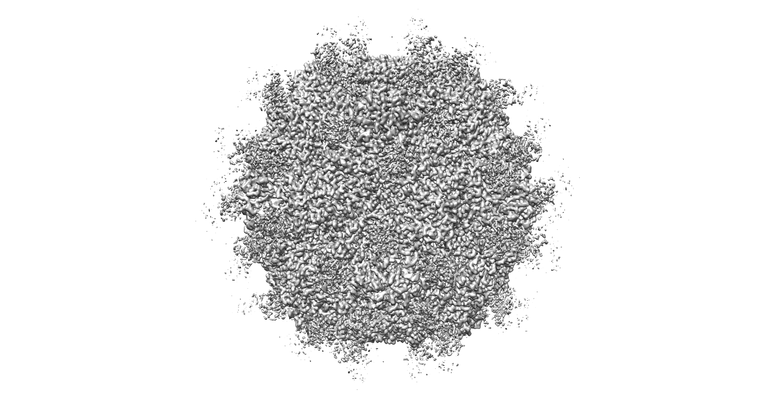
 ダウンロードとリンク
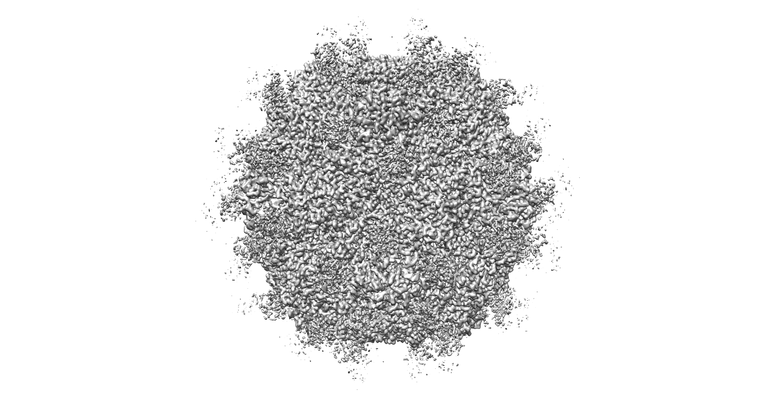 emd_30318.png
 http://ftp.pdbj.org/pub/emdb/structures/EMD-30318








 Z (Sec.)
 Y (Row.)
 X (Col.)


 試料の構成要素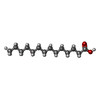
 解析
解析 電子顕微鏡法
 FIELD EMISSION GUN

