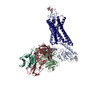
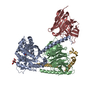
Movie
Movie Controller

[English] 日本語
 Yorodumi
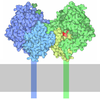
- EMDB-17345: Cryo-EM structure of Rhodopsin-Gi bound with antibody fragments s... -
+ Open data

- Basic information
| Entry |  | |||||||||||||||
|---|---|---|---|---|---|---|---|---|---|---|---|---|---|---|---|---|
| Title | Cryo-EM structure of Rhodopsin-Gi bound with antibody fragments scFv16 and Fab79, conformation 2 | |||||||||||||||
 Map data Map data | ||||||||||||||||
 Sample Sample |
| |||||||||||||||
 Keywords Keywords | GPCR / Rhodopsin / G protein / Fab / SIGNALING PROTEIN | |||||||||||||||
| Function / homology |  Function and homology information Function and homology informationOpsins / VxPx cargo-targeting to cilium / sperm head plasma membrane / opsin binding / The canonical retinoid cycle in rods (twilight vision) / transducin-mediated opsin signaling pathway / absorption of visible light / G protein-coupled opsin signaling pathway / Olfactory Signaling Pathway / 11-cis retinal binding ...Opsins / VxPx cargo-targeting to cilium / sperm head plasma membrane / opsin binding / The canonical retinoid cycle in rods (twilight vision) / transducin-mediated opsin signaling pathway / absorption of visible light / G protein-coupled opsin signaling pathway / Olfactory Signaling Pathway / 11-cis retinal binding / Sensory perception of sweet, bitter, and umami (glutamate) taste / Synthesis, secretion, and inactivation of Glucagon-like Peptide-1 (GLP-1) / G protein-coupled photoreceptor activity / cellular response to light stimulus / photoreceptor inner segment membrane / Inactivation, recovery and regulation of the phototransduction cascade / G protein-coupled receptor complex / Activation of the phototransduction cascade / phototransduction, visible light / outer membrane / arrestin family protein binding / Activation of G protein gated Potassium channels / G-protein activation / G beta:gamma signalling through PI3Kgamma / Prostacyclin signalling through prostacyclin receptor / G beta:gamma signalling through PLC beta / ADP signalling through P2Y purinoceptor 1 / Thromboxane signalling through TP receptor / Presynaptic function of Kainate receptors / G beta:gamma signalling through CDC42 / Inhibition of voltage gated Ca2+ channels via Gbeta/gamma subunits / G alpha (12/13) signalling events / Glucagon-type ligand receptors / G beta:gamma signalling through BTK / ADP signalling through P2Y purinoceptor 12 / Adrenaline,noradrenaline inhibits insulin secretion / Cooperation of PDCL (PhLP1) and TRiC/CCT in G-protein beta folding / Ca2+ pathway / G alpha (z) signalling events / Thrombin signalling through proteinase activated receptors (PARs) / Extra-nuclear estrogen signaling / G alpha (q) signalling events / G alpha (s) signalling events / photoreceptor outer segment membrane / Glucagon-like Peptide-1 (GLP1) regulates insulin secretion / G alpha (i) signalling events / High laminar flow shear stress activates signaling by PIEZO1 and PECAM1:CDH5:KDR in endothelial cells / Vasopressin regulates renal water homeostasis via Aquaporins / phototransduction / response to light stimulus / G-protein alpha-subunit binding / photoreceptor outer segment / visual perception / regulation of eating behavior / adenylate cyclase inhibitor activity / T cell migration / positive regulation of protein localization to cell cortex / positive regulation of relaxation of smooth muscle / Adenylate cyclase inhibitory pathway / D2 dopamine receptor binding / guanyl-nucleotide exchange factor activity / adenylate cyclase-inhibiting serotonin receptor signaling pathway / sperm midpiece / G protein-coupled serotonin receptor binding / cellular response to forskolin / regulation of mitotic spindle organization / mast cell degranulation / chemokine-mediated signaling pathway / neuropeptide signaling pathway / Regulation of insulin secretion / response to prostaglandin E / positive regulation of cholesterol biosynthetic process / G protein-coupled receptor binding / response to peptide hormone / G-protein beta/gamma-subunit complex binding / adenylate cyclase-inhibiting G protein-coupled receptor signaling pathway / adenylate cyclase-modulating G protein-coupled receptor signaling pathway / cell-cell junction / GDP binding / photoreceptor disc membrane / ADP signalling through P2Y purinoceptor 12 / Adrenaline,noradrenaline inhibits insulin secretion / G alpha (z) signalling events / cellular response to catecholamine stimulus / ADORA2B mediated anti-inflammatory cytokines production / adenylate cyclase-activating dopamine receptor signaling pathway / cellular response to prostaglandin E stimulus / GPER1 signaling / heterotrimeric G-protein complex / G-protein beta-subunit binding / adenylate cyclase-activating G protein-coupled receptor signaling pathway / signaling receptor complex adaptor activity / ciliary basal body / GTPase binding / midbody / G protein activity / cell cortex / G alpha (i) signalling events / G alpha (s) signalling events / Hydrolases; Acting on acid anhydrides; Acting on GTP to facilitate cellular and subcellular movement Similarity search - Function | |||||||||||||||
| Biological species |   Bos taurus (domestic cattle) / Bos taurus (domestic cattle) /  Homo sapiens (human) / Homo sapiens (human) /  Mus musculus (house mouse) Mus musculus (house mouse) | |||||||||||||||
| Method | single particle reconstruction / cryo EM / Resolution: 5.9 Å | |||||||||||||||
 Authors Authors | Pamula F / Tejero O / Muehle J / Thoma R / Schertler GFX / Marino J / Tsai C-J | |||||||||||||||
| Funding support |  Switzerland, European Union, 4 items Switzerland, European Union, 4 items
| |||||||||||||||
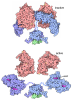
 Citation Citation | Journal: Biophys J / Year: 2026 Title: Tool antibody fragments reveal multiple conformations of the rhodopsin-Gi signaling complex. Authors: Filip Pamula / Oliver Tejero / Jonas Mühle / Ralf Thoma / Gebhard F X Schertler / Jacopo Marino / Ching-Ju Tsai / Abstract: Antibody Fab fragments are widely used protein binders that assist in structural studies of G-protein-coupled receptor (GPCR) signaling complexes. Expanding the repertoire of such binders to target ...Antibody Fab fragments are widely used protein binders that assist in structural studies of G-protein-coupled receptor (GPCR) signaling complexes. Expanding the repertoire of such binders to target distinct components of the signaling complex offers opportunities to probe conformational regulation and dynamics. Here, we report the biochemical and cryo-EM characterization of two Fab fragments, Fab79 and Fab13, raised against the rhodopsin-Gαiβγ complex. Fab79 binds to the flexible α-helical domain (AHD) of the Gαi subunit and prevents complex dissociation in the presence of the nonhydrolyzable GTP analog, GTPγS, likely by hindering AHD closure, a step necessary for complex dissociation. In contrast, Fab13 binds rigidly to Gβ without directly contacting Gα or the receptor. These findings show that Fab79 and Fab13 reveal functionally relevant conformational states of G-protein activation and serve as practical tools to stabilize or modulate GPCR signaling complexes. | |||||||||||||||
| History |
|
- Structure visualization
| Supplemental images |
|---|

- Downloads & links
-EMDB archive
| Map data | emd_17345.map.gz | 18.1 MB | EMDB map data format | |
|---|---|---|---|---|
| Header (meta data) | emd-17345-v30.xmlemd-17345.xml | 33.4 KB 33.4 KB | Display Display | EMDB header |
| Images |  emd_17345.png emd_17345.png | 68.3 KB | ||
| Filedesc metadata | emd-17345.cif.gz | 8.4 KB | ||
| Others | emd_17345_half_map_1.map.gzemd_17345_half_map_2.map.gz | 165.8 MB 165.8 MB | ||
| Archive directory |  https://data.pdbj.org/pub/emdb/structures/EMD-17345ftp://data.pdbj.org/pub/emdb/structures/EMD-17345 https://data.pdbj.org/pub/emdb/structures/EMD-17345ftp://data.pdbj.org/pub/emdb/structures/EMD-17345 | HTTPS FTP |
-Related structure data
| Related structure data | 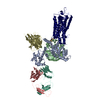 8p15MC  8p12C  8p13C C: citing same article ( M: atomic model generated by this map |
|---|---|
| Similar structure data |


-Links
| EMDB pages | EMDB (EBI/PDBe) / EMDataResource |
|---|---|
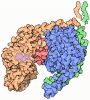
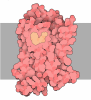
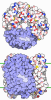
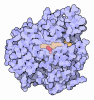
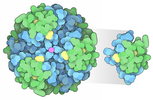
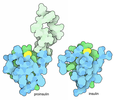
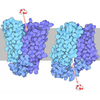
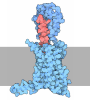
| Related items in Molecule of the Month |

-Map
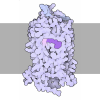
| File | Download / File: emd_17345.map.gz / Format: CCP4 / Size: 209.3 MB / Type: IMAGE STORED AS FLOATING POINT NUMBER (4 BYTES) | ||||||||||||||||||||||||||||||||||||
|---|---|---|---|---|---|---|---|---|---|---|---|---|---|---|---|---|---|---|---|---|---|---|---|---|---|---|---|---|---|---|---|---|---|---|---|---|---|
| Projections & slices | Image control
Images are generated by Spider. | ||||||||||||||||||||||||||||||||||||
| Voxel size | X=Y=Z: 0.854 Å | ||||||||||||||||||||||||||||||||||||
| Density |
| ||||||||||||||||||||||||||||||||||||
| Symmetry | Space group: 1 | ||||||||||||||||||||||||||||||||||||
| Details | EMDB XML:
|
 Z (Sec.)
 Y (Row.)
 X (Col.)


-Supplemental data
-Half map: #1
| File | emd_17345_half_map_1.map | ||||||||||||
|---|---|---|---|---|---|---|---|---|---|---|---|---|---|
| Projections & Slices |
| ||||||||||||
| Density Histograms |


-Half map: #2
| File | emd_17345_half_map_2.map | ||||||||||||
|---|---|---|---|---|---|---|---|---|---|---|---|---|---|
| Projections & Slices |
| ||||||||||||
| Density Histograms |


- Sample components
+Entire : Rhodopsin-Gi-scFv16-Fab79 complex
+Supramolecule #1: Rhodopsin-Gi-scFv16-Fab79 complex
+Supramolecule #2: Rhodopsin
+Supramolecule #3: Guanine nucleotide-binding protein G(i) subunit alpha-1
+Supramolecule #4: Guanine nucleotide-binding protein G(I)/G(S)/G(T) subunit beta-1 ...
+Supramolecule #5: single-chain Fv scFv16
+Supramolecule #6: Immunoglobin G heavy chain FAB fragment and Immunoglobin G light chain
+Macromolecule #1: Rhodopsin
+Macromolecule #2: Guanine nucleotide-binding protein G(i) subunit alpha-1

 Escherichia coli BL21(DE3) (bacteria)
+Macromolecule #3: Guanine nucleotide-binding protein G(I)/G(S)/G(T) subunit beta-1
+Macromolecule #4: Guanine nucleotide-binding protein G(T) subunit gamma-T1
+Macromolecule #5: single-chain Fv scFv16
 Trichoplusia ni (cabbage looper)
+Macromolecule #6: Immunoglobin G heavy chain FAB fragment
+Macromolecule #7: Immunoglobin G light chain
-Experimental details
-Structure determination
| Method | cryo EM |
|---|---|
 Processing Processing | single particle reconstruction |
| Aggregation state | particle |
-Sample preparation
| Concentration | 0.7 mg/mL | |||||||||
|---|---|---|---|---|---|---|---|---|---|---|
| Buffer | pH: 7.5 Component:
Details: 20 mM HEPES (pH 7.5), 100 mM NaCl | |||||||||
| Grid | Model: Quantifoil R1.2/1.3 / Material: COPPER / Mesh: 200 / Pretreatment - Type: GLOW DISCHARGE | |||||||||
| Vitrification | Cryogen name: ETHANE / Chamber humidity: 100 % / Chamber temperature: 277 K / Instrument: FEI VITROBOT MARK IV | |||||||||
| Details | Monodisperse |
- Electron microscopy
| Microscope | FEI TITAN KRIOS |
|---|---|
| Image recording | Film or detector model: GATAN K2 SUMMIT (4k x 4k) / Detector mode: COUNTING / Average electron dose: 60.0 e/Å2 |
| Electron beam | Acceleration voltage: 300 kV / Electron source:  FIELD EMISSION GUN FIELD EMISSION GUN |
| Electron optics | Illumination mode: FLOOD BEAM / Imaging mode: BRIGHT FIELD / Nominal defocus max: 2.4 µm / Nominal defocus min: 0.8 µm / Nominal magnification: 165000 |
| Sample stage | Specimen holder model: FEI TITAN KRIOS AUTOGRID HOLDER / Cooling holder cryogen: NITROGEN |
| Experimental equipment |  Model: Titan Krios / Image courtesy: FEI Company |
+Image processing
-Atomic model buiding 1
| Initial model |
| ||||||||||||||||||||||||||||||
|---|---|---|---|---|---|---|---|---|---|---|---|---|---|---|---|---|---|---|---|---|---|---|---|---|---|---|---|---|---|---|---|
| Refinement | Space: REAL / Protocol: AB INITIO MODEL / Overall B value: 295 / Target criteria: cross-correlation coefficient | ||||||||||||||||||||||||||||||
| Output model | PDB-8p15: |