 Movie
Movie Controller

[English] 日本語
 Yorodumi
- PDB-7t11: CryoEM structure of somatostatin receptor 2 in complex with Octre... -
+ Open data

- Basic information
| Entry | Database: PDB / ID: 7t11 | ||||||
|---|---|---|---|---|---|---|---|
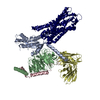
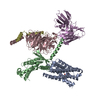
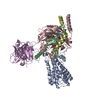
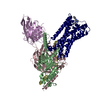
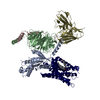
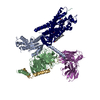
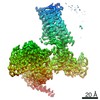
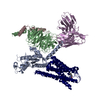
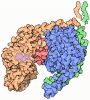
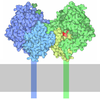
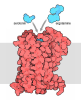
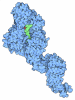
| Title | CryoEM structure of somatostatin receptor 2 in complex with Octreotide and Gi3. | ||||||
 Components Components |
| ||||||
 Keywords Keywords | MEMBRANE PROTEIN/SIGNALING PROTEIN / GPCR / Receptor / Complex / MEMBRANE PROTEIN / MEMBRANE PROTEIN-SIGNALING PROTEIN complex | ||||||
| Function / homology |  Function and homology information Function and homology informationsomatostatin receptor activity / response to acrylamide / dynorphin receptor activity / regulation of saliva secretion / sensory perception of temperature stimulus / positive regulation of eating behavior / adenylate cyclase-inhibiting opioid receptor signaling pathway / negative regulation of luteinizing hormone secretion / G protein-coupled opioid receptor activity / maternal behavior ...somatostatin receptor activity / response to acrylamide / dynorphin receptor activity / regulation of saliva secretion / sensory perception of temperature stimulus / positive regulation of eating behavior / adenylate cyclase-inhibiting opioid receptor signaling pathway / negative regulation of luteinizing hormone secretion / G protein-coupled opioid receptor activity / maternal behavior / G protein-coupled opioid receptor signaling pathway / positive regulation of dopamine secretion / negative regulation of adenylate cyclase activity / positive regulation of potassium ion transmembrane transport / receptor serine/threonine kinase binding / positive regulation of p38MAPK cascade / GTP metabolic process / neuropeptide binding / cellular response to glucocorticoid stimulus / eating behavior / sensory perception / positive regulation of macroautophagy / estrous cycle / G protein-coupled receptor signaling pathway, coupled to cyclic nucleotide second messenger / conditioned place preference / MECP2 regulates neuronal receptors and channels / behavioral response to cocaine / sensory perception of pain / Adenylate cyclase inhibitory pathway / T-tubule / locomotory behavior / axon terminus / response to insulin / Peptide ligand-binding receptors / cellular response to estradiol stimulus / response to nicotine / cellular response to glucose stimulus / sarcoplasmic reticulum / PDZ domain binding / neuropeptide signaling pathway / response to estrogen / G protein-coupled receptor binding / G-protein beta/gamma-subunit complex binding / adenylate cyclase-inhibiting G protein-coupled receptor signaling pathway / adenylate cyclase-modulating G protein-coupled receptor signaling pathway / phospholipase C-activating G protein-coupled receptor signaling pathway / Olfactory Signaling Pathway / Activation of the phototransduction cascade / G protein-coupled acetylcholine receptor signaling pathway / G beta:gamma signalling through PLC beta / Presynaptic function of Kainate receptors / Thromboxane signalling through TP receptor / Activation of G protein gated Potassium channels / Inhibition of voltage gated Ca2+ channels via Gbeta/gamma subunits / G-protein activation / Glucagon signaling in metabolic regulation / G beta:gamma signalling through CDC42 / Prostacyclin signalling through prostacyclin receptor / Synthesis, secretion, and inactivation of Glucagon-like Peptide-1 (GLP-1) / GDP binding / photoreceptor disc membrane / G beta:gamma signalling through BTK / ADP signalling through P2Y purinoceptor 12 / synaptic vesicle membrane / Sensory perception of sweet, bitter, and umami (glutamate) taste / Glucagon-type ligand receptors / Adrenaline,noradrenaline inhibits insulin secretion / Vasopressin regulates renal water homeostasis via Aquaporins / G alpha (z) signalling events / Glucagon-like Peptide-1 (GLP1) regulates insulin secretion / cellular response to catecholamine stimulus / ADP signalling through P2Y purinoceptor 1 / G beta:gamma signalling through PI3Kgamma / ADORA2B mediated anti-inflammatory cytokines production / adenylate cyclase-activating dopamine receptor signaling pathway / cellular response to prostaglandin E stimulus / Cooperation of PDCL (PhLP1) and TRiC/CCT in G-protein beta folding / cellular response to lipopolysaccharide / GPER1 signaling / heterotrimeric G-protein complex / G alpha (12/13) signalling events / Inactivation, recovery and regulation of the phototransduction cascade / G-protein beta-subunit binding / extracellular vesicle / Thrombin signalling through proteinase activated receptors (PARs) / signaling receptor complex adaptor activity / ciliary basal body / GTPase binding / midbody / defense response to virus / chemical synaptic transmission / presynaptic membrane / Ca2+ pathway / High laminar flow shear stress activates signaling by PIEZO1 and PECAM1:CDH5:KDR in endothelial cells / G alpha (i) signalling events / G alpha (s) signalling events / response to ethanol / G alpha (q) signalling events / perikaryon / Ras protein signal transduction Similarity search - Function | ||||||
| Biological species |  Homo sapiens (human) Homo sapiens (human)  Mus musculus (house mouse) Mus musculus (house mouse)synthetic construct (others) | ||||||
| Method | ELECTRON MICROSCOPY / single particle reconstruction / cryo EM / Resolution: 2.7 Å | ||||||
 Authors Authors | Robertson, M.J. / Skinotis, G. | ||||||
| Funding support | 1items
| ||||||
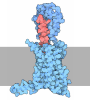
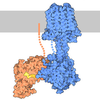
 Citation Citation | Journal: Nat Struct Mol Biol / Year: 2022 Title: Plasticity in ligand recognition at somatostatin receptors. Authors: Michael J Robertson / Justin G Meyerowitz / Ouliana Panova / Kenneth Borrelli / Georgios Skiniotis /  Abstract: Somatostatin is a signaling peptide that plays a pivotal role in physiologic processes relating to metabolism and growth through its actions at somatostatin receptors (SSTRs). Members of the SSTR ...Somatostatin is a signaling peptide that plays a pivotal role in physiologic processes relating to metabolism and growth through its actions at somatostatin receptors (SSTRs). Members of the SSTR subfamily, particularly SSTR2, are key drug targets for neuroendocrine neoplasms, with synthetic peptide agonists currently in clinical use. Here, we show the cryogenic-electron microscopy structures of active-state SSTR2 in complex with heterotrimeric G and either the endogenous ligand SST14 or the FDA-approved drug octreotide. Complemented by biochemical assays and molecular dynamics simulations, these structures reveal key details of ligand recognition and receptor activation at SSTRs. We find that SSTR ligand recognition is highly diverse, as demonstrated by ligand-induced conformational changes in ECL2 and substantial sequence divergence across subtypes in extracellular regions. Despite this complexity, we rationalize several known sources of SSTR subtype selectivity and identify an additional interaction for specific binding. These results provide valuable insights for structure-based drug discovery at SSTRs. | ||||||
| History |
|
- Structure visualization
| Movie |
Movie viewer |
|---|---|
| Structure viewer | Molecule: MolmilJmol/JSmol |
- Downloads & links
-Download
| PDBx/mmCIF format | 7t11.cif.gz | 202.5 KB | Display | PDBx/mmCIF format |
|---|---|---|---|---|
| PDB format | pdb7t11.ent.gz | 157.9 KB | Display | PDB format |
| PDBx/mmJSON format | 7t11.json.gz | Tree view | PDBx/mmJSON format | |
| Others |  Other downloads Other downloads |
-Validation report
| Arichive directory | https://data.pdbj.org/pub/pdb/validation_reports/t1/7t11ftp://data.pdbj.org/pub/pdb/validation_reports/t1/7t11 | HTTPS FTP |
|---|
-Related structure data
| Related structure data | 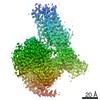 25587MC 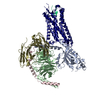 7t10C M: map data used to model this data C: citing same article ( |
|---|---|
| Similar structure data | |
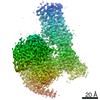
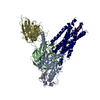
| EM raw data | EMPIAR-10932 (Title: Cryogenic electron microscopy of somatostatin receptor 2/Octreotide/Gi3 complex Data size: 4.2 TB Data #1: Raw movies of SSTR2/Octreotide/Gi3 complex collected on a K3 [micrographs - multiframe]) |

-Links
 PDBj
PDBj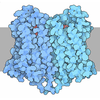

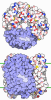
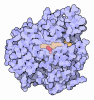
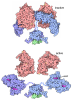
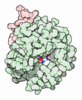
- Assembly
| Deposited unit | 
|
|---|---|
| 1 |
|
-Components
-Guanine nucleotide-binding protein ... , 3 types, 3 molecules ABC
| #1: Protein | Mass: 40584.156 Da / Num. of mol.: 1 / Mutation: S47N, G203A, E245A, A326S Source method: isolated from a genetically manipulated source Details: dominant negative / Source: (gene. exp.) Homo sapiens (human) / Gene: GNAI3 / Production host:  Trichoplusia ni (cabbage looper) / References: UniProt: P08754 Trichoplusia ni (cabbage looper) / References: UniProt: P08754 |
|---|---|
| #2: Protein | Mass: 37671.102 Da / Num. of mol.: 1 Source method: isolated from a genetically manipulated source Source: (gene. exp.) Homo sapiens (human) / Gene: GNB1 / Production host: Trichoplusia ni (cabbage looper) / References: UniProt: P62873 |
| #3: Protein | Mass: 7861.143 Da / Num. of mol.: 1 Source method: isolated from a genetically manipulated source Source: (gene. exp.) Homo sapiens (human) / Gene: GNG2 / Production host: Trichoplusia ni (cabbage looper) / References: UniProt: P59768 |
-Antibody / Protein/peptide / Protein , 3 types, 3 molecules SPR
| #4: Antibody | Mass: 27784.896 Da / Num. of mol.: 1 Source method: isolated from a genetically manipulated source Source: (gene. exp.) Mus musculus (house mouse) / Production host:  Spodoptera frugiperda (fall armyworm) Spodoptera frugiperda (fall armyworm) |
|---|---|
| #5: Protein/peptide | Mass: 1022.263 Da / Num. of mol.: 1 / Source method: obtained synthetically / Source: (synth.) synthetic construct (others) |
| #6: Protein | Mass: 45784.211 Da / Num. of mol.: 1 Source method: isolated from a genetically manipulated source Details: Somatostatin receptor type 2 with intracellular loop 3 (ICL3) replaced with the ICL3 from the Kappa-type opioid receptor Source: (gene. exp.) Homo sapiens (human) / Gene: SSTR2, OPRK1, OPRK / Production host: Spodoptera frugiperda (fall armyworm) / References: UniProt: P30874, UniProt: P41145 |
-Details
| Has ligand of interest | Y |
|---|
-Experimental details
-Experiment
| Experiment | Method: ELECTRON MICROSCOPY |
|---|---|
| EM experiment | Aggregation state: PARTICLE / 3D reconstruction method: single particle reconstruction |
- Sample preparation
| Component | Name: Somatostatin receptor 2 in complex with Octreotide and Gi3. Type: COMPLEX / Entity ID: all / Source: MULTIPLE SOURCES |
|---|---|
| Buffer solution | pH: 7.5 |
| Specimen | Embedding applied: NO / Shadowing applied: NO / Staining applied: NO / Vitrification applied: YES |
| Specimen support | Grid material: GOLD |
| Vitrification | Cryogen name: ETHANE |
- Electron microscopy imaging
| Experimental equipment |  Model: Titan Krios / Image courtesy: FEI Company |
|---|---|
| Microscopy | Model: FEI TITAN KRIOS |
| Electron gun | Electron source:  FIELD EMISSION GUN / Accelerating voltage: 300 kV / Illumination mode: OTHER FIELD EMISSION GUN / Accelerating voltage: 300 kV / Illumination mode: OTHER |
| Electron lens | Mode: BRIGHT FIELD |
| Image recording | Electron dose: 1.22 e/Å2 / Film or detector model: GATAN K3 (6k x 4k) |
- Processing
| CTF correction | Type: PHASE FLIPPING AND AMPLITUDE CORRECTION |
|---|---|
| 3D reconstruction | Resolution: 2.7 Å / Resolution method: FSC 0.143 CUT-OFF / Num. of particles: 281479 / Symmetry type: POINT |
