 Movie
Movie Controller

[English] 日本語
 Yorodumi
- PDB-6usu: Crystal structure of GluN1/GluN2A ligand-binding domain in comple... -
+ Open data

- Basic information
| Entry | Database: PDB / ID: 6usu | |||||||||
|---|---|---|---|---|---|---|---|---|---|---|
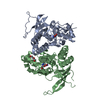
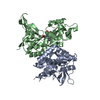
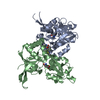
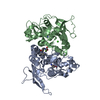
| Title | Crystal structure of GluN1/GluN2A ligand-binding domain in complex with L689,560 and glutamate | |||||||||
 Components Components |
| |||||||||
 Keywords Keywords | METAL TRANSPORT / NMDARs / LBD / Ion channels | |||||||||
| Function / homology |  Function and homology information Function and homology informationregulation of response to alcohol / response to ammonium ion / response to environmental enrichment / mesencephalic trigeminal nucleus development / neurotransmitter receptor transport, plasma membrane to endosome / directional locomotion / receptor recycling / auditory behavior / response to carbohydrate / pons maturation ...regulation of response to alcohol / response to ammonium ion / response to environmental enrichment / mesencephalic trigeminal nucleus development / neurotransmitter receptor transport, plasma membrane to endosome / directional locomotion / receptor recycling / auditory behavior / response to carbohydrate / pons maturation / EPHB-mediated forward signaling / positive regulation of Schwann cell migration / Assembly and cell surface presentation of NMDA receptors / regulation of cell communication / protein localization to postsynaptic membrane / conditioned taste aversion / cellular response to magnesium ion / sleep / serotonin metabolic process / suckling behavior / positive regulation of mitochondrial calcium ion concentration / olfactory learning / response to other organism / response to hydrogen sulfide / response to methylmercury / dendritic branch / regulation of ARF protein signal transduction / locomotion / cellular response to dsRNA / response to manganese ion / response to glycoside / transmitter-gated monoatomic ion channel activity / cellular response to lipid / dendritic spine organization / regulation of respiratory gaseous exchange / propylene metabolic process / response to glycine / neurotransmitter receptor complex / positive regulation of inhibitory postsynaptic potential / RAF/MAP kinase cascade / regulation of NMDA receptor activity / response to amine / Synaptic adhesion-like molecules / NMDA glutamate receptor activity / regulation of monoatomic cation transmembrane transport / spinal cord development / cellular response to zinc ion / neuromuscular process / NMDA selective glutamate receptor complex / glutamate binding / regulation of axonogenesis / ligand-gated sodium channel activity / startle response / voltage-gated monoatomic cation channel activity / regulation of synapse assembly / calcium ion transmembrane import into cytosol / response to morphine / positive regulation of reactive oxygen species biosynthetic process / dopamine metabolic process / male mating behavior / protein heterotetramerization / regulation of dendrite morphogenesis / glycine binding / glutamate receptor signaling pathway / response to lithium ion / parallel fiber to Purkinje cell synapse / positive regulation of calcium ion transport into cytosol / associative learning / response to light stimulus / hypothalamus development / regulation of neuronal synaptic plasticity / social behavior / regulation of postsynaptic membrane potential / multicellular organismal response to stress / action potential / modulation of excitatory postsynaptic potential / positive regulation of dendritic spine maintenance / monoatomic cation transmembrane transport / positive regulation of protein targeting to membrane / cellular response to glycine / Unblocking of NMDA receptors, glutamate binding and activation / monoatomic cation transport / calcium ion homeostasis / glutamate receptor binding / prepulse inhibition / neurogenesis / phosphatase binding / conditioned place preference / long-term memory / adult locomotory behavior / regulation of long-term neuronal synaptic plasticity / response to fungicide / postsynaptic density, intracellular component / monoatomic cation channel activity / sensory perception of pain / glutamate-gated receptor activity / cellular response to manganese ion / response to amphetamine / positive regulation of synaptic transmission, glutamatergic / glutamate-gated calcium ion channel activity Similarity search - Function | |||||||||
| Biological species |   Rattus norvegicus (Norway rat) Rattus norvegicus (Norway rat) | |||||||||
| Method |  X-RAY DIFFRACTION / SYNCHROTRON / MOLECULAR REPLACEMENT / Resolution: 2.092 Å X-RAY DIFFRACTION / SYNCHROTRON / MOLECULAR REPLACEMENT / Resolution: 2.092 Å | |||||||||
 Authors Authors | Romero-Hernandez, A. / Tajima, N. / Chou, T. / Furukawa, H. | |||||||||
| Funding support |  United States, 2items United States, 2items
| |||||||||
 Citation Citation | Journal: Cell / Year: 2020 Title: Structural Basis of Functional Transitions in Mammalian NMDA Receptors. Authors: Tsung-Han Chou / Nami Tajima / Annabel Romero-Hernandez / Hiro Furukawa / Abstract: Excitatory neurotransmission meditated by glutamate receptors including N-methyl-D-aspartate receptors (NMDARs) is pivotal to brain development and function. NMDARs are heterotetramers composed of ...Excitatory neurotransmission meditated by glutamate receptors including N-methyl-D-aspartate receptors (NMDARs) is pivotal to brain development and function. NMDARs are heterotetramers composed of GluN1 and GluN2 subunits, which bind glycine and glutamate, respectively, to activate their ion channels. Despite importance in brain physiology, the precise mechanisms by which activation and inhibition occur via subunit-specific binding of agonists and antagonists remain largely unknown. Here, we show the detailed patterns of conformational changes and inter-subunit and -domain reorientation leading to agonist-gating and subunit-dependent competitive inhibition by providing multiple structures in distinct ligand states at 4 Å or better. The structures reveal that activation and competitive inhibition by both GluN1 and GluN2 antagonists occur by controlling the tension of the linker between the ligand-binding domain and the transmembrane ion channel of the GluN2 subunit. Our results provide detailed mechanistic insights into NMDAR pharmacology, activation, and inhibition, which are fundamental to the brain physiology. | |||||||||
| History |
|
- Structure visualization
| Structure viewer | Molecule: MolmilJmol/JSmol |
|---|
- Downloads & links
-Download
| PDBx/mmCIF format | 6usu.cif.gz | 131.9 KB | Display | PDBx/mmCIF format |
|---|---|---|---|---|
| PDB format | pdb6usu.ent.gz | 98.5 KB | Display | PDB format |
| PDBx/mmJSON format | 6usu.json.gz | Tree view | PDBx/mmJSON format | |
| Others |  Other downloads Other downloads |
-Validation report
| Arichive directory | https://data.pdbj.org/pub/pdb/validation_reports/us/6usuftp://data.pdbj.org/pub/pdb/validation_reports/us/6usu | HTTPS FTP |
|---|
-Related structure data
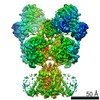
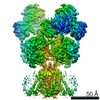
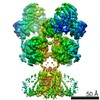
| Related structure data | 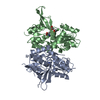 6usvC  6whrC  6whsC  6whtC  6whuC  6whvC  6whwC  6whxC  6whyC  6wi0C 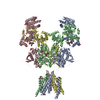 6wi1C  4nf8S S: Starting model for refinement C: citing same article ( |
|---|---|
| Similar structure data |

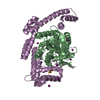
-Links
 PDBj
PDBj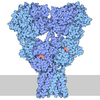
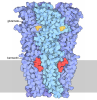
- Assembly
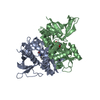
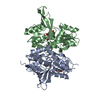
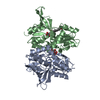
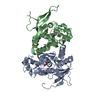
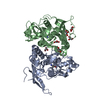
| Deposited unit | 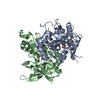
| ||||||||
|---|---|---|---|---|---|---|---|---|---|
| 1 |
| ||||||||
| Unit cell |
|
-Components
| #1: Protein | Mass: 33340.031 Da / Num. of mol.: 1 / Fragment: UNP residues 415-565, 684-821 Source method: isolated from a genetically manipulated source Source: (gene. exp.) Rattus norvegicus (Norway rat) / Gene: Grin1, Nmdar1 / Production host:   Escherichia coli K-12 (bacteria) / References: UniProt: P35439 Escherichia coli K-12 (bacteria) / References: UniProt: P35439 |
|---|---|
| #2: Protein | Mass: 31785.299 Da / Num. of mol.: 1 / Fragment: UNP residues 402-539, 661-802 Source method: isolated from a genetically manipulated source Source: (gene. exp.) Rattus norvegicus (Norway rat) / Gene: Grin2a / Production host: Escherichia coli K-12 (bacteria) / References: UniProt: Q00959 |
| #3: Chemical | ChemComp-QGM / (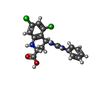  Mass: 380.225 Da / Num. of mol.: 1 / Source method: obtained synthetically / Formula: C17H15Cl2N3O3 / Feature type: SUBJECT OF INVESTIGATION Mass: 380.225 Da / Num. of mol.: 1 / Source method: obtained synthetically / Formula: C17H15Cl2N3O3 / Feature type: SUBJECT OF INVESTIGATION |
| #4: Chemical | ChemComp-GLU / 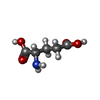 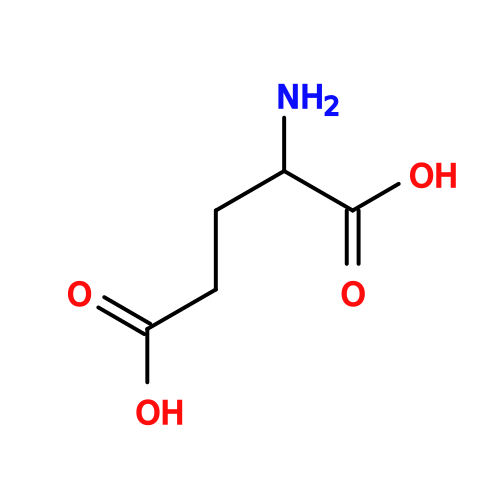 Type: L-peptide linking / Mass: 147.129 Da / Num. of mol.: 1 / Source method: obtained synthetically / Formula: C5H9NO4 / Feature type: SUBJECT OF INVESTIGATION Type: L-peptide linking / Mass: 147.129 Da / Num. of mol.: 1 / Source method: obtained synthetically / Formula: C5H9NO4 / Feature type: SUBJECT OF INVESTIGATION |
| #5: Water | ChemComp-HOH /  Mass: 18.015 Da / Num. of mol.: 249 / Source method: isolated from a natural source / Formula: H2O Mass: 18.015 Da / Num. of mol.: 249 / Source method: isolated from a natural source / Formula: H2O |
| Has ligand of interest | Y |
| Has protein modification | Y |
-Experimental details
-Experiment
| Experiment | Method: X-RAY DIFFRACTION / Number of used crystals: 1 |
|---|
- Sample preparation
| Crystal | Density Matthews: 2.48 Å3/Da / Density % sol: 50.44 % |
|---|---|
| Crystal grow | Temperature: 291 K / Method: evaporation / pH: 7 Details: 0.2 M HEPES, pH 7.0, 60-90 mM sodium chloride, 15-20% PEG2000 MME |
-Data collection
| Diffraction | Mean temperature: 100 K / Serial crystal experiment: N |
|---|---|
| Diffraction source | Source: SYNCHROTRON / Site: APS / Beamline: 23-ID-B / Wavelength: 1.1 Å |
| Detector | Type: DECTRIS EIGER X 16M / Detector: PIXEL / Date: Apr 6, 2013 |
| Radiation | Monochromator: Double crystal cryo-cooled Si(111) / Protocol: SINGLE WAVELENGTH / Monochromatic (M) / Laue (L): M / Scattering type: x-ray |
| Radiation wavelength | Wavelength: 1.1 Å / Relative weight: 1 |
| Reflection | Resolution: 2.09→40 Å / Num. obs: 38873 / % possible obs: 99.9 % / Redundancy: 7.6 % / Biso Wilson estimate: 25.56 Å2 / Rmerge(I) obs: 0.117 / Net I/σ(I): 17.1 |
| Reflection shell | Resolution: 2.09→2.18 Å / Redundancy: 6 % / Rmerge(I) obs: 0.62 / Num. unique obs: 3781 / CC1/2: 0.814 / % possible all: 99.8 |
- Processing
| Software |
| ||||||||||||||||||||||||||||||||||||||||||||||||||||||||||||||||||||||||||||||||||||
|---|---|---|---|---|---|---|---|---|---|---|---|---|---|---|---|---|---|---|---|---|---|---|---|---|---|---|---|---|---|---|---|---|---|---|---|---|---|---|---|---|---|---|---|---|---|---|---|---|---|---|---|---|---|---|---|---|---|---|---|---|---|---|---|---|---|---|---|---|---|---|---|---|---|---|---|---|---|---|---|---|---|---|---|---|---|
| Refinement | Method to determine structure: MOLECULAR REPLACEMENT Starting model: PDB entry 4NF8 Resolution: 2.092→38.161 Å / SU ML: 0.23 / Cross valid method: THROUGHOUT / σ(F): 1.36 / Phase error: 21.77
| ||||||||||||||||||||||||||||||||||||||||||||||||||||||||||||||||||||||||||||||||||||
| Solvent computation | Shrinkage radii: 0.9 Å / VDW probe radii: 1.11 Å | ||||||||||||||||||||||||||||||||||||||||||||||||||||||||||||||||||||||||||||||||||||
| Displacement parameters | Biso max: 77.3 Å2 / Biso mean: 27.2215 Å2 / Biso min: 12.93 Å2 | ||||||||||||||||||||||||||||||||||||||||||||||||||||||||||||||||||||||||||||||||||||
| Refinement step | Cycle: final / Resolution: 2.092→38.161 Å
| ||||||||||||||||||||||||||||||||||||||||||||||||||||||||||||||||||||||||||||||||||||
| LS refinement shell | Refine-ID: X-RAY DIFFRACTION / Rfactor Rfree error: 0
|
