 Movie
Movie Controller


+ Open data

- Basic information
| Entry | Database: EMDB / ID: EMD-30784 | |||||||||
|---|---|---|---|---|---|---|---|---|---|---|
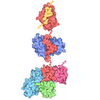
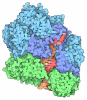
| Title | MDA5 CARDs-MAVS CARD polyUb complex | |||||||||
 Map data Map data | ||||||||||
 Sample Sample |
| |||||||||
 Keywords Keywords | Signaling / polyubiquitin / IMMUNE SYSTEM | |||||||||
| Function / homology |  Function and homology information Function and homology informationpositive regulation of IP-10 production / regulation of peroxisome organization / MDA-5 signaling pathway / regulation of type III interferon production / positive regulation of chemokine (C-C motif) ligand 5 production / positive regulation of myeloid dendritic cell cytokine production / CARD domain binding / detection of virus / positive regulation of response to cytokine stimulus / NF-kB activation through FADD/RIP-1 pathway mediated by caspase-8 and -10 ...positive regulation of IP-10 production / regulation of peroxisome organization / MDA-5 signaling pathway / regulation of type III interferon production / positive regulation of chemokine (C-C motif) ligand 5 production / positive regulation of myeloid dendritic cell cytokine production / CARD domain binding / detection of virus / positive regulation of response to cytokine stimulus / NF-kB activation through FADD/RIP-1 pathway mediated by caspase-8 and -10 / protein localization to mitochondrion / positive regulation of type I interferon-mediated signaling pathway / Modulation of host responses by IFN-stimulated genes / hypothalamus gonadotrophin-releasing hormone neuron development / female meiosis I / TRAF6 mediated IRF7 activation / positive regulation of protein monoubiquitination / peroxisomal membrane / fat pad development / mitochondrion transport along microtubule / negative regulation of viral genome replication / type I interferon-mediated signaling pathway / seminiferous tubule development / cellular response to exogenous dsRNA / pattern recognition receptor activity / female gonad development / cytoplasmic pattern recognition receptor signaling pathway / TRAF6 mediated NF-kB activation / protein complex oligomerization / positive regulation of NLRP3 inflammasome complex assembly / positive regulation of interferon-alpha production / male meiosis I / protein sumoylation / positive regulation of intrinsic apoptotic signaling pathway by p53 class mediator / ribonucleoprotein complex binding / ubiquitin ligase complex / cellular response to interferon-beta / positive regulation of defense response to virus by host / energy homeostasis / positive regulation of type I interferon production / neuron projection morphogenesis / regulation of proteasomal protein catabolic process / activation of innate immune response / signaling adaptor activity / Maturation of protein E / Maturation of protein E / ER Quality Control Compartment (ERQC) / positive regulation of interferon-beta production / Myoclonic epilepsy of Lafora / FLT3 signaling by CBL mutants / IRAK2 mediated activation of TAK1 complex / Alpha-protein kinase 1 signaling pathway / Glycogen synthesis / IRAK1 recruits IKK complex / IRAK1 recruits IKK complex upon TLR7/8 or 9 stimulation / Prevention of phagosomal-lysosomal fusion / Endosomal Sorting Complex Required For Transport (ESCRT) / Membrane binding and targetting of GAG proteins / Negative regulation of FLT3 / Regulation of TBK1, IKKε (IKBKE)-mediated activation of IRF3, IRF7 / PTK6 Regulates RTKs and Their Effectors AKT1 and DOK1 / Regulation of TBK1, IKKε-mediated activation of IRF3, IRF7 upon TLR3 ligation / IRAK2 mediated activation of TAK1 complex upon TLR7/8 or 9 stimulation / Constitutive Signaling by NOTCH1 HD Domain Mutants / NOTCH2 Activation and Transmission of Signal to the Nucleus / TICAM1,TRAF6-dependent induction of TAK1 complex / TICAM1-dependent activation of IRF3/IRF7 / APC/C:Cdc20 mediated degradation of Cyclin B / regulation of neuron apoptotic process / Downregulation of ERBB4 signaling / antiviral innate immune response / APC-Cdc20 mediated degradation of Nek2A / Regulation of FZD by ubiquitination / p75NTR recruits signalling complexes / InlA-mediated entry of Listeria monocytogenes into host cells / TRAF6 mediated IRF7 activation in TLR7/8 or 9 signaling / NF-kB is activated and signals survival / TRAF6-mediated induction of TAK1 complex within TLR4 complex / Regulation of pyruvate metabolism / Pexophagy / Downregulation of ERBB2:ERBB3 signaling / Regulation of innate immune responses to cytosolic DNA / NRIF signals cell death from the nucleus / Regulation of PTEN localization / positive regulation of protein ubiquitination / VLDLR internalisation and degradation / Activated NOTCH1 Transmits Signal to the Nucleus / positive regulation of interleukin-8 production / Synthesis of active ubiquitin: roles of E1 and E2 enzymes / Translesion synthesis by REV1 / TICAM1, RIP1-mediated IKK complex recruitment / Regulation of BACH1 activity / Translesion synthesis by POLK / InlB-mediated entry of Listeria monocytogenes into host cell / JNK (c-Jun kinases) phosphorylation and activation mediated by activated human TAK1 / MAP3K8 (TPL2)-dependent MAPK1/3 activation / protein serine/threonine kinase binding / Activation of IRF3, IRF7 mediated by TBK1, IKKε (IKBKE) / Downregulation of TGF-beta receptor signaling / Translesion synthesis by POLI Similarity search - Function | |||||||||
| Biological species |  Homo sapiens (human) Homo sapiens (human) | |||||||||
| Method | single particle reconstruction / Resolution: 3.2 Å | |||||||||
 Authors Authors | Song B / Chen Y | |||||||||
| Funding support |  China, 1 items China, 1 items
| |||||||||
 Citation Citation | Journal: Immunity / Year: 2021 Title: Ordered assembly of the cytosolic RNA-sensing MDA5-MAVS signaling complex via binding to unanchored K63-linked poly-ubiquitin chains. Authors: Bin Song / Yun Chen / Xin Liu / Fei Yuan / Eddie Yong Jun Tan / Yixuan Lei / Ning Song / Yinqi Han / Bruce D Pascal / Patrick R Griffin / Cheng Luo / Bin Wu / Dahai Luo / Jie Zheng /   Abstract: The RNA sensor MDA5 recruits the signaling adaptor MAVS to initiate type I interferon signaling and downstream antiviral responses, a process that requires K63-linked polyubiquitin chains. Here, we ...The RNA sensor MDA5 recruits the signaling adaptor MAVS to initiate type I interferon signaling and downstream antiviral responses, a process that requires K63-linked polyubiquitin chains. Here, we examined the mechanisms whereby K63-polyUb chain regulate MDA5 activation. Only long unanchored K63-polyUb (n ≥ 8) could mediate tetramerization of the caspase activation and recruitment domains of MDA5 (CARDs). Cryoelectron microscopy structures of a polyUb-bound CARDs tetramer and a polyUb-bound CARDs-CARD assembly revealed a tower-like formation, wherein eight Ubs tethered along the outer rim of the helical shell, bridging CARDs and CARD tetramers into proximity. ATP binding and hydrolysis promoted the stabilization of RNA-bound MDA5 prior to MAVS activation via allosteric effects on CARDs-polyUb complex. Abundant ATP prevented basal activation of apo MDA5. Our findings reveal the ordered assembly of a MDA5 signaling complex competent to recruit and activate MAVS and highlight differences with RIG-I in terms of CARD orientation and Ub sensing that suggest different abilities to induce antiviral responses. | |||||||||
| History |
|
- Structure visualization
| Movie |
Movie viewer |
|---|---|
| Structure viewer | EM map: SurfViewMolmilJmol/JSmol |
| Supplemental images |

- Downloads & links
-EMDB archive
| Map data | emd_30784.map.gz | 24.6 MB | EMDB map data format | |
|---|---|---|---|---|
| Header (meta data) | emd-30784-v30.xmlemd-30784.xml | 13.9 KB 13.9 KB | Display Display | EMDB header |
| Images |  emd_30784.png emd_30784.png | 257.5 KB | ||
| Filedesc metadata | emd-30784.cif.gz | 5.6 KB | ||
| Archive directory |  http://ftp.pdbj.org/pub/emdb/structures/EMD-30784ftp://ftp.pdbj.org/pub/emdb/structures/EMD-30784 http://ftp.pdbj.org/pub/emdb/structures/EMD-30784ftp://ftp.pdbj.org/pub/emdb/structures/EMD-30784 | HTTPS FTP |
-Related structure data
| Related structure data |  7dniMC  7dnjC M: atomic model generated by this map C: citing same article ( |
|---|---|
| Similar structure data |


-Links
| EMDB pages | EMDB (EBI/PDBe) / EMDataResource |
|---|---|
| Related items in Molecule of the Month |



-Map
| File | Download / File: emd_30784.map.gz / Format: CCP4 / Size: 47.6 MB / Type: IMAGE STORED AS FLOATING POINT NUMBER (4 BYTES) | ||||||||||||||||||||||||||||||||||||||||||||||||||||||||||||
|---|---|---|---|---|---|---|---|---|---|---|---|---|---|---|---|---|---|---|---|---|---|---|---|---|---|---|---|---|---|---|---|---|---|---|---|---|---|---|---|---|---|---|---|---|---|---|---|---|---|---|---|---|---|---|---|---|---|---|---|---|---|
| Projections & slices | Image control
Images are generated by Spider. | ||||||||||||||||||||||||||||||||||||||||||||||||||||||||||||
| Voxel size | X=Y=Z: 1.045 Å | ||||||||||||||||||||||||||||||||||||||||||||||||||||||||||||
| Density |
| ||||||||||||||||||||||||||||||||||||||||||||||||||||||||||||
| Symmetry | Space group: 1 | ||||||||||||||||||||||||||||||||||||||||||||||||||||||||||||
| Details | EMDB XML:
CCP4 map header:
| ||||||||||||||||||||||||||||||||||||||||||||||||||||||||||||
 Z (Sec.)
 Y (Row.)
 X (Col.)


-Supplemental data
- Sample components
-Entire : K63-polyUb bound MDA5CARDs-MAVSCARD complex
| Entire | Name: K63-polyUb bound MDA5CARDs-MAVSCARD complex |
|---|---|
| Components |
|
-Supramolecule #1: K63-polyUb bound MDA5CARDs-MAVSCARD complex
| Supramolecule | Name: K63-polyUb bound MDA5CARDs-MAVSCARD complex / type: complex / ID: 1 / Parent: 0 / Macromolecule list: all |
|---|---|
| Source (natural) | Organism: Homo sapiens (human) |
-Macromolecule #1: Ubiquitin
| Macromolecule | Name: Ubiquitin / type: protein_or_peptide / ID: 1 / Number of copies: 8 / Enantiomer: LEVO |
|---|---|
| Source (natural) | Organism: Homo sapiens (human) |
| Molecular weight | Theoretical: 8.576831 KDa |
| Recombinant expression | Organism:   Escherichia coli (E. coli) Escherichia coli (E. coli) |
| Sequence | String: MQIFVKTLTG KTITLEVEPS DTIENVKAKI QDKEGIPPDQ QRLIFAGKQL EDGRTLSDYN IQKESTLHLV LRLRGG UniProtKB: Polyubiquitin-B |
-Macromolecule #2: Interferon-induced helicase C domain-containing protein 1
| Macromolecule | Name: Interferon-induced helicase C domain-containing protein 1 type: protein_or_peptide / ID: 2 / Number of copies: 4 / Enantiomer: LEVO / EC number: RNA helicase |
|---|---|
| Source (natural) | Organism: Homo sapiens (human) |
| Molecular weight | Theoretical: 23.825883 KDa |
| Recombinant expression | Organism: Escherichia coli (E. coli) |
| Sequence | String: MSNGYSTDEN FRYLISCFRA RVKMYIQVEP VLDYLTFLPA EVKEQIQRTV ATSGNMQAVE LLLSTLEKGV WHLGWTREFV EALRRTGSP LAARYMNPEL TDLPSPSFEN AHDEYLQLLN LLQPTLVDKL LVRDVLDKCM EEELLTIEDR NRIAAAENNG N ESGVRELL ...String: MSNGYSTDEN FRYLISCFRA RVKMYIQVEP VLDYLTFLPA EVKEQIQRTV ATSGNMQAVE LLLSTLEKGV WHLGWTREFV EALRRTGSP LAARYMNPEL TDLPSPSFEN AHDEYLQLLN LLQPTLVDKL LVRDVLDKCM EEELLTIEDR NRIAAAENNG N ESGVRELL KRIVQKENWF SAFLNVLRQT GNNELVQELT GSDCSESNAE UniProtKB: Interferon-induced helicase C domain-containing protein 1 |
-Macromolecule #3: Mitochondrial antiviral-signaling protein
| Macromolecule | Name: Mitochondrial antiviral-signaling protein / type: protein_or_peptide / ID: 3 / Number of copies: 4 / Enantiomer: LEVO |
|---|---|
| Source (natural) | Organism: Homo sapiens (human) |
| Molecular weight | Theoretical: 11.342082 KDa |
| Recombinant expression | Organism: Escherichia coli (E. coli) |
| Sequence | String: MPFAEDKTYK YICRNFSNFC NVKVVKILPY LPCLTARDQD RLRATCTLSG NRDTLWHLFN TLQRRPGWVE YFIAALRGCK LVDLADEVA SVYQSYQP UniProtKB: Mitochondrial antiviral-signaling protein |
-Experimental details
-Structure determination
 Processing Processing | single particle reconstruction |
|---|---|
| Aggregation state | particle |
-Sample preparation
| Concentration | 1.6 mg/mL |
|---|---|
| Buffer | pH: 7.5 |
| Details | heterotetrameric complex |
- Electron microscopy
| Microscope | FEI TITAN KRIOS |
|---|---|
| Image recording | Film or detector model: GATAN K3 BIOQUANTUM (6k x 4k) / Average electron dose: 70.0 e/Å2 |
| Electron beam | Acceleration voltage: 300 kV / Electron source:  FIELD EMISSION GUN FIELD EMISSION GUN |
| Electron optics | Illumination mode: OTHER / Imaging mode: BRIGHT FIELD |
| Experimental equipment |  Model: Titan Krios / Image courtesy: FEI Company |
