ATP binding cassette (ABC) transporter / transmembrane domain 0 (TMD0) / regulatory (R) region / TRANSPORT PROTEIN
機能・相同性
機能・相同性情報
ABC-type Cd2+ transporter / ABC-type cadmium transporter activity / Recycling of bile acids and salts / Heme degradation / Cytoprotection by HMOX1 / Aspirin ADME / Atorvastatin ADME / Transport of RCbl within the body / Paracetamol ADME / Synthesis of Leukotrienes (LT) and Eoxins (EX) ...ABC-type Cd2+ transporter / ABC-type cadmium transporter activity / Recycling of bile acids and salts / Heme degradation / Cytoprotection by HMOX1 / Aspirin ADME / Atorvastatin ADME / Transport of RCbl within the body / Paracetamol ADME / Synthesis of Leukotrienes (LT) and Eoxins (EX) / P-type cadmium transporter activity / Sphingolipid de novo biosynthesis / vacuole fusion, non-autophagic / ABC-family protein mediated transport / ABC-type glutathione-S-conjugate transporter / ABC-type glutathione S-conjugate transporter activity / fungal-type vacuole membrane / response to metal ion / response to cadmium ion / ABC-type transporter activity / cell redox homeostasis / glutathione metabolic process / transmembrane transport / membrane raft / ATP hydrolysis activity / ATP binding 類似検索 - 分子機能
: / ABC transporter TMD0 domain / : / ABC transporter transmembrane region / ABC transporter type 1, transmembrane domain / ABC transporter integral membrane type-1 fused domain profile. / ABC transporter type 1, transmembrane domain superfamily / ABC transporter-like, conserved site / ABC transporters family signature. / ABC transporter ...: / ABC transporter TMD0 domain / : / ABC transporter transmembrane region / ABC transporter type 1, transmembrane domain / ABC transporter integral membrane type-1 fused domain profile. / ABC transporter type 1, transmembrane domain superfamily / ABC transporter-like, conserved site / ABC transporters family signature. / ABC transporter / ABC transporter-like, ATP-binding domain / ATP-binding cassette, ABC transporter-type domain profile. / ATPases associated with a variety of cellular activities / AAA+ ATPase domain / P-loop containing nucleoside triphosphate hydrolase 類似検索 - ドメイン・相同性
Natural Sciences and Engineering Research Council (NSERC, Canada)
RGPIN-2015-05372
カナダ
Natural Sciences and Engineering Research Council (NSERC, Canada)
RGPIN-2020-05835
カナダ
Canadian Institutes of Health Research (CIHR)
PJT162186
カナダ
引用
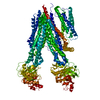
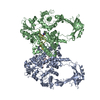
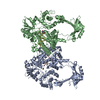
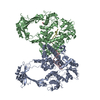
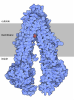
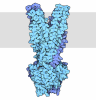
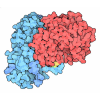
ジャーナル: Proc Natl Acad Sci U S A / 年: 2021 タイトル: Structure of Ycf1p reveals the transmembrane domain TMD0 and the regulatory region of ABCC transporters. 著者: Sarah C Bickers / Samir Benlekbir / John L Rubinstein / Voula Kanelis / 要旨: ATP binding cassette (ABC) proteins typically function in active transport of solutes across membranes. The ABC core structure is composed of two transmembrane domains (TMD1 and TMD2) and two ...ATP binding cassette (ABC) proteins typically function in active transport of solutes across membranes. The ABC core structure is composed of two transmembrane domains (TMD1 and TMD2) and two cytosolic nucleotide binding domains (NBD1 and NBD2). Some members of the C-subfamily of ABC (ABCC) proteins, including human multidrug resistance proteins (MRPs), also possess an N-terminal transmembrane domain (TMD0) that contains five transmembrane α-helices and is connected to the ABC core by the L0 linker. While TMD0 was resolved in SUR1, the atypical ABCC protein that is part of the hetero-octameric ATP-sensitive K channel, little is known about the structure of TMD0 in monomeric ABC transporters. Here, we present the structure of yeast cadmium factor 1 protein (Ycf1p), a homolog of human MRP1, determined by electron cryo-microscopy (cryo-EM). A comparison of Ycf1p, SUR1, and a structure of MRP1 that showed TMD0 at low resolution demonstrates that TMD0 can adopt different orientations relative to the ABC core, including a ∼145° rotation between Ycf1p and SUR1. The cryo-EM map also reveals that segments of the regulatory (R) region, which links NBD1 to TMD2 and was poorly resolved in earlier ABCC structures, interacts with the L0 linker, NBD1, and TMD2. These interactions, combined with fluorescence quenching experiments of isolated NBD1 with and without the R region, suggest how posttranslational modifications of the R region modulate ABC protein activity. Mapping known mutations from MRP2 and MRP6 onto the Ycf1p structure explains how mutations involving TMD0 and the R region of these proteins lead to disease.
 ムービー
ムービー コントローラー


 データを開く
 基本情報
基本情報 マップデータ
 試料
試料 キーワード
キーワード 機能・相同性情報
 Saccharomyces cerevisiae (パン酵母)
 データ登録者
 カナダ, 3件
  引用
引用 構造の表示
構造の表示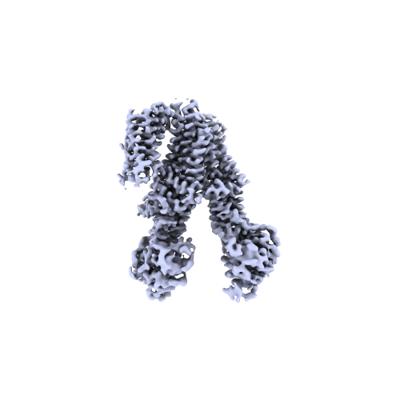
 ダウンロードとリンク
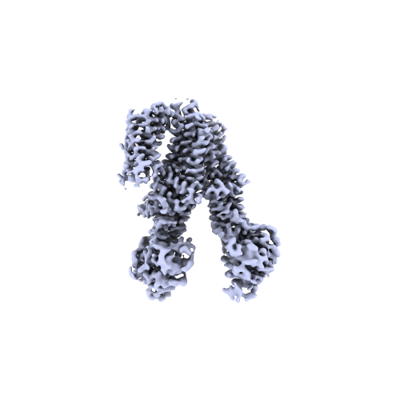 emd_23932.png
 http://ftp.pdbj.org/pub/emdb/structures/EMD-23932

 Z (Sec.)
 Y (Row.)
 X (Col.)






 試料の構成要素
 解析
解析 電子顕微鏡法
 FIELD EMISSION GUN
