cellular response to bleomycin / regulation of nuclear cell cycle DNA replication / DNA secondary structure binding / detection of abiotic stimulus / replication fork protection complex / replication fork arrest / cell cycle phase transition / Switching of origins to a post-replicative state / Unwinding of DNA / DNA replication initiation ...cellular response to bleomycin / regulation of nuclear cell cycle DNA replication / DNA secondary structure binding / detection of abiotic stimulus / replication fork protection complex / replication fork arrest / cell cycle phase transition / Switching of origins to a post-replicative state / Unwinding of DNA / DNA replication initiation / epsilon DNA polymerase complex / DNA strand elongation involved in mitotic DNA replication / cellular response to hydroxyurea / GINS complex / mitotic DNA replication preinitiation complex assembly / cellular response to cisplatin / nuclear origin of replication recognition complex / anaphase-promoting complex binding / regulation of phosphorylation / alpha DNA polymerase:primase complex / nucleotide-excision repair, DNA gap filling / morphogenesis of an epithelium / Regulation of MITF-M-dependent genes involved in DNA replication, damage repair and senescence / CMG complex / DNA replication proofreading / DNA replication checkpoint signaling / DNA replication preinitiation complex / single-stranded DNA 3'-5' DNA exonuclease activity / mitotic DNA replication checkpoint signaling / double-strand break repair via break-induced replication / MCM complex / mitotic DNA replication initiation / mitotic intra-S DNA damage checkpoint signaling / mitotic DNA replication / embryonic organ development / Hydrolases; Acting on ester bonds; Exodeoxyribonucleases producing 5'-phosphomonoesters / Apoptotic cleavage of cellular proteins / DNA strand elongation involved in DNA replication / DNA synthesis involved in DNA repair / leading strand elongation / G1/S-Specific Transcription / mitotic G2 DNA damage checkpoint signaling / positive regulation of double-strand break repair / nuclear replication fork / cochlea development / DNA replication origin binding / PCNA-Dependent Long Patch Base Excision Repair / Activation of the pre-replicative complex / error-prone translesion synthesis / DNA replication initiation / Activation of ATR in response to replication stress / regulation of DNA-templated DNA replication initiation / base-excision repair, gap-filling / positive regulation of double-strand break repair via homologous recombination / DNA damage checkpoint signaling / cellular response to epidermal growth factor stimulus / replication fork processing / DNA helicase activity / Gap-filling DNA repair synthesis and ligation in GG-NER / G1/S transition of mitotic cell cycle / circadian rhythm / Termination of translesion DNA synthesis / Assembly of the pre-replicative complex / Recognition of DNA damage by PCNA-containing replication complex / DNA-templated DNA replication / regulation of circadian rhythm / HDR through Homologous Recombination (HRR) / enzyme activator activity / Dual Incision in GG-NER / Orc1 removal from chromatin / Dual incision in TC-NER / Gap-filling DNA repair synthesis and ligation in TC-NER / mitotic cell cycle / site of double-strand break / chromosome / single-stranded DNA binding / 4 iron, 4 sulfur cluster binding / ciliary basal body / Processing of DNA double-strand break ends / histone binding / DNA-directed DNA polymerase / DNA helicase / DNA-directed DNA polymerase activity / nuclear body / DNA replication / chromosome, telomeric region / response to xenobiotic stimulus / Ub-specific processing proteases / cell division / negative regulation of DNA-templated transcription / nucleotide binding / DNA repair / apoptotic process / positive regulation of cell population proliferation / chromatin binding / DNA damage response / chromatin / perinuclear region of cytoplasm / Golgi apparatus / enzyme binding Similarity search - Function
DNA polymerase epsilon subunit B, N-terminal / DNA polymerases epsilon N terminal / : / : / WDHD1 HMG box / WDHD1 first WD40 domain / Claspin / : / TIMELESS, tri-helical helix-turn-helix domain / Chromosome segregation in meiosis protein 3 ...DNA polymerase epsilon subunit B, N-terminal / DNA polymerases epsilon N terminal / : / : / WDHD1 HMG box / WDHD1 first WD40 domain / Claspin / : / TIMELESS, tri-helical helix-turn-helix domain / Chromosome segregation in meiosis protein 3 / TIPIN/Csm3/Swi3 / Replication Fork Protection Component Swi3 / Timeless, C-terminal / Timeless-like, PAB domain / : / TOF1-like, helical domain / Timeless, N-terminal / Timeless / Timeless protein / DNA polymerase epsilon, subunit B / : / DNA polymerase alpha-binding protein Ctf4, C-terminal domain / Minichromosome loss protein Mcl1, middle region / Minichromosome loss protein, Mcl1, middle region / : / DNA replication licensing factor MCM2-like, winged-helix domain / : / : / DNA polymerase epsilon catalytic subunit A, thumb domain / Zinc finger domain of DNA polymerase-epsilon / Zinc finger domain of DNA polymerase-epsilon / DNA polymerase epsilon, catalytic subunit A, C-terminal / DNA polymerase epsilon catalytic subunit / Domain of unknown function (DUF1744) / DUF1744 / : / PSF2 N-terminal domain / : / : / PSF3 N-terminal domain / PSF1 C-terminal domain / DNA replication complex GINS protein Psf2 / CDC45 family / CDC45 / GINS complex, subunit Psf3 / DNA replication complex GINS protein SLD5, C-terminal / GINS complex, subunit Psf3 superfamily / GINS complex protein Sld5, alpha-helical domain / DNA replication complex GINS protein SLD5 C-terminus / GINS complex subunit Sld5 / GINS subunit, domain A / GINS complex protein helical bundle domain / GINS complex, subunit Psf1 / GINS, helical bundle-like domain superfamily / DNA polymerase alpha/delta/epsilon, subunit B / DNA polymerase alpha/epsilon subunit B / : / MCM5, C-terminal domain / DNA replication licensing factor MCM7, winged helix / DNA replication licensing factor Mcm5 / MCM4, winged helix domain / Mini-chromosome maintenance complex protein 4 / DNA replication licensing factor Mcm3 / : / MCM3-like, winged helix domain / DNA replication licensing factor Mcm6 / DNA replication licensing factor Mcm7 / Mcm6, C-terminal winged-helix domain / MCM6 C-terminal winged-helix domain / DNA replication licensing factor Mcm2 / Mini-chromosome maintenance protein 2 / Mini-chromosome maintenance, conserved site / MCM family signature. / MCM N-terminal domain / MCM N-terminal domain / MCM OB domain / MCM OB domain / Mini-chromosome maintenance protein / MCM, AAA-lid domain / MCM P-loop domain / MCM AAA-lid domain / MCM family C-terminal AAA(+) ATPase domain (MCM-CTD) profile. / minichromosome maintenance proteins / MCM domain / DNA polymerase family B, thumb domain / HMG boxes A and B DNA-binding domains profile. / high mobility group / High mobility group box domain / High mobility group box domain superfamily / DNA polymerase family B, exonuclease domain / DNA-directed DNA polymerase, family B, exonuclease domain / DNA polymerase, palm domain superfamily / DNA polymerase type-B family / DNA-directed DNA polymerase, family B / Ribonuclease H superfamily / Ribonuclease H-like superfamily / WD40 repeat, conserved site / Trp-Asp (WD) repeats signature. / Trp-Asp (WD) repeats profile. / Trp-Asp (WD) repeats circular profile. Similarity search - Domain/homology
Cell division control protein 45 homolog / WD repeat and HMG-box DNA-binding protein 1 / DNA replication licensing factor MCM3 / DNA replication licensing factor MCM4 / DNA replication licensing factor MCM5 / DNA replication licensing factor MCM7 / DNA replication licensing factor MCM2 / DNA polymerase epsilon subunit 2 / DNA polymerase epsilon catalytic subunit A / DNA replication licensing factor MCM6 ...Cell division control protein 45 homolog / WD repeat and HMG-box DNA-binding protein 1 / DNA replication licensing factor MCM3 / DNA replication licensing factor MCM4 / DNA replication licensing factor MCM5 / DNA replication licensing factor MCM7 / DNA replication licensing factor MCM2 / DNA polymerase epsilon subunit 2 / DNA polymerase epsilon catalytic subunit A / DNA replication licensing factor MCM6 / DNA replication complex GINS protein PSF1 / DNA replication complex GINS protein SLD5 / DNA replication complex GINS protein PSF3 / TIMELESS-interacting protein / Claspin / Protein timeless homolog / DNA replication complex GINS protein PSF2 Similarity search - Component
Biological species
Homo sapiens (human)
Method
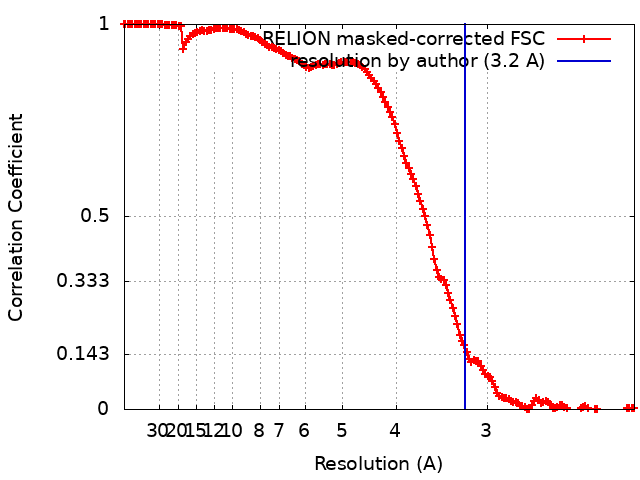
single particle reconstruction / cryo EM / Resolution: 3.2 Å
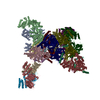
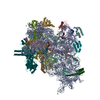
Journal: Nature / Year: 2021 Title: A conserved mechanism for regulating replisome disassembly in eukaryotes. Authors: Michael Jenkyn-Bedford / Morgan L Jones / Yasemin Baris / Karim P M Labib / Giuseppe Cannone / Joseph T P Yeeles / Tom D Deegan / Abstract: Replisome disassembly is the final step of eukaryotic DNA replication and is triggered by ubiquitylation of the CDC45-MCM-GINS (CMG) replicative helicase. Despite being driven by evolutionarily ...Replisome disassembly is the final step of eukaryotic DNA replication and is triggered by ubiquitylation of the CDC45-MCM-GINS (CMG) replicative helicase. Despite being driven by evolutionarily diverse E3 ubiquitin ligases in different eukaryotes (SCF in budding yeast, CUL2 in metazoa), replisome disassembly is governed by a common regulatory principle, in which ubiquitylation of CMG is suppressed before replication termination, to prevent replication fork collapse. Recent evidence suggests that this suppression is mediated by replication fork DNA. However, it is unknown how SCF and CUL2 discriminate terminated from elongating replisomes, to selectively ubiquitylate CMG only after termination. Here we used cryo-electron microscopy to solve high-resolution structures of budding yeast and human replisome-E3 ligase assemblies. Our structures show that the leucine-rich repeat domains of Dia2 and LRR1 are structurally distinct, but bind to a common site on CMG, including the MCM3 and MCM5 zinc-finger domains. The LRR-MCM interaction is essential for replisome disassembly and, crucially, is occluded by the excluded DNA strand at replication forks, establishing the structural basis for the suppression of CMG ubiquitylation before termination. Our results elucidate a conserved mechanism for the regulation of replisome disassembly in eukaryotes, and reveal a previously unanticipated role for DNA in preserving replisome integrity.
History
Deposition
Aug 11, 2021
-
Header (metadata) release
Nov 10, 2021
-
Map release
Nov 10, 2021
-
Update
Jul 9, 2025
-
Current status
Jul 9, 2025
Processing site: PDBe / Status: Released
-
Structure visualization
Movie
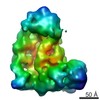
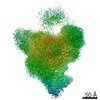
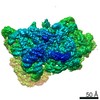
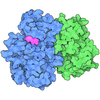
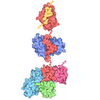
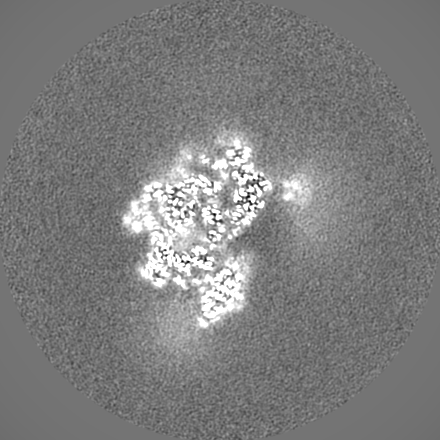
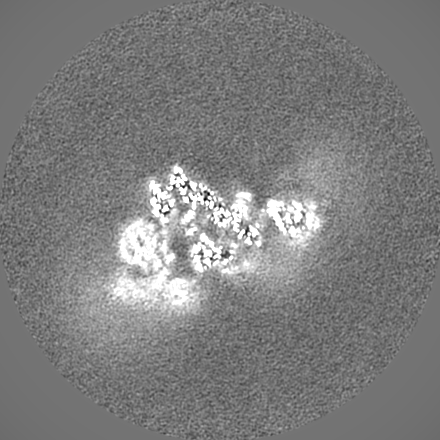
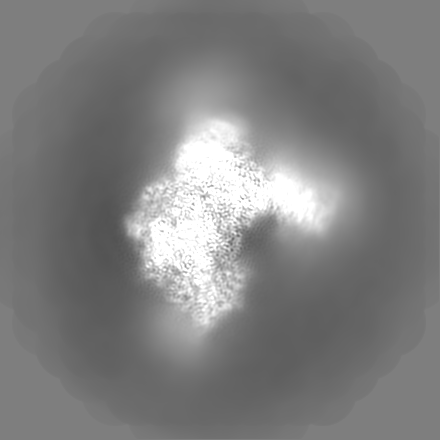
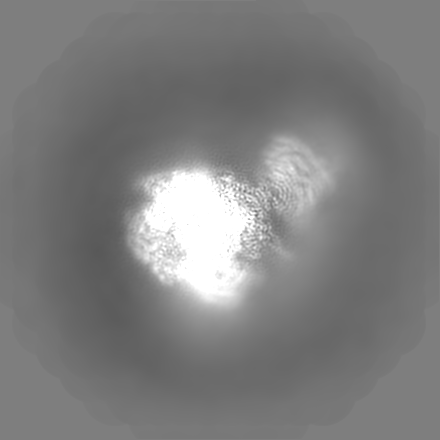
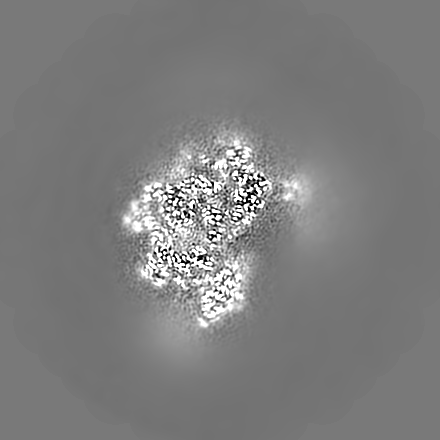
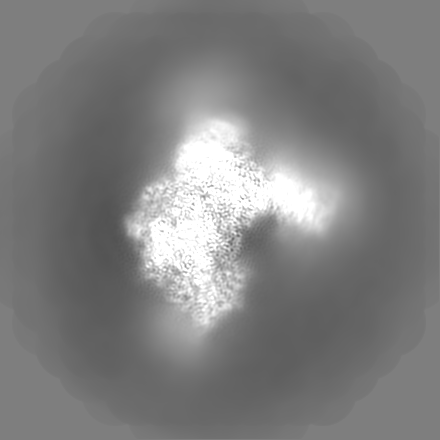
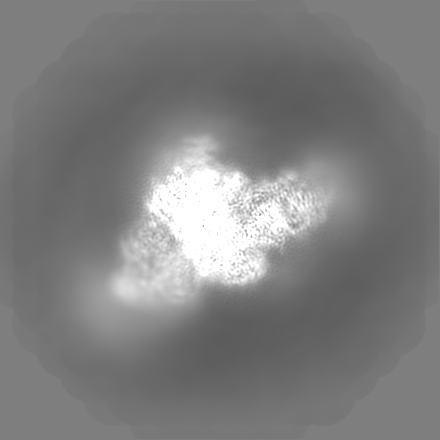
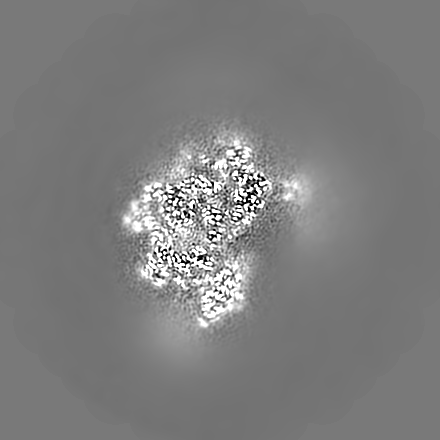
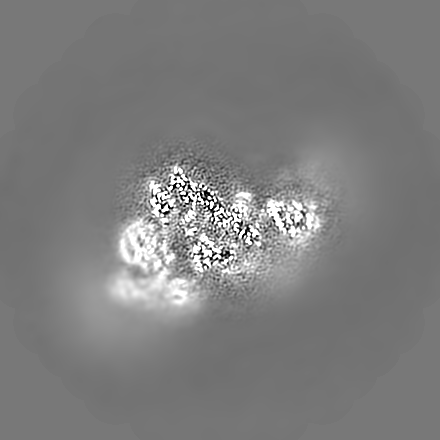
Surface view with section colored by density value
In the structure databanks used in Yorodumi, some data are registered as the other names, "COVID-19 virus" and "2019-nCoV". Here are the details of the virus and the list of structure data.
Jan 31, 2019. EMDB accession codes are about to change! (news from PDBe EMDB page)
EMDB accession codes are about to change! (news from PDBe EMDB page)
The allocation of 4 digits for EMDB accession codes will soon come to an end. Whilst these codes will remain in use, new EMDB accession codes will include an additional digit and will expand incrementally as the available range of codes is exhausted. The current 4-digit format prefixed with “EMD-” (i.e. EMD-XXXX) will advance to a 5-digit format (i.e. EMD-XXXXX), and so on. It is currently estimated that the 4-digit codes will be depleted around Spring 2019, at which point the 5-digit format will come into force.
The EM Navigator/Yorodumi systems omit the EMD- prefix.
Related info.:Q: What is EMD? / ID/Accession-code notation in Yorodumi/EM Navigator
Yorodumi is a browser for structure data from EMDB, PDB, SASBDB, etc.
This page is also the successor to EM Navigator detail page, and also detail information page/front-end page for Omokage search.
The word "yorodu" (or yorozu) is an old Japanese word meaning "ten thousand". "mi" (miru) is to see.
Related info.:EMDB / PDB / SASBDB / Comparison of 3 databanks / Yorodumi Search / Aug 31, 2016. New EM Navigator & Yorodumi / Yorodumi Papers / Jmol/JSmol / Function and homology information / Changes in new EM Navigator and Yorodumi
 Movie
Movie Controller


 Open data
 Basic information
 Map data
 Sample
 Keywords
 Function and homology information
 Homo sapiens (human)
 Authors
 United Kingdom, 1 items
  Citation
 Structure visualization
 Downloads & links
 emd_13375.png
 http://ftp.pdbj.org/pub/emdb/structures/EMD-13375




 Z (Sec.)
 Y (Row.)
 X (Col.)
























 Sample components
 Trichoplusia ni (cabbage looper)
 Processing
 Electron microscopy
 FIELD EMISSION GUN