[English] 日本語
Yorodumi Papers
- Database of articles cited by EMDB/PDB/SASBDB data -

+
Search query

Keywords
Structure methods
Author
Journal
IF

-
Structure paper

TitleToward a Random Background for Ligand Optimization.
Journal, issue, pagesbioRxiv, Year 2026
Publish dateMay 13, 2026
PubMed AbstractLigand optimization is central to drug discovery as hundreds of analogs might be designed and synthesized between an initial hit and a therapeutic candidate. The efficiency of this process is ...Ligand optimization is central to drug discovery as hundreds of analogs might be designed and synthesized between an initial hit and a therapeutic candidate. The efficiency of this process is unclear, at least partly because there is no random background for optimization against which to compare. Such a random background might emerge from synthetically accessible but otherwise systematic random small substitutions across starting ligands, measuring likelihood of achieving a substantial improvement in affinity/potency or other property by any single perturbation. Recent literature and ligand-affinity/potency databases suggest that perhaps 10% of analogs with minor modifications improve upon a parent's potency substantially (by ≥10-fold), but this number is clouded by reporting bias, intentional improvement, and inter-group reproducibility. To begin to establish a background expectation for ligand optimization, we comprehensively and systematically modified 18 lead molecules across six targets with single atom changes; 257 compounds were synthesized. Unexpectedly, 11.2% of these random small perturbation analogs improved potency by ≥10-fold over their parents. Conversely, these more potent analogs typically had worse pharmacokinetics (e.g. reduced metabolic stability, lower plasma free fraction). While it was possible to find analogs where the potency increase compensated for inferior exposure and half-life, resulting in more potent compounds in vivo, overall a frustrated landscape for ligand optimization is revealed. This study begins to establish a background expectation for ligand potency optimization and offers a simple strategy to do so. It also begins to quantify the challenges confronting the field in moving beyond in vitro potency.
External linksbioRxiv / PubMed:42182464 / PubMed Central
MethodsEM (single particle)
Resolution2.74 - 2.8 Å
Structure data

EMDB-71718, PDB-9pln:
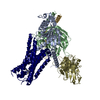
Locally-refined structure of alpha2a adrenergic receptor in complex with Go heterotrimer, scFv16, and N-(5-methylnaphthalen-1-yl)pyridin-4-amine (compound 4905)
Method: EM (single particle) / Resolution: 2.8 Å

EMDB-71719, PDB-9plo:
Structure of alpha2a adrenergic receptor in complex with Go heterotrimer, scFv16, and N-(5-methylnaphthalen-1-yl)pyridin-4-amine (compound 4905)
Method: EM (single particle) / Resolution: 2.74 Å

Chemicals

PDB-1ciu:
THERMOSTABLE CGTASE FROM THERMOANAEROBACTERIUM THERMOSULFURIGENES EM1 AT PH 8.0.

Source
  • homo sapiens (human)
  • mus musculus (house mouse)
KeywordsMEMBRANE PROTEIN / Receptor / Drug / Complex / GPCR / G-protein / scFv16

+
About Yorodumi Papers

-
News

-
Feb 9, 2022. New format data for meta-information of EMDB entries

New format data for meta-information of EMDB entries

  • Version 3 of the EMDB header file is now the official format.
  • The previous official version 1.9 will be removed from the archive.

Related info.:EMDB header

External links:wwPDB to switch to version 3 of the EMDB data model

-
Aug 12, 2020. Covid-19 info

Covid-19 info

URL: https://pdbj.org/emnavi/covid19.php

New page: Covid-19 featured information page in EM Navigator.

Related info.:Covid-19 info / Mar 5, 2020. Novel coronavirus structure data

+
Mar 5, 2020. Novel coronavirus structure data

Novel coronavirus structure data

Related info.:Yorodumi Speices / Aug 12, 2020. Covid-19 info

External links:COVID-19 featured content - PDBj / Molecule of the Month (242):Coronavirus Proteases

+
Jan 31, 2019. EMDB accession codes are about to change! (news from PDBe EMDB page)

EMDB accession codes are about to change! (news from PDBe EMDB page)

  • The allocation of 4 digits for EMDB accession codes will soon come to an end. Whilst these codes will remain in use, new EMDB accession codes will include an additional digit and will expand incrementally as the available range of codes is exhausted. The current 4-digit format prefixed with “EMD-” (i.e. EMD-XXXX) will advance to a 5-digit format (i.e. EMD-XXXXX), and so on. It is currently estimated that the 4-digit codes will be depleted around Spring 2019, at which point the 5-digit format will come into force.
  • The EM Navigator/Yorodumi systems omit the EMD- prefix.

Related info.:Q: What is EMD? / ID/Accession-code notation in Yorodumi/EM Navigator

External links:EMDB Accession Codes are Changing Soon! / Contact to PDBj

+
Jul 12, 2017. Major update of PDB

Major update of PDB

  • wwPDB released updated PDB data conforming to the new PDBx/mmCIF dictionary.
  • This is a major update changing the version number from 4 to 5, and with Remediation, in which all the entries are updated.
  • In this update, many items about electron microscopy experimental information are reorganized (e.g. em_software).
  • Now, EM Navigator and Yorodumi are based on the updated data.

External links:wwPDB Remediation / Enriched Model Files Conforming to OneDep Data Standards Now Available in the PDB FTP Archive

-
Yorodumi Papers

Database of articles cited by EMDB/PDB/SASBDB data

  • Database of articles cited by EMDB, PDB, and SASBDB entries
  • Using PubMed data

Related info.:EMDB / PDB / SASBDB / Yorodumi / EMN Papers / Changes in new EM Navigator and Yorodumi

Read more