 Movie
Movie Controller
 Structure viewers
 About Yorodumi Papers


+Search query
-Structure paper
| Title | Toward a Random Background for Ligand Optimization. |
|---|---|
| Journal, issue, pages | bioRxiv, Year 2026 |
| Publish date | May 13, 2026 |
| PubMed Abstract | Ligand optimization is central to drug discovery as hundreds of analogs might be designed and synthesized between an initial hit and a therapeutic candidate. The efficiency of this process is ...Ligand optimization is central to drug discovery as hundreds of analogs might be designed and synthesized between an initial hit and a therapeutic candidate. The efficiency of this process is unclear, at least partly because there is no random background for optimization against which to compare. Such a random background might emerge from synthetically accessible but otherwise systematic random small substitutions across starting ligands, measuring likelihood of achieving a substantial improvement in affinity/potency or other property by any single perturbation. Recent literature and ligand-affinity/potency databases suggest that perhaps 10% of analogs with minor modifications improve upon a parent's potency substantially (by ≥10-fold), but this number is clouded by reporting bias, intentional improvement, and inter-group reproducibility. To begin to establish a background expectation for ligand optimization, we comprehensively and systematically modified 18 lead molecules across six targets with single atom changes; 257 compounds were synthesized. Unexpectedly, 11.2% of these random small perturbation analogs improved potency by ≥10-fold over their parents. Conversely, these more potent analogs typically had worse pharmacokinetics (e.g. reduced metabolic stability, lower plasma free fraction). While it was possible to find analogs where the potency increase compensated for inferior exposure and half-life, resulting in more potent compounds in vivo, overall a frustrated landscape for ligand optimization is revealed. This study begins to establish a background expectation for ligand potency optimization and offers a simple strategy to do so. It also begins to quantify the challenges confronting the field in moving beyond in vitro potency. |
 External links External links | bioRxiv / PubMed:42182464 / PubMed Central |
| Methods | EM (single particle) |
| Resolution | 2.74 - 2.8 Å |
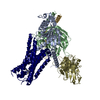
| Structure data | EMDB-71718, PDB-9pln: EMDB-71719, PDB-9plo: |
| Chemicals | 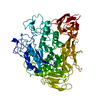 PDB-1ciu: |
| Source |
|
 Keywords Keywords | MEMBRANE PROTEIN / Receptor / Drug / Complex / GPCR / G-protein / scFv16 |


 homo sapiens (human)
 mus musculus (house mouse)