[English] 日本語
Yorodumi Papers
- Database of articles cited by EMDB/PDB/SASBDB data -

+
Search query

Keywords
Structure methods
Author
Journal
IF

-
Structure paper

TitleDelta-type glutamate receptors are ligand-gated ion channels.
Journal, issue, pagesNature, Vol. 647, Issue 8091, Page 1063-1071, Year 2025
Publish dateSep 16, 2025
AuthorsHaobo Wang / Fairine Ahmed / Jeffrey Khau / Anish Kumar Mondal / Edward C Twomey /
PubMed AbstractDelta-type ionotropic glutamate receptors (iGluRs, also known as GluDs) are members of the iGluR ligand-gated ion channel family, yet their function remains unknown. Although GluDs are widely ...Delta-type ionotropic glutamate receptors (iGluRs, also known as GluDs) are members of the iGluR ligand-gated ion channel family, yet their function remains unknown. Although GluDs are widely expressed in the brain, have key roles in synaptic organization, and harbour disease-linked mutations, whether they retain iGluR-like channel function is debated as currents have not been directly observed. Here we define GluDs as ligand-gated ion channels that are tightly regulated in cellular contexts by purifying human GluD2 (hGluD2) and directly characterizing its structure and function using cryo-electron microscopy and bilayer recordings. We show that hGluD2 is activated by D-serine and GABA (γ-aminobutyric acid), with augmented activation at physiological temperatures. We reveal that hGluD2 contains an ion channel directly coupled to clamshell-like ligand-binding domains, which are coordinated by the amino-terminal domain above the ion channel. Ligand binding triggers channel opening via an asymmetric mechanism, and a cerebellar ataxia point mutation in the ligand-binding domain rearranges the receptor architecture and induces leak currents. Our findings demonstrate that GluDs possess the intrinsic biophysical properties of ligand-gated ion channels, reconciling prior conflicting observations to establish a framework for understanding their cellular regulation and for developing therapies targeting GluD2.
External linksNature / PubMed:40957579 / PubMed Central
MethodsEM (single particle)
Resolution3.57 - 3.74 Å
Structure data

EMDB-49888, PDB-9nwo:
Human delta 2 receptor in the resting state
Method: EM (single particle) / Resolution: 3.57 Å

EMDB-49889, PDB-9nwp:
Human delta 2 receptor activated by D-serine
Method: EM (single particle) / Resolution: 3.69 Å

EMDB-49890, PDB-9nwq:
Human delta 2 receptor in the resting state with ATD deleted
Method: EM (single particle) / Resolution: 3.74 Å

EMDB-70667, PDB-9ooo:
Human delta 2 receptor with R710W Cerebellar Ataxia mutation in the apo closed state
Method: EM (single particle) / Resolution: 3.68 Å

EMDB-70668, PDB-9oop:
Human delta 2 receptor with R710W Cerebellar Ataxia mutation in the apo leak state
Method: EM (single particle) / Resolution: 3.73 Å

Chemicals

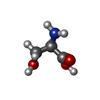
ChemComp-DSN:
D-SERINE

Source
  • homo sapiens (human)
KeywordsTRANSPORT PROTEIN / Ligand-gated ion channel / ion channel / neurotransmitter receptor

+
About Yorodumi Papers

-
News

-
Feb 9, 2022. New format data for meta-information of EMDB entries

New format data for meta-information of EMDB entries

  • Version 3 of the EMDB header file is now the official format.
  • The previous official version 1.9 will be removed from the archive.

Related info.:EMDB header

External links:wwPDB to switch to version 3 of the EMDB data model

-
Aug 12, 2020. Covid-19 info

Covid-19 info

URL: https://pdbj.org/emnavi/covid19.php

New page: Covid-19 featured information page in EM Navigator.

Related info.:Covid-19 info / Mar 5, 2020. Novel coronavirus structure data

+
Mar 5, 2020. Novel coronavirus structure data

Novel coronavirus structure data

Related info.:Yorodumi Speices / Aug 12, 2020. Covid-19 info

External links:COVID-19 featured content - PDBj / Molecule of the Month (242):Coronavirus Proteases

+
Jan 31, 2019. EMDB accession codes are about to change! (news from PDBe EMDB page)

EMDB accession codes are about to change! (news from PDBe EMDB page)

  • The allocation of 4 digits for EMDB accession codes will soon come to an end. Whilst these codes will remain in use, new EMDB accession codes will include an additional digit and will expand incrementally as the available range of codes is exhausted. The current 4-digit format prefixed with “EMD-” (i.e. EMD-XXXX) will advance to a 5-digit format (i.e. EMD-XXXXX), and so on. It is currently estimated that the 4-digit codes will be depleted around Spring 2019, at which point the 5-digit format will come into force.
  • The EM Navigator/Yorodumi systems omit the EMD- prefix.

Related info.:Q: What is EMD? / ID/Accession-code notation in Yorodumi/EM Navigator

External links:EMDB Accession Codes are Changing Soon! / Contact to PDBj

+
Jul 12, 2017. Major update of PDB

Major update of PDB

  • wwPDB released updated PDB data conforming to the new PDBx/mmCIF dictionary.
  • This is a major update changing the version number from 4 to 5, and with Remediation, in which all the entries are updated.
  • In this update, many items about electron microscopy experimental information are reorganized (e.g. em_software).
  • Now, EM Navigator and Yorodumi are based on the updated data.

External links:wwPDB Remediation / Enriched Model Files Conforming to OneDep Data Standards Now Available in the PDB FTP Archive

-
Yorodumi Papers

Database of articles cited by EMDB/PDB/SASBDB data

  • Database of articles cited by EMDB, PDB, and SASBDB entries
  • Using PubMed data

Related info.:EMDB / PDB / SASBDB / Yorodumi / EMN Papers / Changes in new EM Navigator and Yorodumi

Read more