[English] 日本語
Yorodumi Papers
- Database of articles cited by EMDB/PDB/SASBDB data -

+
Search query

Keywords
Structure methods
Author
Journal
IF

-
Structure paper

TitleDivergent acetyl-CoA binding modes mediate allosteric inhibition of bacterial hybrid-type malic enzymes.
Journal, issue, pagesJ Biol Chem, Vol. 301, Issue 12, Page 110887, Year 2025
Publish dateNov 4, 2025
AuthorsMunetoshi Sassa / Haruka Yamato / Hiroki Tanino / Yohta Fukuda / Tsuyoshi Inoue /
PubMed AbstractMalic enzymes (MEs) function as the bypass enzyme in the Krebs cycle and have attracted attention in a wide range of scientific and industrial fields. In contrast to eukaryotic MEs, there is ...Malic enzymes (MEs) function as the bypass enzyme in the Krebs cycle and have attracted attention in a wide range of scientific and industrial fields. In contrast to eukaryotic MEs, there is currently a lack of understanding of the structure-function relationships of prokaryotic MEs. Especially, little is known about an allosteric inhibition mechanism by an effector ligand in multi-domain MEs called hybrid-type MEs. Many bacterial hybrid-type MEs are inhibited by acetyl-CoA; however, the proposed acetyl-CoA binding site is not conserved. Here, we determined crystal and cryo-EM structures of hybrid-type MEs from Escherichia coli (EcMaeB) and Bdellovibrio bacteriovorus including complexes with acetyl-CoA. They reveal that these MaeBs have totally different acetyl-CoA binding sites and show different overall structural changes. However, the binding acetyl-CoA molecules induce identical movements of several α helices near the ligand both in EcMaeB and BbMaeB. Enzymatic assays proved that residues at the acetyl-CoA binding site are needed for inhibition. Phylogenetic analysis uncovered that EcMaeB and BbMaeB are classified into different clades of hybrid-type MEs and that the amino acid residues at the acetyl-CoA binding sites in different clades have evolved exclusively from each other. These results not only provide insights into bacterial MEs but also expand our knowledge about allosteric regulation in enzymes.
External linksJ Biol Chem / PubMed:41197718 / PubMed Central
MethodsEM (single particle) / X-ray diffraction
Resolution2.03 - 3.85 Å
Structure data

EMDB-62540, PDB-9krt:
E. coli MaeB holo form
Method: EM (single particle) / Resolution: 2.73 Å

EMDB-62541, PDB-9kru:
B. bacteriovorus MaeB holo form
Method: EM (single particle) / Resolution: 2.59 Å

EMDB-62542, PDB-9krv:
B. bacteriovorus MaeB acetyl-CoA bound form
Method: EM (single particle) / Resolution: 3.18 Å

EMDB-62816, PDB-9l4n:
E. coli MaeB acetyl-CoA bound form
Method: EM (single particle) / Resolution: 2.03 Å

EMDB-63586, PDB-9m2i:
E. coli MaeB holo form ME domain dimer
Method: EM (single particle) / Resolution: 3.19 Å

EMDB-63599, PDB-9m35:
E. coli MaeB acetyl-CoA bound form ME domain dimer
Method: EM (single particle) / Resolution: 2.39 Å

PDB-9krw:
E. coli MaeB apo form
Method: X-RAY DIFFRACTION / Resolution: 3.85 Å

Chemicals

ChemComp-NAP:
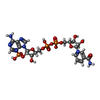
NADP NICOTINAMIDE-ADENINE-DINUCLEOTIDE PHOSPHATE

ChemComp-MG:
Unknown entry

ChemComp-ACO:
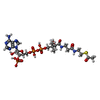
ACETYL COENZYME *A

ChemComp-HOH:
WATER

Source
  • escherichia coli k-12 (bacteria)
  • bdellovibrio bacteriovorus (bacteria)
KeywordsSTRUCTURAL PROTEIN / oxidoreductase / cryo-EM / allostery

+
About Yorodumi Papers

-
News

-
Feb 9, 2022. New format data for meta-information of EMDB entries

New format data for meta-information of EMDB entries

  • Version 3 of the EMDB header file is now the official format.
  • The previous official version 1.9 will be removed from the archive.

Related info.:EMDB header

External links:wwPDB to switch to version 3 of the EMDB data model

-
Aug 12, 2020. Covid-19 info

Covid-19 info

URL: https://pdbj.org/emnavi/covid19.php

New page: Covid-19 featured information page in EM Navigator.

Related info.:Covid-19 info / Mar 5, 2020. Novel coronavirus structure data

+
Mar 5, 2020. Novel coronavirus structure data

Novel coronavirus structure data

Related info.:Yorodumi Speices / Aug 12, 2020. Covid-19 info

External links:COVID-19 featured content - PDBj / Molecule of the Month (242):Coronavirus Proteases

+
Jan 31, 2019. EMDB accession codes are about to change! (news from PDBe EMDB page)

EMDB accession codes are about to change! (news from PDBe EMDB page)

  • The allocation of 4 digits for EMDB accession codes will soon come to an end. Whilst these codes will remain in use, new EMDB accession codes will include an additional digit and will expand incrementally as the available range of codes is exhausted. The current 4-digit format prefixed with “EMD-” (i.e. EMD-XXXX) will advance to a 5-digit format (i.e. EMD-XXXXX), and so on. It is currently estimated that the 4-digit codes will be depleted around Spring 2019, at which point the 5-digit format will come into force.
  • The EM Navigator/Yorodumi systems omit the EMD- prefix.

Related info.:Q: What is EMD? / ID/Accession-code notation in Yorodumi/EM Navigator

External links:EMDB Accession Codes are Changing Soon! / Contact to PDBj

+
Jul 12, 2017. Major update of PDB

Major update of PDB

  • wwPDB released updated PDB data conforming to the new PDBx/mmCIF dictionary.
  • This is a major update changing the version number from 4 to 5, and with Remediation, in which all the entries are updated.
  • In this update, many items about electron microscopy experimental information are reorganized (e.g. em_software).
  • Now, EM Navigator and Yorodumi are based on the updated data.

External links:wwPDB Remediation / Enriched Model Files Conforming to OneDep Data Standards Now Available in the PDB FTP Archive

-
Yorodumi Papers

Database of articles cited by EMDB/PDB/SASBDB data

  • Database of articles cited by EMDB, PDB, and SASBDB entries
  • Using PubMed data

Related info.:EMDB / PDB / SASBDB / Yorodumi / EMN Papers / Changes in new EM Navigator and Yorodumi

Read more