Journal: J Biol Chem / Year: 2025 Title: Divergent acetyl-CoA binding modes mediate allosteric inhibition of bacterial hybrid-type malic enzymes. Authors: Munetoshi Sassa / Haruka Yamato / Hiroki Tanino / Yohta Fukuda / Tsuyoshi Inoue / Abstract: Malic enzymes (MEs) function as the bypass enzyme in the Krebs cycle and have attracted attention in a wide range of scientific and industrial fields. In contrast to eukaryotic MEs, there is ...Malic enzymes (MEs) function as the bypass enzyme in the Krebs cycle and have attracted attention in a wide range of scientific and industrial fields. In contrast to eukaryotic MEs, there is currently a lack of understanding of the structure-function relationships of prokaryotic MEs. Especially, little is known about an allosteric inhibition mechanism by an effector ligand in multi-domain MEs called hybrid-type MEs. Many bacterial hybrid-type MEs are inhibited by acetyl-CoA; however, the proposed acetyl-CoA binding site is not conserved. Here, we determined crystal and cryo-EM structures of hybrid-type MEs from Escherichia coli (EcMaeB) and Bdellovibrio bacteriovorus including complexes with acetyl-CoA. They reveal that these MaeBs have totally different acetyl-CoA binding sites and show different overall structural changes. However, the binding acetyl-CoA molecules induce identical movements of several α helices near the ligand both in EcMaeB and BbMaeB. Enzymatic assays proved that residues at the acetyl-CoA binding site are needed for inhibition. Phylogenetic analysis uncovered that EcMaeB and BbMaeB are classified into different clades of hybrid-type MEs and that the amino acid residues at the acetyl-CoA binding sites in different clades have evolved exclusively from each other. These results not only provide insights into bacterial MEs but also expand our knowledge about allosteric regulation in enzymes.
In the structure databanks used in Yorodumi, some data are registered as the other names, "COVID-19 virus" and "2019-nCoV". Here are the details of the virus and the list of structure data.
Jan 31, 2019. EMDB accession codes are about to change! (news from PDBe EMDB page)
EMDB accession codes are about to change! (news from PDBe EMDB page)
The allocation of 4 digits for EMDB accession codes will soon come to an end. Whilst these codes will remain in use, new EMDB accession codes will include an additional digit and will expand incrementally as the available range of codes is exhausted. The current 4-digit format prefixed with “EMD-” (i.e. EMD-XXXX) will advance to a 5-digit format (i.e. EMD-XXXXX), and so on. It is currently estimated that the 4-digit codes will be depleted around Spring 2019, at which point the 5-digit format will come into force.
The EM Navigator/Yorodumi systems omit the EMD- prefix.
Related info.:Q: What is EMD? / ID/Accession-code notation in Yorodumi/EM Navigator
Yorodumi is a browser for structure data from EMDB, PDB, SASBDB, etc.
This page is also the successor to EM Navigator detail page, and also detail information page/front-end page for Omokage search.
The word "yorodu" (or yorozu) is an old Japanese word meaning "ten thousand". "mi" (miru) is to see.
Related info.:EMDB / PDB / SASBDB / Comparison of 3 databanks / Yorodumi Search / Aug 31, 2016. New EM Navigator & Yorodumi / Yorodumi Papers / Jmol/JSmol / Function and homology information / Changes in new EM Navigator and Yorodumi
 Movie
Movie Controller


 Open data
 Basic information
 Map data
 Sample
 Keywords
 Function and homology information
 Escherichia coli K-12 (bacteria)
 Authors
 Japan, 1 items
  Citation
 Structure visualization
 Downloads & links
 emd_63586.png
 http://ftp.pdbj.org/pub/emdb/structures/EMD-63586


 Z (Sec.)
 Y (Row.)
 X (Col.)


 Sample components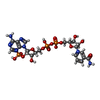
 Processing
 Electron microscopy
 FIELD EMISSION GUN
