[English] 日本語
Yorodumi Papers
- Database of articles cited by EMDB/PDB/SASBDB data -

+
Search query

Keywords
Structure methods
Author
Journal
IF

-
Structure paper

TitlemTORC1 phosphorylates and stabilizes LST2 to negatively regulate EGFR.
Journal, issue, pagesProc Natl Acad Sci U S A, Vol. 121, Issue 34, Page e2405959121, Year 2024
Publish dateAug 20, 2024
AuthorsStefania Battaglioni / Louise-Marie Craigie / Sofia Filippini / Timm Maier / Michael N Hall /
PubMed AbstractTORC1 (target of rapamycin complex 1) is a highly conserved protein kinase that plays a central role in regulating cell growth. Given the role of mammalian TORC1 (mTORC1) in metabolism and disease, ...TORC1 (target of rapamycin complex 1) is a highly conserved protein kinase that plays a central role in regulating cell growth. Given the role of mammalian TORC1 (mTORC1) in metabolism and disease, understanding mTORC1 downstream signaling and feedback loops is important. mTORC1 recognizes some of its substrates via a five amino acid binding sequence called the TOR signaling (TOS) motif. mTORC1 binding to a TOS motif facilitates phosphorylation of a distinct, distal site. Here, we show that LST2, also known as ZFYVE28, contains a TOS motif (amino acids 401 to 405) and is directly phosphorylated by mTORC1 at serine 670 (S670). mTORC1-mediated S670 phosphorylation promotes LST2 monoubiquitination on lysine 87 (K87). Monoubiquitinated LST2 is stable and displays a broad reticular distribution. When mTORC1 is inactive, unphosphorylated LST2 is degraded by the proteasome. The absence of LST2 enhances EGFR (epidermal growth factor receptor) signaling. We propose that mTORC1 negatively feeds back on its upstream receptor EGFR via LST2.
External linksProc Natl Acad Sci U S A / PubMed:39141345 / PubMed Central
MethodsEM (single particle)
Resolution3.27 - 4.02 Å
Structure data

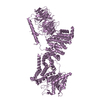
EMDB-50181, PDB-9f42:
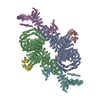
cryo-EM structure of LST2 TOS peptide bound to human mTOR complex 1, focused on RAPTOR
Method: EM (single particle) / Resolution: 3.27 Å

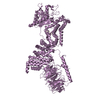
EMDB-50182, PDB-9f43:
cryo-EM structure of human LST2 bound to human mTOR complex 1, focused on RAPTOR
Method: EM (single particle) / Resolution: 3.49 Å

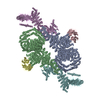
EMDB-50183, PDB-9f44:
cryo-EM structure of LST2 TOS peptide bound to human mTOR complex 1
Method: EM (single particle) / Resolution: 3.68 Å

EMDB-50184, PDB-9f45:
cryo-EM structure of human LST2 bound to human mTOR complex 1
Method: EM (single particle) / Resolution: 3.74 Å

EMDB-50253: cryo-EM structure of human LST2 bound to human mTOR complex 1
Method: EM (single particle) / Resolution: 4.02 Å

EMDB-50254: Cryo-EM structure of human LST2 bound to human mTOR complex 1, focused on one protomer
Method: EM (single particle) / Resolution: 3.75 Å

EMDB-50255: Cryo-EM structure of human LST2 bound to human mTOR complex 1, focused on one protomer
Method: EM (single particle) / Resolution: 3.73 Å

Chemicals

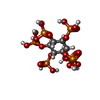
ChemComp-IHP:
INOSITOL HEXAKISPHOSPHATE

Source
  • homo sapiens (human)
KeywordsSIGNALING PROTEIN / MTOR / MTORC1 / LST2 / ZFYVE28 / EGFR / TOS

+
About Yorodumi Papers

-
News

-
Feb 9, 2022. New format data for meta-information of EMDB entries

New format data for meta-information of EMDB entries

  • Version 3 of the EMDB header file is now the official format.
  • The previous official version 1.9 will be removed from the archive.

Related info.:EMDB header

External links:wwPDB to switch to version 3 of the EMDB data model

-
Aug 12, 2020. Covid-19 info

Covid-19 info

URL: https://pdbj.org/emnavi/covid19.php

New page: Covid-19 featured information page in EM Navigator.

Related info.:Covid-19 info / Mar 5, 2020. Novel coronavirus structure data

+
Mar 5, 2020. Novel coronavirus structure data

Novel coronavirus structure data

Related info.:Yorodumi Speices / Aug 12, 2020. Covid-19 info

External links:COVID-19 featured content - PDBj / Molecule of the Month (242):Coronavirus Proteases

+
Jan 31, 2019. EMDB accession codes are about to change! (news from PDBe EMDB page)

EMDB accession codes are about to change! (news from PDBe EMDB page)

  • The allocation of 4 digits for EMDB accession codes will soon come to an end. Whilst these codes will remain in use, new EMDB accession codes will include an additional digit and will expand incrementally as the available range of codes is exhausted. The current 4-digit format prefixed with “EMD-” (i.e. EMD-XXXX) will advance to a 5-digit format (i.e. EMD-XXXXX), and so on. It is currently estimated that the 4-digit codes will be depleted around Spring 2019, at which point the 5-digit format will come into force.
  • The EM Navigator/Yorodumi systems omit the EMD- prefix.

Related info.:Q: What is EMD? / ID/Accession-code notation in Yorodumi/EM Navigator

External links:EMDB Accession Codes are Changing Soon! / Contact to PDBj

+
Jul 12, 2017. Major update of PDB

Major update of PDB

  • wwPDB released updated PDB data conforming to the new PDBx/mmCIF dictionary.
  • This is a major update changing the version number from 4 to 5, and with Remediation, in which all the entries are updated.
  • In this update, many items about electron microscopy experimental information are reorganized (e.g. em_software).
  • Now, EM Navigator and Yorodumi are based on the updated data.

External links:wwPDB Remediation / Enriched Model Files Conforming to OneDep Data Standards Now Available in the PDB FTP Archive

-
Yorodumi Papers

Database of articles cited by EMDB/PDB/SASBDB data

  • Database of articles cited by EMDB, PDB, and SASBDB entries
  • Using PubMed data

Related info.:EMDB / PDB / SASBDB / Yorodumi / EMN Papers / Changes in new EM Navigator and Yorodumi

Read more