[English] 日本語
Yorodumi Papers
- Database of articles cited by EMDB/PDB/SASBDB data -

+
Search query

Keywords
Structure methods
Author
Journal
IF

-
Structure paper

TitleRegulation of STING activation by phosphoinositide and cholesterol.
Journal, issue, pagesNature, Year 2026
Publish dateFeb 4, 2026
AuthorsJie Li / Jay Xiaojun Tan / Zhijian J Chen / Xuewu Zhang / Xiao-Chen Bai /
PubMed AbstractStimulator of interferon genes (STING) is an essential adaptor in the cytosolic DNA-sensing innate immune pathway. STING is activated by cyclic GMP-AMP (cGAMP) produced by the DNA sensor cGAMP ...Stimulator of interferon genes (STING) is an essential adaptor in the cytosolic DNA-sensing innate immune pathway. STING is activated by cyclic GMP-AMP (cGAMP) produced by the DNA sensor cGAMP synthase (cGAS). cGAMP-induced high-order oligomerization and translocation of STING from the endoplasmic reticulum to the Golgi and post-Golgi vesicles are critical for STING activation. Other studies have shown that phosphatidylinositol phosphates (PtdInsPs) and cholesterol also have important roles in STING activation, but the underlying mechanisms remain unclear. Here we demonstrate that cGAMP-induced high-order oligomerization of STING is enhanced strongly by phosphatidylinositol 3,5-bisphosphate (PtdIns(3,5)P and PtdIns(4,5)P, and by PtdIns4P to a lesser extent. Our cryo-electron microscopy structures reveal that PtdInsPs together with cholesterol bind at the interface between STING dimers, directly promoting the high-order oligomerization. The structures also provide an explanation for the preference of the STING oligomer to different PtdInsPs. Mutational and biochemical analyses confirm the binding modes of PtdInsPs and cholesterol and their roles in STING activation. Our findings shed light on the regulatory mechanisms of STING mediated by specific lipids, which may underlie the role of intracellular trafficking in dictating STING signalling.
External linksNature / PubMed:41639452
MethodsEM (single particle)
Resolution2.6 - 2.9 Å
Structure data

EMDB-46694, PDB-9dan:
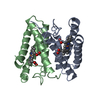
STING oligomer bound to PI(4,5)P2
Method: EM (single particle) / Resolution: 2.6 Å

EMDB-46697, PDB-9dat:
STING oligomer bound to PI(3,5)P2
Method: EM (single particle) / Resolution: 2.9 Å

EMDB-46699, PDB-9dav:
STING oligomer bound to cGAMP and STG2 in the presence of PI4P
Method: EM (single particle) / Resolution: 2.8 Å

EMDB-46700, PDB-9daw:
STING oligomer bound to cGAMP, C53 and PI(3,5)P2
Method: EM (single particle) / Resolution: 2.9 Å

Chemicals

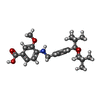
ChemComp-Y6H:
4-({[4-(2-tert-butyl-5,5-dimethyl-1,3-dioxan-2-yl)phenyl]methyl}amino)-3-methoxybenzoic acid

PDB-1bbg:
RAGWEED POLLEN ALLERGEN FROM AMBROSIA TRIFIDA V, NMR, MINIMIZED AVERAGE STRUCTURE

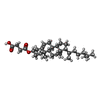
ChemComp-Y01:
CHOLESTEROL HEMISUCCINATE

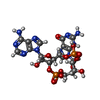
ChemComp-1SY:
cGAMP

PDB-1bbh:
ATOMIC STRUCTURE OF A CYTOCHROME C' WITH AN UNUSUAL LIGAND-CONTROLLED DIMER DISSOCIATION AT 1.8 ANGSTROMS RESOLUTION

ChemComp-9IM:
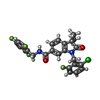
1-[(2-chloro-6-fluorophenyl)methyl]-3,3-dimethyl-2-oxo-N-[(2,4,6-trifluorophenyl)methyl]-2,3-dihydro-1H-indole-6-carboxamide

Source
  • homo sapiens (human)
KeywordsSIGNALING PROTEIN/ACTIVATOR / STING / lipid / oligomerization / SIGNALING PROTEIN / SIGNALING PROTEIN-ACTIVATOR complex / oligomer / PI(3 / 5)P2

+
About Yorodumi Papers

-
News

-
Feb 9, 2022. New format data for meta-information of EMDB entries

New format data for meta-information of EMDB entries

  • Version 3 of the EMDB header file is now the official format.
  • The previous official version 1.9 will be removed from the archive.

Related info.:EMDB header

External links:wwPDB to switch to version 3 of the EMDB data model

-
Aug 12, 2020. Covid-19 info

Covid-19 info

URL: https://pdbj.org/emnavi/covid19.php

New page: Covid-19 featured information page in EM Navigator.

Related info.:Covid-19 info / Mar 5, 2020. Novel coronavirus structure data

+
Mar 5, 2020. Novel coronavirus structure data

Novel coronavirus structure data

Related info.:Yorodumi Speices / Aug 12, 2020. Covid-19 info

External links:COVID-19 featured content - PDBj / Molecule of the Month (242):Coronavirus Proteases

+
Jan 31, 2019. EMDB accession codes are about to change! (news from PDBe EMDB page)

EMDB accession codes are about to change! (news from PDBe EMDB page)

  • The allocation of 4 digits for EMDB accession codes will soon come to an end. Whilst these codes will remain in use, new EMDB accession codes will include an additional digit and will expand incrementally as the available range of codes is exhausted. The current 4-digit format prefixed with “EMD-” (i.e. EMD-XXXX) will advance to a 5-digit format (i.e. EMD-XXXXX), and so on. It is currently estimated that the 4-digit codes will be depleted around Spring 2019, at which point the 5-digit format will come into force.
  • The EM Navigator/Yorodumi systems omit the EMD- prefix.

Related info.:Q: What is EMD? / ID/Accession-code notation in Yorodumi/EM Navigator

External links:EMDB Accession Codes are Changing Soon! / Contact to PDBj

+
Jul 12, 2017. Major update of PDB

Major update of PDB

  • wwPDB released updated PDB data conforming to the new PDBx/mmCIF dictionary.
  • This is a major update changing the version number from 4 to 5, and with Remediation, in which all the entries are updated.
  • In this update, many items about electron microscopy experimental information are reorganized (e.g. em_software).
  • Now, EM Navigator and Yorodumi are based on the updated data.

External links:wwPDB Remediation / Enriched Model Files Conforming to OneDep Data Standards Now Available in the PDB FTP Archive

-
Yorodumi Papers

Database of articles cited by EMDB/PDB/SASBDB data

  • Database of articles cited by EMDB, PDB, and SASBDB entries
  • Using PubMed data

Related info.:EMDB / PDB / SASBDB / Yorodumi / EMN Papers / Changes in new EM Navigator and Yorodumi

Read more