 Movie
Movie Controller
 Structure viewers
 About Yorodumi Papers


+Search query
-Structure paper
| Title | A structure-based mechanism for initiation of AP-3 coated vesicle formation. |
|---|---|
| Journal, issue, pages | Proc Natl Acad Sci U S A, Vol. 121, Issue 52, Page e2411974121, Year 2024 |
| Publish date | Dec 24, 2024 |
 Authors Authors | Matthew Begley / Mahira Aragon / Richard W Baker /  |
| PubMed Abstract | Adaptor protein complex-3 (AP-3) mediates cargo sorting from endosomes to lysosomes and lysosome-related organelles. Recently, it was shown that AP-3 adopts a constitutively open conformation ...Adaptor protein complex-3 (AP-3) mediates cargo sorting from endosomes to lysosomes and lysosome-related organelles. Recently, it was shown that AP-3 adopts a constitutively open conformation compared to the related AP-1 and AP-2 coat complexes, which are inactive until undergoing large conformational changes upon membrane recruitment. How AP-3 is regulated is therefore an open question. To understand the mechanism of AP-3 membrane recruitment and activation, we reconstituted human AP-3 and determined multiple structures in the soluble and membrane-bound states using electron cryo-microscopy. Similar to yeast AP-3, human AP-3 is in a constitutively open conformation. To reconstitute AP-3 activation by adenosine di-phosphate (ADP)-ribosylation factor 1 (Arf1), a small guanosine tri-phosphate (GTP)ase, we used lipid nanodiscs to build Arf1-AP-3 complexes on membranes and determined three structures showing the stepwise conformational changes required for formation of AP-3 coated vesicles. First, membrane recruitment is driven by one of two predicted Arf1 binding sites, which flexibly tethers AP-3 to the membrane. Second, cargo binding causes AP-3 to adopt a fixed position and rigidifies the complex, which stabilizes binding for a second Arf1 molecule. Finally, binding of the second Arf1 molecule provides the template for AP-3 dimerization, providing a glimpse into the first step of coat polymerization. We propose coat polymerization only occurs after cargo engagement, thereby linking cargo sorting with assembly of higher-order coat structures. Additionally, we provide evidence for two amphipathic helices in AP-3, suggesting that AP-3 contributes to membrane deformation during coat assembly. In total, these data provide evidence for the first stages of AP-3-mediated vesicle coat assembly. |
 External links External links | Proc Natl Acad Sci U S A / PubMed:39705307 / PubMed Central |
| Methods | EM (single particle) |
| Resolution | 3.6 - 5.6 Å |
| Structure data | EMDB-45207, PDB-9c58: EMDB-45208, PDB-9c59: EMDB-45209, PDB-9c5a:  EMDB-45210: AP-3 bound to myristoylated Arf1 and LAMPI on a lipid nanodisc; concensus refinement  EMDB-45211: AP-3 bound to myristoylated Arf1 and LAMPI on a lipid nanodisc; focus refinement 1  EMDB-45212: AP-3 bound to myristoylated Arf1 and LAMPI on a lipid nanodisc; focus refinement 2 EMDB-45213, PDB-9c5b: EMDB-45214, PDB-9c5c: |
| Chemicals |  ChemComp-MG: 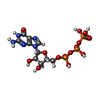 ChemComp-GTP: |
| Source |
|
 Keywords Keywords | TRANSPORT PROTEIN / Adaptor Protein complex / AP-3 / Lysosomal transport / Endosomal transport / Protein trafficking / Endosomal Trafficking / Lysosomal Trafficking / Protein transport / AP complex |


 homo sapiens (human)