 Movie
Movie Controller
 Structure viewers
 About Yorodumi Papers


+Search query
-Structure paper
| Title | De novo design of proteins housing excitonically coupled chlorophyll special pairs. |
|---|---|
| Journal, issue, pages | Nat Chem Biol, Vol. 20, Issue 7, Page 906-915, Year 2024 |
| Publish date | Jun 3, 2024 |
 Authors Authors | Nathan M Ennist / Shunzhi Wang / Madison A Kennedy / Mariano Curti / George A Sutherland / Cvetelin Vasilev / Rachel L Redler / Valentin Maffeis / Saeed Shareef / Anthony V Sica / Ash Sueh Hua / Arundhati P Deshmukh / Adam P Moyer / Derrick R Hicks / Avi Z Swartz / Ralph A Cacho / Naia Novy / Asim K Bera / Alex Kang / Banumathi Sankaran / Matthew P Johnson / Amala Phadkule / Mike Reppert / Damian Ekiert / Gira Bhabha / Lance Stewart / Justin R Caram / Barry L Stoddard / Elisabet Romero / C Neil Hunter / David Baker /    |
| PubMed Abstract | Natural photosystems couple light harvesting to charge separation using a 'special pair' of chlorophyll molecules that accepts excitation energy from the antenna and initiates an electron-transfer ...Natural photosystems couple light harvesting to charge separation using a 'special pair' of chlorophyll molecules that accepts excitation energy from the antenna and initiates an electron-transfer cascade. To investigate the photophysics of special pairs independently of the complexities of native photosynthetic proteins, and as a first step toward creating synthetic photosystems for new energy conversion technologies, we designed C-symmetric proteins that hold two chlorophyll molecules in closely juxtaposed arrangements. X-ray crystallography confirmed that one designed protein binds two chlorophylls in the same orientation as native special pairs, whereas a second designed protein positions them in a previously unseen geometry. Spectroscopy revealed that the chlorophylls are excitonically coupled, and fluorescence lifetime imaging demonstrated energy transfer. The cryo-electron microscopy structure of a designed 24-chlorophyll octahedral nanocage with a special pair on each edge closely matched the design model. The results suggest that the de novo design of artificial photosynthetic systems is within reach of current computational methods. |
 External links External links | Nat Chem Biol / PubMed:38831036 / PubMed Central |
| Methods | EM (single particle) / X-ray diffraction |
| Resolution | 2 - 6.5 Å |
| Structure data | EMDB-40208, PDB-8glt:  EMDB-40209: Chlorophyll-binding region of de novo-designed nanocage O32-15 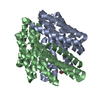 PDB-7unh:  PDB-7uni:  PDB-7unj:  PDB-8evm: |
| Chemicals |  ChemComp-EDO:  ChemComp-HOH: 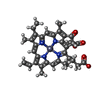 ChemComp-OE9:  ChemComp-PO4:  ChemComp-PGE:  ChemComp-SO4: |
| Source |
|
 Keywords Keywords | DE NOVO PROTEIN / design / homodimer / rosetta / symmetric / designed / circular tandem repeat protein / cTRP / apo / chlorophyll / Zn pheophorbide a methyl ester / Zn / de novo design / electron donor / photosynthetic / nanocage / helical repeats / chlorophyll-binding / octahedral symmetry |


