 Movie
Movie Controller
 Structure viewers
 About Yorodumi Papers


+Search query
-Structure paper
| Title | Molecular basis of tRNA substrate recognition and modification by the atypical SPOUT methyltransferase Trm10. |
|---|---|
| Journal, issue, pages | bioRxiv, Year 2025 |
| Publish date | Dec 14, 2025 |
 Authors Authors | Suparno Nandi / Sarah E Strassler / Debayan Dey / Aiswarya Krishnamohan / George M Harris / Lindsay R Comstock / Jane E Jackman / Graeme L Conn /  |
| PubMed Abstract | The evolutionarily conserved methyltransferase Trm10 modifies the N1 position of guanosine 9 (G9) in some tRNAs, but how the enzyme recognizes and modifies its substrate tRNAs remains unclear. Here, ...The evolutionarily conserved methyltransferase Trm10 modifies the N1 position of guanosine 9 (G9) in some tRNAs, but how the enzyme recognizes and modifies its substrate tRNAs remains unclear. Here, we used an S-adenosyl-L-methionine (SAM) analog to trap the Trm10-tRNA complex and enable determination of its structure in a post-catalytic state by cryogenic electron microscopy (cryo-EM). We observed three distinct complexes: two with a single Trm10 bound to tRNA that differ in their tRNA acceptor stem orientation ("closed" and "open") and a minor population with two Trm10s engaging the same tRNA. The monomeric complexes reveal a positively charged surface that guides the G9 into the catalytic site with key conserved residues forming "pincer"-like interactions that stabilize the flipped methylated nucleotide. In the open tRNA conformation, the acceptor stem is rotated away from the enzyme, weakening the tRNA-protein contacts, consistent with a product-release conformation. The dimeric complex, which is supported by tRNA-dependent protein crosslinking, reveals one Trm10 positioned similarly to the monomeric complexes and engaged with G9, while the other Trm10 contacts distal tRNA regions, suggesting a potential role in facilitating a key conformational transition during the process of catalysis or modified tRNA release. Finally, molecular dynamics simulations comparing G9- and A9-containing complexes reveal that G9 is efficiently stabilized in the binding pocket unlike A9, identifying the structural basis for guanosine selectivity. Overall, these findings reveal the structural determinants of G9-specific tRNA methylation by Trm10 and suggest a unique mechanism of action among RNA-modifying SPOUT methyltransferases. |
 External links External links | bioRxiv / PubMed:41427370 / PubMed Central |
| Methods | EM (single particle) |
| Resolution | 3.37 - 3.89 Å |
| Structure data | EMDB-72368, PDB-9xzq: EMDB-72369, PDB-9xzr: EMDB-72370, PDB-9xzs: |
| Chemicals | 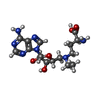 ChemComp-AN6: |
| Source |
|
 Keywords Keywords | RNA BINDING PROTEIN/RNA / SPOUT methyltransferase / Complex / tRNA / methylation / RNA BINDING PROTEIN / RNA BINDING PROTEIN-RNA complex |


 saccharomyces cerevisiae (brewer's yeast)