[English] 日本語
Yorodumi Papers
- Database of articles cited by EMDB/PDB/SASBDB data -

+
Search query

Keywords
Structure methods
Author
Journal
IF

-
Structure paper

TitleMolecular Basis for Asynchronous Chain Elongation During Rifamycin Antibiotic Biosynthesis.
Journal, issue, pagesbioRxiv, Year 2025
Publish dateJul 6, 2025
AuthorsChengli Liu / Ryan C West / Muyuan Chen / Whitaker Cohn / George Wang / Aryan M Mandot / Selena Kim / Dillon P Cogan /
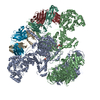
PubMed AbstractThe rifamycin synthetase (RIFS) from the bacterium is a large (3.5 MDa) multienzyme system that catalyzes over 40 chemical reactions to generate a complex precursor to the antibiotic rifamycin B. It ...The rifamycin synthetase (RIFS) from the bacterium is a large (3.5 MDa) multienzyme system that catalyzes over 40 chemical reactions to generate a complex precursor to the antibiotic rifamycin B. It is considered a hybrid enzymatic assembly line and consists of an N-terminal nonribosomal peptide synthetase loading module followed by a decamodular polyketide synthase (PKS). While the biosynthetic functions are known for each enzymatic domain of RIFS, structural and biochemical analyses of this system from purified components are relatively scarce. Here, we examine the biosynthetic mechanism of RIFS through complementary crosslinking, kinetic, and structural analyses of its first PKS module (M1). Thiol-selective crosslinking of M1 provided a plausible molecular basis for previously observed conformational asymmetry with respect to ketosynthase (KS)-substrate carrier protein (CP) interactions during polyketide chain elongation. Our data suggest that C-terminal dimeric interfaces-which are ubiquitous in bacterial PKSs-force their adjacent CP domains to co-migrate between two equivalent KS active site chambers. Cryogenic electron microscopy analysis of M1 further supported this observation while uncovering its unique architecture. Single-turnover kinetic analysis of M1 indicated that although removal of C-terminal dimeric interfaces supported 2-fold greater KS-CP interactions, it did not increase the partial product occupancy of the homodimeric protein. Our findings cast light on molecular details of natural antibiotic biosynthesis that will aid in the design of artificial megasynth(et)ases with untold product structures and bioactivities.
External linksbioRxiv / PubMed:40631255 / PubMed Central
MethodsEM (single particle)
Resolution3.22 - 3.96 Å
Structure data

EMDB-71445, PDB-9pat:
Antibody (1B2) Bound Rifamycin Synthetase Module 1 in the Transacylation Mode
Method: EM (single particle) / Resolution: 3.96 Å

EMDB-71446, PDB-9pav:
Antibody (1B2) Bound Rifamycin Synthetase Module 1 in the Elongation Mode
Method: EM (single particle) / Resolution: 3.22 Å

EMDB-71497, PDB-9pc6:
Antibody (1B2) Bound Crosslinked Rifamycin Synthetase Module 1 with a C-terminal Type II Thioesterase
Method: EM (single particle) / Resolution: 3.96 Å

Source
  • amycolatopsis mediterranei (bacteria)
  • homo sapiens (human)
KeywordsTransferase/Immune System / Polyketide Synthase Module / Antibody (Fab) / Transferase-Immune System complex

+
About Yorodumi Papers

-
News

-
Feb 9, 2022. New format data for meta-information of EMDB entries

New format data for meta-information of EMDB entries

  • Version 3 of the EMDB header file is now the official format.
  • The previous official version 1.9 will be removed from the archive.

Related info.:EMDB header

External links:wwPDB to switch to version 3 of the EMDB data model

-
Aug 12, 2020. Covid-19 info

Covid-19 info

URL: https://pdbj.org/emnavi/covid19.php

New page: Covid-19 featured information page in EM Navigator.

Related info.:Covid-19 info / Mar 5, 2020. Novel coronavirus structure data

+
Mar 5, 2020. Novel coronavirus structure data

Novel coronavirus structure data

Related info.:Yorodumi Speices / Aug 12, 2020. Covid-19 info

External links:COVID-19 featured content - PDBj / Molecule of the Month (242):Coronavirus Proteases

+
Jan 31, 2019. EMDB accession codes are about to change! (news from PDBe EMDB page)

EMDB accession codes are about to change! (news from PDBe EMDB page)

  • The allocation of 4 digits for EMDB accession codes will soon come to an end. Whilst these codes will remain in use, new EMDB accession codes will include an additional digit and will expand incrementally as the available range of codes is exhausted. The current 4-digit format prefixed with “EMD-” (i.e. EMD-XXXX) will advance to a 5-digit format (i.e. EMD-XXXXX), and so on. It is currently estimated that the 4-digit codes will be depleted around Spring 2019, at which point the 5-digit format will come into force.
  • The EM Navigator/Yorodumi systems omit the EMD- prefix.

Related info.:Q: What is EMD? / ID/Accession-code notation in Yorodumi/EM Navigator

External links:EMDB Accession Codes are Changing Soon! / Contact to PDBj

+
Jul 12, 2017. Major update of PDB

Major update of PDB

  • wwPDB released updated PDB data conforming to the new PDBx/mmCIF dictionary.
  • This is a major update changing the version number from 4 to 5, and with Remediation, in which all the entries are updated.
  • In this update, many items about electron microscopy experimental information are reorganized (e.g. em_software).
  • Now, EM Navigator and Yorodumi are based on the updated data.

External links:wwPDB Remediation / Enriched Model Files Conforming to OneDep Data Standards Now Available in the PDB FTP Archive

-
Yorodumi Papers

Database of articles cited by EMDB/PDB/SASBDB data

  • Database of articles cited by EMDB, PDB, and SASBDB entries
  • Using PubMed data

Related info.:EMDB / PDB / SASBDB / Yorodumi / EMN Papers / Changes in new EM Navigator and Yorodumi

Read more