 Movie
Movie Controller
 Structure viewers
 About Yorodumi Papers


+Search query
-Structure paper
| Title | Structural and functional analysis of a photosystem II mutant PsbA3-S264V. |
|---|---|
| Journal, issue, pages | Biochim Biophys Acta Bioenerg, Vol. 1868, Issue 1, Page 149607, Year 2026 |
| Publish date | Sep 6, 2026 |
 Authors Authors | Songbo Fan / Yoshiki Nakajima / Koji Kato / Haowei Jiang / Pi-Cheng Tsai / Anqi Jia / Miwa Sugiura / Jian-Ren Shen /  |
| PubMed Abstract | Photosystem II (PSII) catalyzes water oxidation and oxygen evolution by a light-induced electron transfer chain, leading to the generation of electrons, protons and dioxygen. D1-S264 is a residue ...Photosystem II (PSII) catalyzes water oxidation and oxygen evolution by a light-induced electron transfer chain, leading to the generation of electrons, protons and dioxygen. D1-S264 is a residue located close to the Q-binding site, and mutation of this residue has been shown to bring significant effects on the electron transfer and oxygen-evolving activities. Here we analyzed the structure of a Thermosynechococcus elongatus mutant PsbA3-S264V by cryo-electron microscopy at 1.96 Å resolution, which showed significant changes in the structure surrounding the bicarbonate and Q-binding region. Due to change of Ser to Val, the hydrogen-bond between the Q carbonyl oxygen and S264 is altered, which changed the protonation pathway of Q from the original route of D1-H252 through D1-S264 to Q, to a new, longer and less efficient route of D1-H252 through D1-F265 to Q. Two residues, D1-E244 and D2-E242, changed their side chain orientations significantly. Among them, D2-E242 adopted two conformations, and both are largely deviated from the original structure. All these changes led to alterations in hydrogen-bonding networks of two channels, channel A and channel B, that connect the stromal surface to Q and may function to transport protons to protonate Q. Furthermore, isothermal titration calorimetry experiments showed a diminished 3-(3,4-dichlorophenyl)-1, 1-dimethylurea (DCMU) binding affinity of the mutated PSII, which may be explained by a structural rotation of D1-F255 in the mutant based on structural analysis of DCMU-bound PSII. These findings offer valuable insights into the functions of D1-S264 in Q protonation and function, as well as in the DCMU-binding. |
 External links External links | Biochim Biophys Acta Bioenerg / PubMed:42702229 |
| Methods | EM (single particle) |
| Resolution | 1.96 - 2.08 Å |
| Structure data | EMDB-65652, PDB-9w5b: EMDB-65724, PDB-9w7d: EMDB-65941, PDB-9wfz: |
| Chemicals | 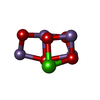 ChemComp-OEX:  ChemComp-FE2:  ChemComp-CL:  ChemComp-CLA:  ChemComp-BCR:  ChemComp-SQD:  ChemComp-PL9: 
ChemComp-UNL:  ChemComp-BCT:  ChemComp-LHG:  ChemComp-LMG:  ChemComp-LMT:  ChemComp-DGD:  ChemComp-PHO:  ChemComp-HEM:  ChemComp-CA:  ChemComp-HEC:  ChemComp-RRX:  ChemComp-HOH:  ChemComp-W9M: |
| Source |
|
 Keywords Keywords | PHOTOSYNTHESIS / PSII mutation / DCMU / local refinement |


 thermosynechococcus vestitus bp-1 (bacteria)